

During Tajikistan visit, Pakistan PM urges world to hold India accountable for ‘acts of war’

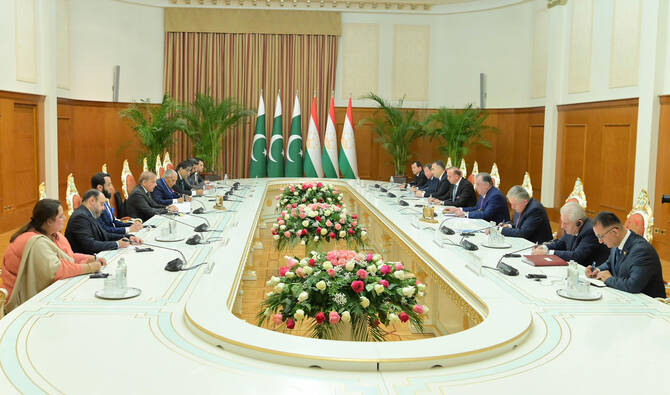
Pakistan Prime Minister Shehbaz Sharif speaks during the delegation-level talks between Pakistan and Tajikistan in Dushanbe on May 29, 2025. (Handout/PMO)
Short Url
Updated 29 May 2025
Follow

During Tajikistan visit, Pakistan PM urges world to hold India accountable for ‘acts of war’

  • Shehbaz Sharif made the remarks during a meeting with Tajik President Emomali Rahmon in Dushanbe
  • He will attend a glacier preservation conference in Tajikistan, present Pakistan’s stance on climate change

ISLAMABAD: Prime Minister Shehbaz Sharif on Thursday urged the international community to hold India accountable for what he described as “acts of war” earlier this month, saying the region could not afford New Delhi’s “irresponsible and unlawful actions.”

Sharif made the remarks during a meeting with Tajik President Emomali Rahmon in Dushanbe, where the two leaders discussed regional security, economic ties and cooperation on climate issues.

His statement came just days after a military confrontation between nuclear-armed India and Pakistan, which saw the two countries exchange missile, drone and artillery fire between them.

Sharif arrived in Tajikistan’s capital on the final leg of a five-day regional diplomacy tour that earlier took him to Türkiye, Iran and Azerbaijan, as Islamabad seeks to reinforce strategic ties and shore up support following the South Asian standoff.

He was received in Dushanbe by Tajik Prime Minister Qohir Rasulzoda and later attended a bilateral meeting with President Rahmon at the Qasr-e-Millat.

“The Prime Minister underscored that our region could not afford India’s irresponsible and unlawful actions since 7 May 2025, which amounted to acts of war and violation the UN Charter and international law,” a statement released by his office said after the meeting. “The Prime Minister urged the international community to hold India accountable, reiterating that Pakistan desires peace, but will defend its sovereignty with full resolve if challenged.”

President Rahmon, expressing concern over the recent conflict, said he was “very worried” about the events of early May and praised Sharif’s leadership in helping restore peace and stability. He also called Pakistan a “trusted partner” and reaffirmed Tajikistan’s commitment to deepening cooperation across all sectors.

The two leaders reviewed progress under the Strategic Partnership Agreement signed in 2024 and pledged to expand collaboration in trade, defense, education, technology and counterterrorism. They also agreed to accelerate work on the CASA-1000 energy project, a regional initiative to transmit surplus hydroelectric power from Central Asia to South Asia, which they termed a “pivotal initiative” for regional integration.

Sharif underscored Pakistan’s push for deeper connectivity with Central Asia through infrastructure and transit links, citing the China-Pakistan Economic Corridor (CPEC) as a linchpin of that strategy. He also briefed the Tajik president on Pakistan’s role in regional peace efforts and acknowledged Tajikistan’s leadership in water diplomacy and glacier preservation.

The Pakistani prime minister is in Dushanbe to attend the International High-Level Conference on Glaciers’ Preservation, where he is expected to speak on the impact of climate change on Pakistan and call for stronger global cooperation on environmental issues.

Earlier this week, Sharif held talks in Türkiye, Iran and Azerbaijan, including a trilateral summit with Turkish President Recep Tayyip Erdoğan and Azerbaijani President Ilham Aliyev in Lachin, where the three leaders pledged to deepen regional cooperation and transform fraternal ties into a strategic partnership.


Pakistan denies reports army ordered ‘depopulation’ in Tirah Valley ahead of anti-militant operation

Updated 5 sec ago
Follow

Pakistan denies reports army ordered ‘depopulation’ in Tirah Valley ahead of anti-militant operation

  • Tirah Valley residents started fleeing homes this month ahead of a planned military operation against militants
  • Reports aimed at creating alarm among public, disinformation against security institutions, says information ministry

ISLAMABAD: Pakistan’s information ministry on Sunday denied reports the army has ordered depopulation in the northwestern Tirah Valley ahead of a planned anti-militant offensive, stating that any movement of residents from the area is voluntary. 

The denial from the government comes as residents of Tirah Valley in Pakistan’s northwestern Khyber Pakhtunkhwa (KP) province bordering Afghanistan flee their homes ahead of a planned military operation by the army against militants, particularly the Tehreek-e-Taliban Pakistan (TTP) group. 

Despite major military operations in the mid-2010s, Tirah Valley has remained a stronghold for insurgents, prompting authorities to plan what they describe as a targeted clearance.

“The government has taken notice of misleading claims in circulation regarding alleged ‘depopulation’ from Tirah Valley on the orders of the Army,” the Ministry of Information and Broadcasting (MoIB) said in a statement on Sunday. 

“These assertions are baseless, malicious, and driven by ulterior motives aimed at creating alarm among the public, disinformation against security institutions and furthering vested political interest.”

The ministry said Pakistan’s federal government and the armed forces had not issued directives for any such depopulation of the territory. It clarified that law enforcement agencies are “routinely conducting targeted, intelligence-based operations strictly against terrorist elements” with care to avoid disruption to peaceful civilian life. 

It said locals are increasingly concerned over presence of the “khawarij,” a term the military and government frequently use for the TTP, in Tirah Valley and desire peace and stability in the area.

The information ministry mentioned that the Khyber Pakhtunkhwa Relief, Rehabilitation and Resettlement Department issued a notification on Dec. 26 last year for the release of funds, reportedly Rs4 billion [$14.24 million], for the “anticipated temporary and voluntary movement of population from certain localities of Tirah.”

Families load their belongings onto vehicles in Pakistan’s Tirah Valley on January 15, 2026. (AN photo)

It also said that the notification mentioned that the deputy commissioner of Khyber District, where Tirah Valley is located, said the voluntary movement of people reflects the views of the local population articulated through a jirga at the district level. 

“Hence any stated position of the Provincial Government or their officials being conveyed to media that the said migration has anything to do with the Armed Forces is false and fabricated,” the information ministry said. 

“Given with malafide intent to gain political capital and unfortunately malign security institutions and therefore highly regrettable.”

The evacuation has exposed tensions between the provincial government, run by former prime minister Imran Khan’s Pakistan Tehreek-e-Insaf (PTI) party, and the military establishment over the use of force in the region.

“We have neither allowed the operation nor will we ever allow the operation,” KP Law Minister Aftab Alam Afridi said earlier this month, arguing that past military campaigns had failed to deliver lasting stability.

Pakistan military spokesperson Lt. Gen. Ahmed Shareef Chaudhry has previously defended security operations as necessary as militant attacks surge in the country. 

In a recent briefing, Chaudhry said security forces carried out 75,175 intelligence-based operations nationwide last year, including more than 14,000 in Khyber Pakhtunkhwa, attributing the surge in violence to what he described as a “politically conducive environment” for militants.