

Cholera outbreak in Sudan capital kills 70 in 2 days: health ministry

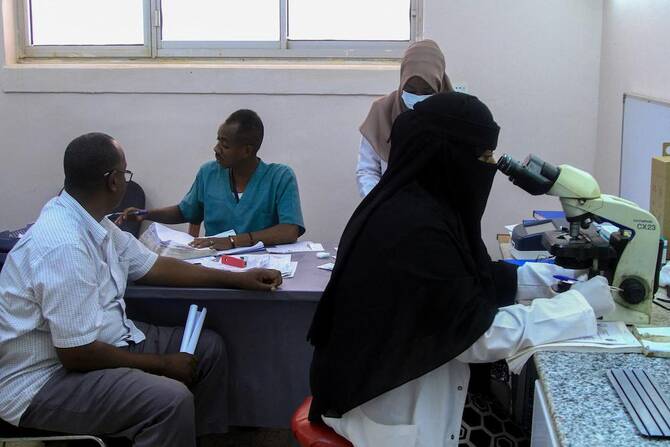
Up to 90 percent of hospitals in the Sudan conflict’s main battlegrounds have been forced out of service by the fighting. (AFP)
Short Url
Updated 29 May 2025
Follow

Cholera outbreak in Sudan capital kills 70 in 2 days: health ministry

  • Health ministry for Khartoum State said it had recorded 942 new infections and 25 deaths on Wednesday
  • Army-backed government announced last week that it had dislodged RSF fighters from their last positions in Khartoum State

PORT SUDAN, Sudan: A cholera outbreak in Sudan’s capital has killed 70 people in two days, health officials said, as Khartoum battles a fast-spreading epidemic amid a collapse of basic services.

The health ministry for Khartoum State said it had recorded 942 new infections and 25 deaths on Wednesday, following 1,177 cases and 45 deaths on Tuesday.

The surge in infections comes weeks after drone strikes blamed on the paramilitary Rapid Support Forces (RSF) knocked out the water and electricity supply across the capital.

The army-backed government announced last week that it had dislodged RSF fighters from their last positions in Khartoum State two months after retaking the heart of the capital from the paramilitaries.

Greater Khartoum had been a battleground for much of the previous two years, and suffered massive damage to housing and infrastructure.

The cholera outbreak has piled further pressure on an already overwhelmed health care system.

The federal health ministry reported 172 deaths in the week to Tuesday, 90 percent of them in Khartoum State.

Authorities say 89 percent of patients in isolation centers are recovering, but warn that deteriorating environmental conditions are driving a surge in cases.

The war between the paramilitaries and the regular army has killed tens of thousands of people and displaced 13 million in what the United Nations has described as the world’s worst humanitarian crisis.

Up to 90 percent of hospitals in the conflict’s main battlegrounds have been forced out of service by the fighting.


Turkiye to forge on with tight economic policy, some fine-tuning, VP Yilmaz says

Updated 57 min 50 sec ago
Follow

Turkiye to forge on with tight economic policy, some fine-tuning, VP Yilmaz says

  • The central ‍bank forecasts inflation between 13-19 percent by end-2026

ISTANBUL: Turkiye is committed to carrying on its tight economic policies ​in order to cool inflation, and though it may fine-tune the program it will not change course, Vice President Cevdet Yilmaz said in comments embargoed to Friday.
“There is no plan to pause our program,” Yilmaz said at a briefing with reporters in Istanbul on Thursday. “All programs are dynamic, and adjustments can always be made.”
Yilmaz, who plays a key role overseeing economic policy at the presidency, said any such adjustments would aim to support production, investment and ‌exports while moderating consumption.
Turkiye ‌has pursued tight monetary and fiscal policies ‌for more ⁠than ​two years ‌in order to reduce price pressure, leading to high financing and borrowing costs that have weighed on businesses and households. Inflation has eased slowly but steadily over the last year but remains elevated at 31 percent annually.
Last month, Is Bank CEO Hakan Aran warned that focusing solely on one target — inflation — could create side effects, suggesting a “pause and restart” might be healthy once the program achieves certain targets.
Yılmaz said the ⁠government expects improvements in inflation in the first quarter, which should reflect to market expectations for year-end ‌inflation around 23 percent. The government projects inflation to dip ‍as far as 16 percent by year end, ‍within a 13-19 percent range, and falling to 9 percent in 2027. The central ‍bank forecasts inflation between 13-19 percent by end-2026.
Yilmaz noted inflation fell by nearly 45 points despite pressure from elevated food prices, hit by agricultural frost and drought.
The agricultural sector is expected to support growth and help ease price rises this year, which could ​help achieve official inflation targets, he said.
Yilmaz said the government wants to avoid a rapid drop in inflation that could hurt economic ⁠growth, jobs and social stability.
Turkiye’s economic program was established in 2023 after years of unorthodox easy money that aimed to stoke growth but that sent inflation soaring and the lira plunging. The program aims to dislodge high inflation expectations while boosting production and exports, in order to address long-standing current account deficits.
The central bank, having raised interest rates as high as 50 percent in 2024, eased policy through most of last year, bringing the key rate down to 38 percent.
Asked whether lower rates could trigger an exit from the lira currency, Yilmaz said: “What matters is real interest rates. Lowering rates as inflation falls does not affect real rates, so we do ‌not expect such an impact.”
He added that the government will strengthen mechanisms that selectively support companies while improving overall financial conditions.