MOSCOW: Russia said Wednesday it wanted new talks with Ukraine in Istanbul next Monday to present its plan for a peace settlement, but Kyiv said it needed to see the plan in advance for the meeting to yield results.
Diplomatic efforts to end the three-year conflict have accelerated in recent months, but Moscow has repeatedly rejected calls for an unconditional ceasefire and shown no signs of scaling back its maximalist demands.
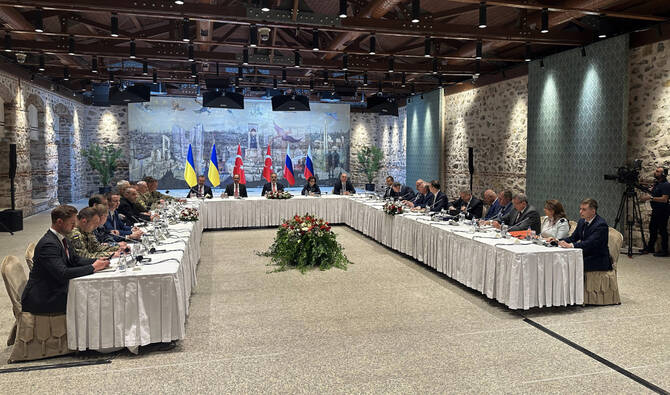
The two sides previously met in Istanbul on May 16, their first direct talks in over three years. That encounter failed to yield a breakthrough.
US President Donald Trump, who has been pushing for a peace deal, has become increasingly frustrated with Moscow’s apparent stalling and warned Wednesday he would determine within “about two weeks” whether Vladimir Putin was serious about ending the fighting.
Ukraine said it had already submitted its peace terms to Russia and demanded Moscow do the same.
“We are not opposed to further meetings with the Russians and are awaiting their memorandum,” Ukrainian defense minister Rustem Umerov, who negotiated for Kyiv at the last talks, said in a post on X.
“The Russian side has at least four more days before their departure to provide us with their document for review. Diplomacy must be substantive, and the next meeting must yield results.”
Moscow’s offensive, launched in February 2022, has resulted in tens of thousands of deaths and the destruction of large parts of eastern and southern Ukraine.
The Russian army now controls around a fifth of Ukraine’s territory, including the Crimean peninsula, which it annexed in 2014.
Russia said it would present a “memorandum” outlining its peace terms at the talks next Monday, and that its foreign minister Sergei Lavrov had briefed US counterpart Marco Rubio on the proposal.
“Our delegation, led by Vladimir Medinsky, is ready to present a memorandum to the Ukrainian delegation and provide the necessary explanations during a second round of direct talks in Istanbul on Monday, June 2,” Lavrov said in a video statement.
Medinsky, a Russian political scientist and former culture minister, led Russia’s negotiating team during a first round of talks in Istanbul on May 16.
The two sides have traded waves of massive aerial attacks in recent weeks, with Ukraine unleashing one of its largest-ever drone barrages on Russia overnight and Moscow pounding Ukraine with deadly strikes over the weekend.
Trump told reporters on Wednesday he was “very disappointed” at Russia’s deadly bombardment during the negotiating process, but rebuffed calls to impose more sanctions on Moscow.
“If I think I’m close to getting a deal, I don’t want to screw it up by doing that,” he said.
The Kremlin earlier rejected a call by Ukrainian President Zelensky for a three-way summit with Trump and Putin.
Moscow said any meeting involving Russian President Putin and Zelensky would only happen after “concrete agreements” had been struck between negotiators from each side.
In exchange for peace, the Kremlin has demanded Ukraine abandon its ambition of joining NATO as well as cede territory it already controls — a proposition that Ukraine has called unacceptable.
Talks between the two sides in Istanbul earlier this month yielded a 1,000-for-1,000 prisoner exchange and the two sides agreed to work on respective peace proposals.
But Russia has kept up its deadly strikes on Ukraine in the meantime while rejecting calls for a ceasefire.
Zelensky on Wednesday accused Russia of dragging out the peace process and of not wanting to halt its offensive.
“They will constantly look for reasons not to end the war,” he said at a press conference in Berlin alongside German Chancellor Friedrich Merz.
On the battlefield, Zelensky said Russia was “amassing” more than 50,000 troops on the front line around the northeastern Sumy border region, where Moscow’s army has captured a number of settlements as it seeks to establish what Putin has called a “buffer zone” inside Ukrainian territory.


![]()

Russia proposes new Ukraine talks, Kyiv demands terms upfront
Short Url
https://arab.news/z869d
Russia proposes new Ukraine talks, Kyiv demands terms upfront


Latest updates


Recommended


© 2026 SAUDI RESEARCH & PUBLISHING COMPANY, All Rights Reserved And subject to Terms of Use Agreement.