

On 27th anniversary of acquiring nukes, Pakistan reaffirms pledge of defensive use only

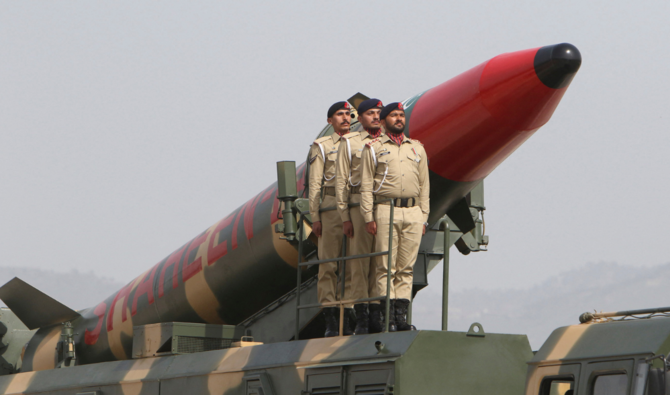
Pakistani army soldiers stand on a vehicle carrying a long-range ballistic missile Shaheen during the Pakistan Day parade in Islamabad on March 23, 2022. (AFP/ file)
Short Url
Updated 28 May 2025
Follow

On 27th anniversary of acquiring nukes, Pakistan reaffirms pledge of defensive use only

  • Pakistan began program to obtain nuclear weapons after 1971 war led to division of the country and creation of Bangladesh
  • Pakistan conducted nuclear tests in May 1998, officially becoming a nuclear-weapon state shortly after India conducted its own tests

ISLAMABAD: Pakistan is celebrating Youm-e-Takbeer today, Wednesday, to commemorate the 27th anniversary of the day it acquired nuclear weapons, reaffirming its pledge to use the capability for defensive purposes only.

Pakistan began a program to obtain nuclear weapons after the 1971 war which led to the division of the country and the creation of Bangladesh, then East Pakistan. The army sees its nuclear weapons as essential to offset the conventional superiority of its much bigger neighbor, India. India sees its own nuclear weapons as a deterrent against Pakistan and China, which defeated it in a border war in 1962.

Pakistan tested nuclear weapons in May 1998, shortly after India announced it had done so.

“Youm-e-Takbeer commemorates the momentous occasion in 1998 when Pakistan emerged as a nuclear power— restoring the strategic balance in South Asia and asserting its sovereign right to self-defense,” the army said in a statement. 

“This historic achievement epitomizes the nation’s resolve, unity, and unwavering pursuit of a dignified and peaceful existence.

“The Armed Forces of Pakistan reiterate their unflinching resolve to defend the motherland against all threats across the full spectrum of conflict. As responsible custodians of the nation’s strategic assets, we reaffirm that our nuclear capability remains solely for defensive purposes and stands as a guarantor of peace.”

The military added that the day underscored Pakistan’s “steadfast commitment” to preserving its sovereignty and territorial integrity and affirmed its doctrine of credible minimum deterrence, rooted in the principle of maintaining peace and strategic stability in the region.

Both India and Pakistan faced international sanctions as a result of testing nukes in 1998, although India has since won effective recognition as a nuclear power following an accord negotiated with the United States. Neither Pakistan, nor India, have signed the nuclear Non-Proliferation Treaty (NPT).

The Bulletin of the Atomic Scientists estimates Pakistan’s arsenal at about 170 warheads. These can be delivered by aircraft, or by missiles, which both countries have been developing and testing. 

The nuclear program is controlled by the army and run by the Strategic Plans Division.

Pakistan and India’s nuclear capabilities make any conflict between them especially dangerous and raise global alarm, as happened earlier this month when they launched missiles and drones deep into each other’s territories and exchanged gunfire on their de facto border, the Line of Control, until a ceasefire was announced on May 10. Nearly 70 people combined were killed on both sides of the border. 

It was the worst conflict in decades between the neighbors.

Pakistan has fought three full-scale wars with India, including two over the disputed Kashmir region.


Pakistan announces plan to develop Port Qasim into climate-resilient industrial complex

Updated 4 sec ago
Follow

Pakistan announces plan to develop Port Qasim into climate-resilient industrial complex

  • Port Qasim handles 51% of Pakistan’s sea trade, facilitates Islamabad’s trade with Central Asian states
  • Maritime affairs ministry says 833 industrial units currently operational at Port Qasim, with 40 under construction

KARACHI: Pakistan’s Maritime Affairs Ministry announced on Monday that it aims to develop Port Qasim into a climate-resilient industrial complex, saying the move would create jobs, usher in investment and ensure sustainable development for the country. 

According to its website, Port Qasim is one of the largest contributors to Pakistan’s economy, handling 51 percent of the country’s sea trade. The port also connects directly to Pakistan’s national highway and motorway network, facilitating trade between Afghanistan and the Central Asian Republics.

Pakistan has recently attempted to upgrade its port infrastructure to handle higher trade volumes and improve connectivity between sea lanes and landlocked Central Asian states, leveraging its geographic position at the crossroads of South and Central Asia. 

Maritime Affairs Minister Junaid Anwar Chaudhry chaired a meeting to discuss projects related to Port Qasim, the ministry said in a statement. 

“During the meeting, a long-term plan for a climate-resilient industrial complex at Port Qasim was announced,” the statement said. 

Chaudhry said Port Qasim would be developed into a global industrial and logistics hub, adding that it will become a “key gateway” for Pakistan’s national economy.

Officials briefed the minister that the development project for the port would cover an area of more than 14,000 acres. The port’s industrial complex has been divided into three distinct zones, with the eastern one designated for heavy industry and export-oriented units, and the northwestern zone for the promotion of value-added industries and port services.

The southwestern zone of the complex has been earmarked for special industrial and commercial activities, the ministry said. 

Chaudhry said 833 industrial units are currently operational at the port while 40 are under construction. He also reaffirmed the government’s commitment to modernizing port infrastructure and improving road and rail connectivity.

“Junaid Anwar Chaudhry said the Port Qasim Industrial Complex will emerge as a hub for employment generation, investment, and sustainable development,” the statement said. 

Pakistan seeks to upgrade streamline port operations and enhance trade relations with regional countries as it seeks to escape a prolonged macroeconomic crisis that has put a strain on its resources and triggered a balance of payments crisis in the country over the past few years.