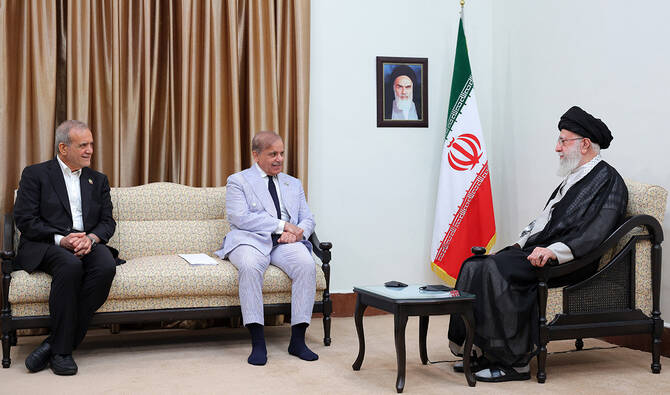

ISLAMABAD: Prime Minister Shehbaz Sharif on Monday praised the Iranian leadership for its “farsightedness” in pursuing nuclear negotiations with the United States and expressed hope for a positive outcome during a meeting with Supreme Leader Ayatollah Ali Khamenei in Tehran.
Sharif arrived in Iran earlier in the day after a stop in Istanbul, as part of a regional diplomacy tour that includes upcoming visits to Azerbaijan and Tajikistan. His trip follows a brief but intense military standoff with neighboring India, in which the two nuclear-armed rivals exchanged missile, drone and artillery fire.
Pakistan has thanked Tehran for its support during the conflict.
“The Prime Minister praised the farsightedness of the Iranian leadership in pursuing the nuclear negotiations with the United States and hoped that a constructive deal is reached between the two countries that can promote peace and stability in the region,” Sharif’s office said in a statement.
Talks between Iran and the US aim to limit Tehran’s nuclear program in exchange for the lifting of US sanctions. A key sticking point remains uranium enrichment, with Washington asking Iran to halt its program, while Tehran insisting on its right to continue enrichment for civilian purposes.
During the meeting, Sharif also informed Khamenei about Pakistan’s recent conflict with India and accused New Delhi of “hegemonistic and revisionist designs.”
He emphasized Pakistan’s desire for regional peace and economic development, and expressed a commitment to deepening strategic cooperation with Iran “in complex geo-political times.”
The Prime Minister’s Office said Khamenei praised Sharif’s efforts to promote peace and regional stability and reaffirmed support for closer bilateral ties.
Earlier on Monday, Sharif also met newly elected Iranian President Masoud Pezeshkian.
At a joint press conference, the two leaders discussed bilateral cooperation, with Pezeshkian emphasizing the need for secure and peaceful borders free from militant and criminal activity.
Relations between the two neighbors became strained last year after Iran launched strikes inside Pakistani territory against suspected militant hideouts, prompting retaliatory strikes by Islamabad against separatist militants in Iran.
Both sides have since sought to de-escalate tensions and pledged to respect each other’s sovereignty.
Sharif concluded his meeting with Khamenei by inviting the Supreme Leader to visit Islamabad and expressed appreciation for his admiration of Dr. Muhammad Iqbal, Pakistan’s national poet.