

Iranian president calls for cooperation with Pakistan to combat militant activity on shared border 

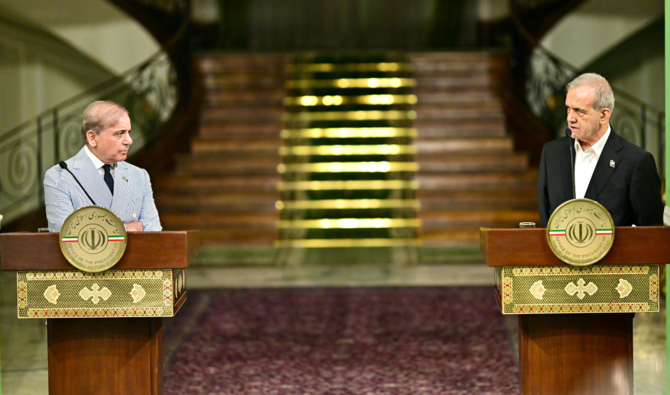
President of Iran, Masoud Pezeshkian (R) and Prime Minister of Pakistan Shehbaz Sharif giving joint press statement, at Sa'dabad Palace in Tehran on May 26, 2025. (PMO)
Short Url
Updated 26 May 2025
Follow

Iranian president calls for cooperation with Pakistan to combat militant activity on shared border 

  • Iran and Pakistan have variously accused each other of not doing enough to stamp out militants allegedly sheltering across shared border
  • Last year, Iran launched strikes inside Pakistan’s border, saying it had destroyed terror bases, with Islamabad responding with strikes of its own 

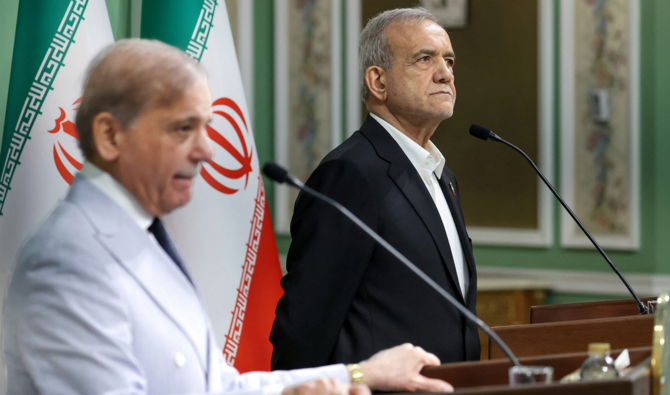
ISLAMABAD: Islamabad and Tehran should increase cooperation to combat militant activity on their shared border, Iran’s President Masoud Pezeshkian said on Monday during a televised news conference with Pakistani Prime Minister Shehbaz Sharif. 

Sharif arrived in Iran on Monday after a visit to Istanbul as part of a regional diplomacy tour that will also include trips to Azerbaijan and Tajikistan. 

Relations between Iran and Pakistan have been strained in recent years, with both sides accusing each other of not doing enough to stamp out militants allegedly sheltering across their shared border.

“We believe that the joint borders between Iran and Pakistan should be free from any insecurity and free from the presence and activity of terrorist and criminal groups,” Pezeshkian said during a joint press conference with Sharif.

“In this regard, we believe we need to promote cooperation at the border areas to fight against those who are trying to create trouble.”


President of Iran, Masoud Pezeshkian (R) and Prime Minister of Pakistan Shehbaz Sharif shake hands after a joint press statement, at Sa'dabad Palace in Tehran on May 26, 2025. (PMO)

Last year, Iran launched strikes inside Pakistan’s border, saying it had destroyed two bases of Jaish al Adl, a Pakistan-based group that Tehran accuses of attacking Iranian security forces. Pakistan launched strikes on separatist militants inside Iran in response, saying it hit bases of the separatist Baloch Liberation Front and Baloch Liberation Army.

The militant groups operate in an area that includes Pakistan’s southwestern province of Balochistan and Iran’s southeastern Sistan-Baluchestan province. Both regions are restive, mineral-rich and largely underdeveloped and wracked by decades-long separatist insurgencies. 

The tit-for-tat conflict quickly de-escalated and the foreign minister of Iran visited Islamabad, with both nations saying they respected each other’s sovereignty and territorial integrity and would expand security cooperation in a bid to mend ties.

The most notable deal between the neighboring countries — a 2010 gas pipeline agreement from Iran’s South Fars field to Pakistan’s Balochistan and Sindh — also remains stalled.

During meetings on Monday, the two countries discussed the spectrum of bilateral ties. 

“We discussed expanding bilateral relations in different sectors including politics, economy, culture as well as international cooperation between the two countries,” Pezeshkian said at the joint press conference. 

In May, Iranian Foreign Minister Seyyed Abbas Araghchi visited Pakistan to help ease tensions between Pakistan and India during the worst military confrontation in decades between the nuclear-armed neighbors. 


Pakistani student launches ‘Urdu ChatGPT’ AI model

Updated 18 January 2026
Follow

Pakistani student launches ‘Urdu ChatGPT’ AI model

  • Developer says “Qalb” is largest large language model built exclusively for Urdu
  • Project highlights push to localize artificial intelligence for non-English users

ISLAMABAD: A Pakistani student studying in the United States has launched an artificial intelligence model designed exclusively for the Urdu language, a development its creator says could help bridge longstanding gaps in access to advanced digital tools for millions of speakers worldwide.

The project, called Qalb, is positioned as an Urdu-first large language model at a time when most generative AI systems are primarily trained on English and other widely used global languages. Supporters of language-specific models argue they can improve accuracy, cultural relevance and accessibility for users in education, business and public services.

Urdu is spoken by more than 230 million people globally, including in Pakistan, India and diaspora communities, but remains under-represented in advanced AI systems. Efforts to localize artificial intelligence have increasingly been seen as critical for widening participation in digital economies, particularly in developing countries.

“Qalb is now recognized as the world’s largest Large Language Model created exclusively for the Urdu language,” Taimoor Hassan, the project’s developer, was quoted this month in a report in state-run news agency APP. 

“Trained on a massive dataset of 1.97 billion tokens and benchmarked across seven-plus international evaluation frameworks, Qalb outperforms existing Urdu-focused AI models on key real-world performance indicators, setting a new standard for natural language processing in Pakistan,” Hassan said.

“This is a development model and in the next phase we would soon launch App for mobile and web so that people could use and benefit from Qalb ChatGPT.”

Hassan completed his undergraduate degree in computer science at FAAST University’s Peshawar campus and is currently studying for a master’s degree in computer science and software engineering at Auburn University in the United States. According to APP, he is a serial entrepreneur who has previously launched and exited multiple startups and has represented Pakistan at international technology forums.

“I had the opportunity to contribute in a small way to a much bigger mission for the country,” Hassan said.

“Together with my undergraduate roommates and teammates, Jawad Ahmed and Muhammad Awais, we are committed to continuously fine-tuning localized models for niche industries, which we believe can become a major breakthrough for Pakistan.”

Both collaborators are also graduates of FAAST University Peshawar Campus and are currently studying in Germany, APP reported.

The team behind Qalb said the model is intended to support local businesses, startups, educational platforms and voice-based digital services, arguing that meaningful innovation is no longer limited to large technology firms.

“Technology is no longer locked behind big budgets or big teams. With the right mindset, even a small group can build products that educate, automate, and serve millions,” Hassan told APP.