

Australian PM calls Israel’s defense of Gaza blockade ‘completely untenable’

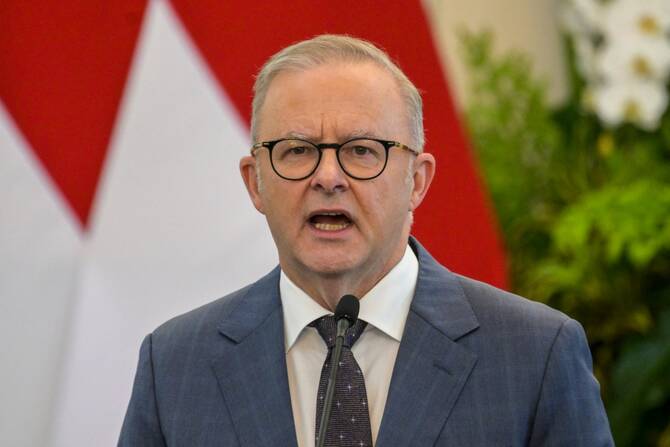
Australia’s prime minister Anthony Albanese has strongly criticized Israel’s ongoing blockade of humanitarian aid into Gaza, calling the move “an outrage” and the Israeli government’s justifications “completely untenable.” (AFP/File Photo)
Short Url
Updated 26 May 2025
Follow

Australian PM calls Israel’s defense of Gaza blockade ‘completely untenable’

  • Idea of democratic state withholding supplies ‘an outrage,’ Anthony Albanese says
  • Australian lawmaker urges government to terminate defense contracts with Israel

LONDON: Australia’s prime minister has strongly criticized Israel’s ongoing blockade of humanitarian aid into Gaza, calling the move “an outrage” and the Israeli government’s justifications “completely untenable.”

Speaking at a press conference on Monday, Anthony Albanese said: “Israel’s actions are completely unacceptable. It is outrageous that there be a blockade of food and supplies to people who are in need in Gaza. People are starving. The idea that a democratic state withholds supply is an outrage.”

His comments follow Australia’s decision to join 22 other countries — including the UK, Canada and New Zealand — in condemning Israel over the restricted flow of aid into the war-torn Palestinian territory.

The UN has warned that the entire population of Gaza is facing famine, describing the 80-day blockade as potentially “the cruelest phase of this cruel conflict.”

Albanese said he conveyed Australia’s “deep concern” directly to Israeli President Isaac Herzog during a meeting in Rome last week.

“I made it very clear that Australia finds these actions as completely unacceptable and we find Israel’s excuses and explanations completely untenable and without credibility,” The Guardian newspaper quoted him as saying.

“That is (a position) I have indicated clearly and directly to the Israeli government. It’s one that we will continue to be part of international statements as we were last week.”

While reaffirming that Hamas should have no future role in governing Gaza or the West Bank and calling for the release of remaining Israeli hostages taken during the Oct. 7 attacks, Albanese urged Israel to respect humanitarian obligations.

“States which are democratic states have a responsibility to behave in a way that is consistent with international law and with humanitarian concerns,” he said.

“The whole world is concerned about what has occurred with the blockade and Australia will continue to make clear statements on that.”

Meanwhile, Australian Foreign Minister Penny Wong condemned the “abhorrent and outrageous” recent comments from members of the government of Israeli Prime Minister Benjamin Netanyahu, saying Israel “cannot allow the suffering” in Gaza to continue.

The statements from Albanese and Wong come amid growing domestic pressure.

Labor Party lawmaker Ed Husic wrote in The Guardian last week that Australia “can and should be doing more” and called on the government to summon the Israeli ambassador and demand the immediate, freer flow of aid.

“Australia has a proud tradition of refusing to be silent on the world stage when it comes to defending vulnerable and oppressed people,” he said.

“We can be emboldened by our legacy of doing so. Two million starving people in Gaza need all the help we can muster alongside others.”

On Monday, Greens Sen. David Shoebridge renewed calls for the government to go further by terminating defense contracts with Israeli arms manufacturers and their subsidiaries.

Despite Netanyahu promising last week to ease the 11-week siege to prevent a “starvation crisis,” aid agencies have said the situation in Gaza is becoming critical.

UN Secretary-General Antonio Guterres said on Friday that what Israel had authorized “amounts to a teaspoon of aid when a flood of assistance is required.”

The Israeli military said 107 aid trucks entered Gaza on Thursday, but the UN and aid groups argue the quantity is grossly inadequate. Israel accuses Hamas of diverting supplies, a claim disputed by the UN and humanitarian organizations.


In show of support, Canada, France open consulates in Greenland

Updated 50 min 11 sec ago
Follow

In show of support, Canada, France open consulates in Greenland

  • Decisions taken in a strong show of support for Greenland government amid threats by US President Trump to seize the island

COPENHAGEN, Denmark: Canada and France, which both adamantly oppose Donald Trump’s wish to control Greenland, will open consulates in the Danish autonomous territory’s capital on Friday, in a strong show of support for the local government.
Since returning to the White House last year, Trump has repeatedly insisted that Washington needs to control the strategic, mineral-rich Arctic island for security reasons.
The US president last month backed off his threats to seize Greenland after saying he had struck a “framework” deal with NATO chief Mark Rutte to ensure greater American influence.
A US-Denmark-Greenland working group has been established to discuss ways to meet Washington’s security concerns in the Arctic, but the details of the talks have not been made public.
While Denmark and Greenland have said they share Trump’s security concerns, they have insisted that sovereignty and territorial integrity are a “red line” in the discussions.
“In a sense, it’s a victory for Greenlanders to see two allies opening diplomatic representations in Nuuk,” said Jeppe Strandsbjerg, a political scientist at the University of Greenland.
“There is great appreciation for the support against what Trump has said.”
French President Emmanuel Macron announced Paris’s plans to open a consulate during a visit to Nuuk in June, where he expressed Europe’s “solidarity” with Greenland and criticized Trump’s ambitions.
The newly-appointed French consul, Jean-Noel Poirier, has previously served as ambassador to Vietnam.
Canada meanwhile announced in late 2024 that it would open a consulate in Greenland to boost cooperation.
The opening of the consulates is “a way of telling Donald Trump that his aggression against Greenland and Denmark is not a question for Greenland and Denmark alone, it’s also a question for European allies and also for Canada as an ally, as a friend of Greenland and the European allies also,” Ulrik Pram Gad, Arctic expert at the Danish Institute of International Studies, told AFP.
“It’s a small step, part of a strategy where we are making this problem European,” said Christine Nissen, security and defense analyst at the Europa think tank.
“The consequences are obviously not just Danish. It’s European and global.”

Recognition

According to Strandsbjerg, the two consulates — which will be attached to the French and Canadian embassies in Copenhagen — will give Greenland an opportunity to “practice” at being independent, as the island has long dreamt of cutting its ties to Denmark one day.
The decision to open diplomatic missions is also a recognition of Greenland’s growing autonomy, laid out in its 2009 Self-Government Act, Nissen said.
“In terms of their own quest for sovereignty, the Greenlandic people will think to have more direct contact with other European countries,” she said.
That would make it possible to reduce Denmark’s role “by diversifying Greenland’s dependence on the outside world, so that it is not solely dependent on Denmark and can have more ties for its economy, trade, investments, politics and so on,” echoed Pram Gad.
Greenland has had diplomatic ties with the European Union since 1992, with Washington since 2014 and with Iceland since 2017.
Iceland opened its consulate in Nuuk in 2013, while the United States, which had a consulate in the Greenlandic capital from 1940 to 1953, reopened its mission in 2020.
The European Commission opened its office in 2024.