

India’s biggest Palestine art exhibition exposes life under Israeli occupation

1 / 3
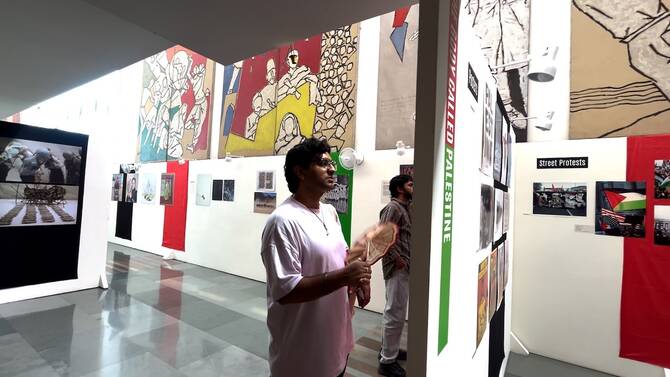
“The Body Called Palestine” exhibition at Jawahar Bhawan, New Delhi, May 24, 2025. (AN photo)
2 / 3
3 / 3
Short Url
Updated 26 May 2025
Follow

India’s biggest Palestine art exhibition exposes life under Israeli occupation

  • 40 Palestinian artists contributed their work, including Sliman Mansour
  • ‘The Body Called Palestine’ focuses on themes of resistance, identity

NEW DELHI: From paintings and photographs to graffiti and posters, one of India’s biggest-ever showcases of Palestine-related art is now on view in central New Delhi, featuring works by Indian and Palestinian artists that highlight life under Israeli occupation.

“The Body Called Palestine” exhibition at Jawahar Bhawan — next to key government institutions —is a month-long show that will run until May 31.

Organized by the art collective Safdar Hashmi Memorial Trust, it features 140 works focusing on themes of resistance, identity and solidarity with Palestine. Some 40 of the contributing artists are Palestinians, 30 are Indians, and others come from places such as the US, Poland, Egypt and Sweden.

“‘The Body Called Palestine’” is the largest-ever exhibition in India on Palestine,” Amit Mukhopadhyay, the art historian who curated the show, told Arab News.

“(It is) the largest in terms of size, in terms of the number of works, in terms of the number of artists.”

Among the displayed works is “Searching for Life” by Sliman Mansour, a leading figure among contemporary Palestinian artists. Painted in 2024, it shows three women carefully brushing through the rubble. They are surrounded by destruction and fire in the background — evoking the Gaza Strip, where in the past 19 months Israeli forces have killed tens of thousands of people and reduced much of the region’s cities to rubble.


“Searching for Life” — a 2024 painting by Palestinian artist Sliman Mansour features in “The Body Called Palestine” exhibition at Jawahar Bhawan, New Delhi, May 1-31, 2025. (Safdar Hashmi Memorial Trust)


“The Wave,” by sculptor Abdul Rahman Katanani, is a 3-meter-high wave made from barbed wire, representing the Gaza Sea.

“Homes for The Disembodied,” an installation by Mary Tuma, shows five flowing black dresses made from one piece of chiffon — a memorial to the Palestinians displaced from Jerusalem who were unable to return to their homes before their death.

“Palestinian artists display the violence of life under occupation and subjugatory difference. The nostalgia and the desire to return to their homeland, the human emotions of alienation, loss, grief, anger, all are reflected in their artistic language and practice,” Mukhopadhyay says in his curator’s note for the exhibition.

“This expression and language of art may not be similar to any previously existing language system of the world.”

Many of the participating Palestinian artists were only able to submit their work digitally.

“Their houses and their residential areas and their villages are constantly being bombed ... It was impossible for them to send their physical works to us,” trust member Suhail Hashmi told Arab News.

It did not deter the organizers from displaying them. SAHMAT has prepared huge printouts to present them properly and include as many voices as possible.

“The world has to know, and people in India have to know, the great injustice that is being done to the Palestinian people — how barbaric this continuous, ongoing onslaught on unarmed people is,” Hashmi said.

“When we were fighting for our freedom, people all over the world supported our struggle. It is important for us to support anybody, anywhere in the world, fighting for freedom and the right to live peacefully. And the more people know what is going on, there will be at least some reaction.”

Vijendra Vij, an Indian artist who has contributed to the exhibition, based his work on the Palestinian poetry of Taha Muhammad Ali, Khaled Juma, Ghassan Zaqtan and others who have been translated into Hindi.


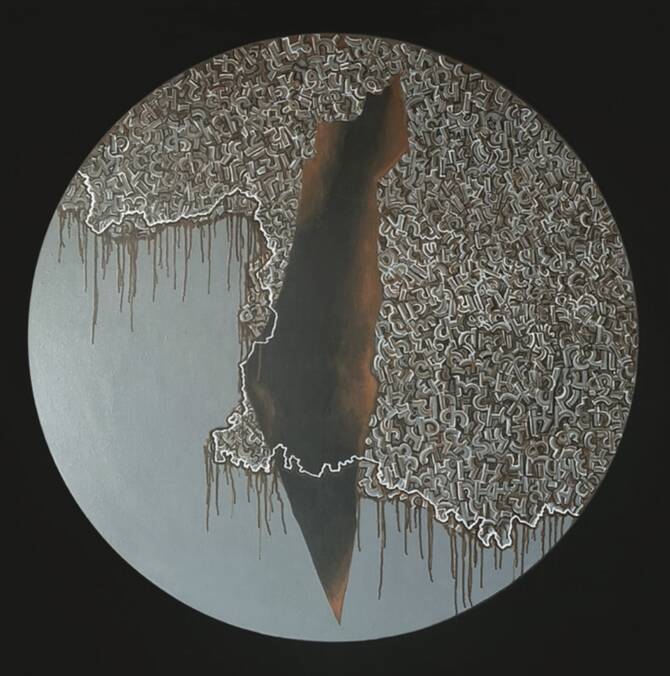
A painting by Indian artist Vijendra Vij features in “The Body Called Palestine” exhibition at Jawahar Bhawan, New Delhi, May 1-31, 2025. (Safdar Hashmi Memorial Trust)

“When I read the poetry of all these poets, they recall the people, places and experience of left-behind homes, trees, fruits, flowers, the earth, the sea, the sky, colors and scents. Even after decades of hard work and attainment of comfort and professional success, the enduring connection to Palestine remains unbroken. That is behind the inspiration of (my) work,” he said.

The works have generally received emotional responses, with fear and anger followed by thoughtful observation.

“If you look at some of the works that are quite graphic, you see a bit of fear, you fear for yourself, and you also feel extremely despondent about how people are actually going through those situations,” said Saurabh Wasan, an art manager in Delhi.

“Exhibitions like this are very important and very much needed ... in whatever small way, we’re kind of keeping their voices going. Their voices are still being heard.”


Trump has ‘productive’ talks with Putin before Zelensky meet

Updated 4 sec ago
Follow

Trump has ‘productive’ talks with Putin before Zelensky meet

  • Trump’s upbeat tone on peace deal comes after Russia carried out another massive bombardment of Kyiv
  • US president due to meet Zelensky at his Mar-a-Lago estate today
PALM BEACH: Donald Trump said Sunday he had “productive” talks with Russian leader Vladimir Putin hours before the US president meets Ukraine’s Volodymyr Zelensky, in a year-end sprint to seal a deal to end the war.
Trump’s renewed upbeat tone comes despite wide skepticism in Europe about Putin’s intentions after Russia carried out another massive bombardment of the Ukrainian capital Kyiv just as Zelensky was heading to Trump’s Florida estate.
“I just had a very good and productive telephone call with President Putin of Russia,” Trump announced on his Truth Social platform.
The Kremlin gave a more pointed readout, saying that Trump agreed that a mere ceasefire “would only prolong the conflict” as it demanded Ukraine compromise on territory.
Trump is meeting Zelensky in the dining room of his Mar-a-Lago estate, where he frequently brings both foreign guests and domestic supporters.
Trump has made ending the Ukraine war a centerpiece of his second term as a self-proclaimed “president of peace,” and he has repeatedly blamed both Kyiv and Moscow for the failure to secure a ceasefire.
Zelensky, who has faced verbal attacks from Trump, has sought to show willingness to work with the contours of the US leader’s plans, but Putin has offered no sign that he will accept it.
Sunday’s meeting will be Trump’s first in-person encounter with Zelensky since October, when the US president refused to grant his request for long-range Tomahawk missiles.
And the Ukrainian leader could face another hard sell this time around, with Trump insisting that he “doesn’t have anything until I approve it.”

- European allies -

The talks are expected to last an hour, after which the two presidents are scheduled to hold a joint call with the leaders of key European allies.
Polish Prime Minister Donald Tusk, who will join the call, wrote on X that the Russian attacks on Kyiv were “contrary to President Trump’s expectations and despite the readiness to make compromises” by Zelensky.
The revised peace plan, which emerged from weeks of intense US-Ukraine negotiations, would stop the war along its current front lines and could require Ukraine to pull troops back from the east, allowing the creation of demilitarized buffer zones.
As such, it contains Kyiv’s most explicit acknowledgement yet of possible territorial concessions.
It does not, however, envisage Ukraine withdrawing from the 20 percent of the eastern Donetsk region that it still controls — Russia’s main territorial demand.
The Ukrainian leader said he hoped the talks in Florida would be “very constructive” but stressed that Putin had shown his hand with a deadly drone and missile assault on Kyiv that temporarily knocked out power and heating to hundreds of thousands of residents during freezing temperatures.
“This attack is again Russia’s answer on our peace efforts. And this really showed that Putin doesn’t want peace,” he said as he visited Canada.
He also told reporters that he would press Trump on the importance of providing security guarantees that would prevent any renewed Russian aggression if a ceasefire were secured.
“We need strong security guarantees. We will discuss this and we will discuss the terms,” he said.
Ukraine insists it needs more European and US funding and weapons — especially drones.

- Russian opposition -

Russia has accused Ukraine and its European backers of trying to “torpedo” a previous US-brokered plan to stop the fighting, and recent battlefield gains — Russia announced on Saturday it had captured two more towns in eastern Ukraine — are seen as strengthening Moscow’s hand when it comes to peace talks.
“If the authorities in Kyiv don’t want to settle this business peacefully, we’ll resolve all the problems before us by military means,” Putin said on Saturday.
Russian Foreign Minister Sergei Lavrov told state news agency TASS that Moscow would continue its engagement with US negotiators but criticized European governments as the “main obstacle” to peace.
“They are making no secret of their plans to prepare for war with Russia,” Lavrov said, adding that the ambitions of European politicians are “literally blinding them.”