

Saudi-French archeological mission uncovers ancient sites on Farasan Island

1 / 3
A joint Saudi-French archeological mission to excavate ancient sites on Farasan Island, in the Jazan region, has been concluded by the Heritage Commission. (X: @MOCHeritage)
2 / 3
A joint Saudi-French archeological mission to excavate ancient sites on Farasan Island, in the Jazan region, has been concluded by the Heritage Commission. (X: @MOCHeritage)
3 / 3
A joint Saudi-French archeological mission to excavate ancient sites on Farasan Island, in the Jazan region, has been concluded by the Heritage Commission. (X: @MOCHeritage)
Short Url
Updated 26 May 2025
Follow

Saudi-French archeological mission uncovers ancient sites on Farasan Island

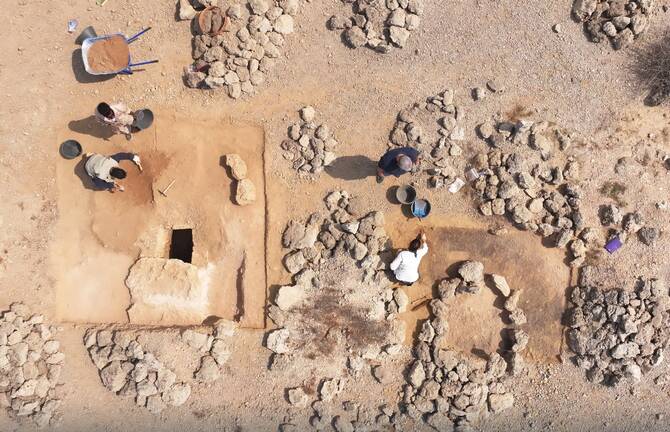
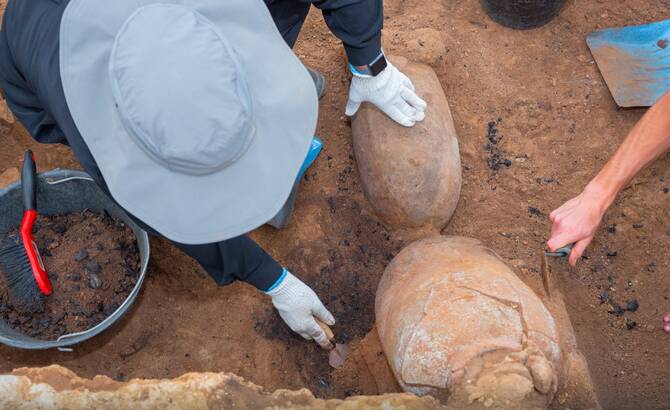
RIYADH: A joint Saudi-French archeological mission to excavate ancient sites on Farasan Island, in the Jazan region, has been concluded by the Heritage Commission.

The initiative, in collaboration with Paris 1 Pantheon-Sorbonne University, featured a team of experts from the French National Centre for Scientific Research, the Saudi Press Agency reported.

It aimed to reveal settlement phases and chronological sequences at the excavation sites — Qusar, Ghurrayn, and Wadi Shami, which date from the first to third centuries — as well as study various burial grounds.

The work is part of a scientific project highlighting the historical and strategic importance of the Farasan archipelago, particularly its key role in maritime trade across the Red Sea through various historical periods.

It included male and female students from national universities, as well as participants from Paris 1 Pantheon-Sorbonne University.

Previous excavations under the same project, which took place from 2011 to 2024, have yielded significant findings dating back to the Bronze Age and the periods of Southern Arabian states.

Discoveries have included watchtowers and industrial sites believed to be remnants of a camp dating back to the second century B.C.

The findings underscore the rich cultural exchange that took place on Farasan Island, highlighting its pivotal role in connecting Southern Arabian civilizations with those of the Mediterranean. Prehistoric shell mounds and human settlements further emphasize the islands’ historical significance.


Saudi reserve records critically endangered Ruppel’s vulture

Updated 4 sec ago
Follow

Saudi reserve records critically endangered Ruppel’s vulture

RIYADH: King Abdulaziz Royal Reserve Development Authority has announced the sighting and documentation of a Ruppel’s vulture (Gyps rueppellii) within the boundaries of the reserve — a landmark environmental and historical event.

This is the third officially documented record of the species at national level and the first of its kind in the central and eastern regions of the Kingdom, the Saudi Press Agency reported.

The sighting carries global significance given the conservation status of the vulture, which is classified as critically endangered by the International Union for Conservation of Nature, following the loss of more than 90 percent of its population throughout its original range in Africa over the past three decades.

The appearance of this rare bird in King Abdulaziz Royal Reserve adds a new entry to the limited record of its sightings in the Kingdom, which began in Aseer region in 1985, followed by a sighting in 2018, and another in AlUla in September 2025. 

Its latest recording in central and eastern Saudi Arabia is considered an important environmental indicator of the quality of natural habitats provided by the reserve.

Globally, Ruppel’s vulture faces major threats, including poisoning from pesticides, electrocution, collisions with power lines, and the loss of nesting sites as a result of urban expansion and land-use change. 

Additional challenges include the decline of carrion resulting from changes in livestock-rearing practices, illegal hunting for use in traditional beliefs, and the adverse effects of climate change on its breeding areas and migratory routes.

The vulture is primarily found in the African Sahel and is considered extremely rare in the Arabian Peninsula. Its sighting in King Abdulaziz Royal Reserve underscores the Kingdom’s leading role in conserving biodiversity and supporting the objectives of Saudi Vision 2030 for protecting ecosystems.

It also reflects the success of the authority’s efforts to protect wildlife and restore ecosystems, positioning the reserve as a safe and attractive habitat for rare and native species.
