

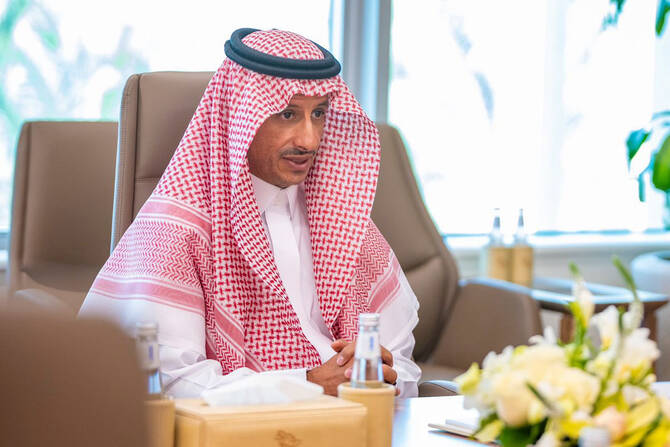
Human-centered travel takes priority in Saudi Arabia’s tourism vision, says minister

Tourism Minister Ahmed Al-Khateeb emphasized that this people-first approach is designed to balance the Kingdom’s rapid infrastructure development with heritage preservation and stronger community connections.
Short Url
Updated 25 May 2025
Follow

Human-centered travel takes priority in Saudi Arabia’s tourism vision, says minister

  • Minister says Kingdom’s tourism future lies in authentic human experiences, not just infrastructure
  • Ahmed Al-Khateeb stresses technology should enhance — not replace — personal interaction

RIYADH: Saudi Arabia is placing human-centered travel at the forefront of its tourism strategy, focusing on authentic cultural experiences, meaningful interactions, and community engagement as it reshapes its global tourism identity.

Tourism Minister Ahmed Al-Khateeb emphasized that this people-first approach is designed to balance the Kingdom’s rapid infrastructure development with heritage preservation and stronger community connections. The strategy, he said, forms a cornerstone of Saudi Arabia’s broader ambition to become a leading international tourism destination.

Al-Khateeb’s remarks come amid the launch of TOURISE, a new platform introduced by the Kingdom to unite global leaders across tourism, technology, investment, and sustainability. The initiative aims to foster innovation and collaboration as Saudi Arabia accelerates its tourism growth while maintaining a focus on sustainable and inclusive development.

In an interview with CNN,  Al-Khateeb emphasized the importance of human connection in travel, stating: “We want the experience in travel and tourism to be human.”

While acknowledging the role of innovation, Al-Khateeb stressed that technology should enhance — not replace — personal interaction. “We will definitely always use technology, but we will encourage and protect” human interaction because travel is all about people, he said.

The recently launched TOURISE platform, unveiled in late May, is designed to serve as a global forum bringing together key players in the tourism industry. According to Al-Khateeb, the initiative will unite regulators, operators, investors, and nongovernmental organizations to shape the future of a sector that accounts for “10 percent of global GDP and 10 percent of global jobs.”

He described the initiative as “unique” in its ability to bridge government and business to foster innovation and sustainable development in tourism.  

The Kingdom welcomed 30 million international visitors in 2024, a 9.5 percent increase from the previous year.  This influx is part of the kingdom’s broader strategy to diversify its economy beyond oil. 

Riyadh is a focal point of the Kingdom’s destination development plans. “Riyadh is top priority. Riyadh winter is the most beautiful winter in the world,” said Al-Khateeb, referencing attractions like Diriyah, King Salman Park, and the entertainment hub Qiddiya, which he described as “the largest-ever built sport, entertainment and culture city.”  

Al-Khateeb pointed to the Red Sea as a top priority, noting the launch of new resorts under Red Sea Global.   

“People love to visit the Red Sea, to explore the Red Sea,” he said, highlighting the region’s appeal alongside heritage tourism and Arabian hospitality.  

Despite geopolitical challenges, Al-Khateeb maintained that Saudi Arabia is moving forward with confidence.  

“We’re happy to see that there’s de-escalation in many areas in the region. And I think what is happening in Syria is a very positive thing, and I hope the rest of the region will follow,” he said.   

“It is very normal that you have some huge investment, upload investment in a country like Saudi Arabia, this investment is exposed to, sometimes, risk — capacity, availability risk, financial risk and so on.”   

“However, we know this. We have all the mitigation in place,” he added.  

Looking to the future, Al-Khateeb emphasized the Kingdom’s preparations for hosting the FIFA World Cup 2034 across multiple cities, including the mountainous south.   

“We are holding the World Cup in many cities in Saudi Arabia that will give the chance for the fans to explore the nature and the topography,” he said.  

Among the projects is the new Mohammed bin Salman Stadium in Qiddiya, which he described as “out of this world” and offering a “different experience for fans and for the players.”  

This strategic focus on human-centered tourism aligns with Saudi Arabia's Vision 2030, aiming to position the Kingdom as a leading global tourism destination. 


Arab food and beverage sector draws $22bn in foreign investment over 2 decades: Dhaman 

Updated 16 sec ago
Follow

Arab food and beverage sector draws $22bn in foreign investment over 2 decades: Dhaman 

JEDDAH: Foreign investors committed about $22 billion to the Arab region’s food and beverage sector over the past two decades, backing 516 projects that generated roughly 93,000 jobs, according to a new sectoral report. 

In its third food and beverage industry study for 2025, the Arab Investment and Export Credit Guarantee Corp., known as Dhaman, said the bulk of investment flowed to a handful of markets. Egypt, Saudi Arabia, the UAE, Morocco and Qatar attracted 421 projects — about 82 percent of the total — with capital expenditure exceeding $17 billion, or nearly four-fifths of overall investment. 

Projects in those five countries accounted for around 71,000 jobs, representing 76 percent of total employment created by foreign direct investment in the sector over the 2003–2024 period, the report said, according to figures carried by the Kuwait News Agency. 

“The US has been the region's top food and beverage investor over the past 22 years with 74 projects or 14 projects of the total, and Capex of approximately $4 billion or 18 percent of the total, creating more than 14,000 jobs,” KUNA reported. 

Investment was also concentrated among a small group of multinational players. The sector’s top 10 foreign investors accounted for roughly 15 percent of projects, 32 percent of capital expenditure and 29 percent of newly created jobs.  

Swiss food group Nestlé led in project count with 14 initiatives, while Ukrainian agribusiness firm NIBULON topped capital spending and job creation, investing $2 billion and generating around 6,000 jobs. 

At the inter-Arab investment level, the report noted that 12 Arab countries invested in 108 projects, accounting for about 21 percent of total FDI projects in the sector over the past 22 years. These initiatives, carried out by 65 companies, involved $6.5 billion in capital expenditure, representing 30 percent of total FDI, and generated nearly 28,000 jobs. 

The UAE led inter-Arab investments, accounting for 45 percent of total projects and 58 percent of total capital expenditure, the report added, according to KUNA. 

The report also noted that the UAE, Saudi Arabia, Egypt, and Qatar topped the Arab ranking as the most attractive countries for investment in the sector in 2024, followed by Oman, Bahrain, Algeria, Morocco, and Kuwait. 

Looking ahead, Dhaman expects consumer demand to continue rising. Food and non-alcoholic beverage sales across 16 Arab countries are projected to increase 8.6 percent to more than $430 billion by the end of 2025, equivalent to 4.2 percent of global sales, before exceeding $560 billion by 2029. 

Sales are expected to remain highly concentrated geographically, with Egypt, Saudi Arabia, Algeria, the UAE and Iraq accounting for about 77 percent of the regional total. By product category, meat and poultry are forecast to lead with sales of about $106 billion, followed by cereals, pasta and baked goods at roughly $63 billion. 

Average annual per capita spending on food and non-alcoholic beverages in the region is projected to rise 7.2 percent to more than $1,845 by the end of 2025, approaching the global average, and to reach about $2,255 by 2029. Household spending on these products is expected to represent 25.8 percent of total expenditure in 13 Arab countries, above the global average of 24.2 percent. 

Arab external trade in food and beverages grew more than 15 percent in 2024 to $195 billion, with exports rising 18 percent to $56 billion and imports increasing 14 percent to $139 billion. Brazil was the largest foreign supplier to the region, exporting $16.5 billion worth of products, while Saudi Arabia ranked as the top Arab exporter at $6.6 billion.