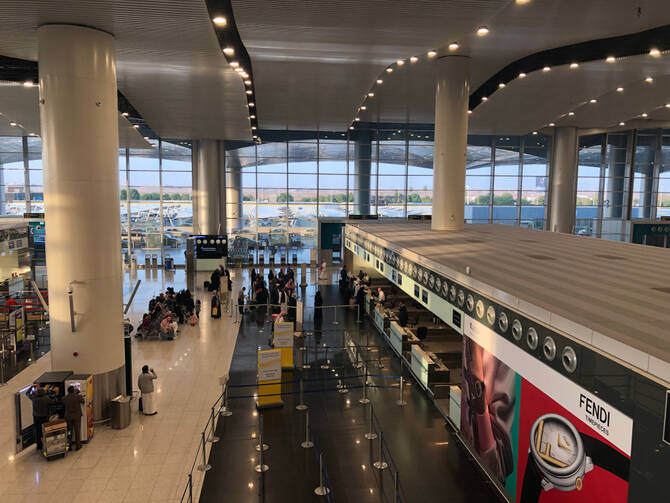
Riyadh airport tops Saudi on-time performance rankings in April: GACA data 

According to the monthly report published by the General Authority of Civil Aviation, the Riyadh-based hub outperformed larger airports such as Jeddah’s King Abdulaziz International. Shutterstock
Short Url
Updated 25 May 2025
Follow

Riyadh airport tops Saudi on-time performance rankings in April: GACA data 

  • Saudia reported an 89% on-time rate for arrivals and departures
  • Riyadh–Amman route recorded the highest on-time performance at 97%

JEDDAH: Saudi Arabia’s King Khalid International Airport recorded the highest on-time departure rate among the Kingdom’s international airports in April, achieving 90 percent punctuality, official data showed.  

According to the monthly report published by the General Authority of Civil Aviation, the Riyadh-based hub outperformed larger airports such as Jeddah’s King Abdulaziz International, the Saudi Press Agency reported. 

The report comes as Saudi Arabia continues to push operational upgrades under its National Aviation Strategy, part of the broader Vision 2030 plan to position the Kingdom as a regional air transit hub. 

“The report issued in April 2025 indicated that King Khalid International Airport in Riyadh, King Fahd International Airport in Dammam, Abha International Airport, Neom International Airport, Turaif Airport, and Wadi Al-Dawasir Airport topped the advanced positions in the report,” the SPA report stated. 

The rankings are based on data compiled by Matarat Holding Co. and exclude canceled flights. Performance is measured by flights departing or arriving within 15 minutes of their scheduled times. 

In the category of international airports handling more than 15 million passengers annually, the Jeddah-based King Abdulaziz International Airport recorded a punctuality rate of 78 percent, according to the study.  

For international airports serving between 5 million and 15 million passengers annually, King Fahd International Airport in Dammam secured the highest ranking with an on-time performance of 87 percent. Prince Mohammad bin Abdulaziz International Airport in Madinah, which also falls under this category, recorded a 72 percent rate. 

In the segment of international airports accommodating between 2 million and 5 million passengers annually, Abha International Airport posted the highest punctuality rate at 91 percent. This was followed by King Abdullah bin Abdulaziz Airport in Jizan with 90 percent, and Tabuk Airport with 82 percent. 

NEOM Bay International Airport led among international airports with fewer than 2 million passengers annually, achieving a 95 percent on-time departure rate. Other strong performers in this category included Al-Ahsa International Airport at 93 percent and Najran Airport at 89 percent. 

Turaif and Wadi Al-Dawasir airports recorded perfect performance among domestic flight hubs, achieving 100 percent on-time departures. King Saud bin Abdulaziz Airport in Al-Baha followed closely with 99 percent, while Bisha Airport posted 94 percent. 

At the airline level, national flag carrier Saudia reported an 89 percent on-time rate for arrivals and departures. Meanwhile, flynas achieved 86 percent for arrivals and 91 percent for departures, while flyadeal recorded 87 percent and 91 percent, respectively. 

Regarding specific flight routes, the Riyadh–Abha domestic passage maintained a strong on-time departure rate of 96 percent. Other high-performing domestic routes included Riyadh–Tabuk and Riyadh–Dammam, both at 96 percent, while the Jizan–Riyadh route sustained its previous month’s rate of 95 percent. 

Internationally, the Riyadh–Amman route recorded the highest on-time performance at 97 percent, followed by Riyadh–Bahrain at 94 percent, Riyadh–Dubai at 93 percent, and Riyadh–Kuwait at 92 percent. The Jeddah–Amman route also achieved a 94 percent punctuality rate.


Saudi Finance Ministry acquires 86% stake in Binladin Group through debt-to-equity conversion

Updated 16 sec ago
Follow

Saudi Finance Ministry acquires 86% stake in Binladin Group through debt-to-equity conversion

RIYADH: The general assembly of Binladin International Holding Group has approved a capital increase through the conversion of existing debt into equity, a move that results in the Saudi Ministry of Finance acquiring an 86 percent ownership stake in the company, according to a report by Al-Arabiya.

The decision marks a significant step in restructuring the group’s financial position and reflects shareholder confidence in the company’s long-term strategy and operational recovery.

In a statement cited by the Al-Arabiya report, Binladin Group’s board of directors said the approval underscores trust in the company’s future direction and reinforces its development and growth objectives.

Under the approved arrangement, outstanding financial obligations will be settled through the issuance of new shares, allowing the company to substantially reduce its debt burden and strengthen its balance sheet.

As a result, the Ministry of Finance will become the group’s majority shareholder, aligning the government directly with the company’s growth trajectory while supporting its financial stability.

The transaction follows earlier measures taken by the Ministry of Finance to stabilize the group’s financial structure.

Previously, Saudi Arabia’s National Debt Management Center announced the successful completion of a syndicated loan facility on behalf of the ministry, arranged with a consortium of local and international banks. The facility totaled approximately SR23.3 billion ($6.2 billion) and was part of a broader framework to address the company’s liabilities.

The Ministry of Finance had earlier outlined a series of coordinated steps with Binladin Group to settle outstanding cash obligations to banks and restructure the company’s financial commitments. These measures were designed to restore operational stability and enable the group to continue executing its portfolio of large-scale construction projects.

The move is seen as a continuation of the government’s broader support for the construction and infrastructure sector, a key pillar of Saudi Arabia’s economic transformation agenda under Vision 2030.

The restructuring is expected to help ensure the timely completion of strategic projects, safeguard employment, and enhance the sector’s attractiveness to investors.

Commenting on the development, Mohammed Al-Tayyar, a political economy researcher, said the capital increase through a debt-to-equity swap significantly strengthens Binladin Group’s financial standing. He noted that the transaction is likely to bolster investor confidence, improve governance and transparency, and open up new opportunities for sustainable growth as the company moves forward under a more stable financial framework.