

GAMI, GACA sign deal to enable advanced air mobility in Saudi Arabia

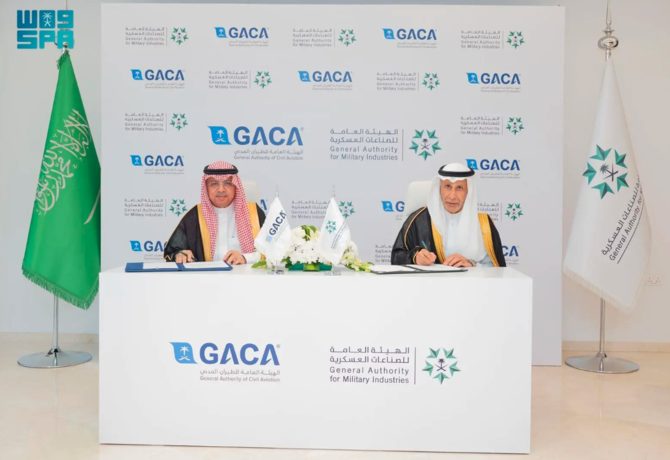
GAMI Governor Ahmed Al-Ohali, and Abdulaziz Al-Duailej, president of GACA. SPA
Short Url
Updated 16 October 2024
Follow

GAMI, GACA sign deal to enable advanced air mobility in Saudi Arabia

  • Deal focuses on collaboration with the Advanced Air Mobility project to develop systems to enable advanced flight modes in the Kingdom
  • Agreement includes exchanging scientific and practical expertise between the two parties

RIYADH: Technology supporting vertical take-off and landing aircraft and unmanned planes will be developed in Saudi Arabia thanks to a new agreement between the Kingdom’s military and aviation authorities.
The General Authority for Military Industries has signed a memorandum of understanding with the General Authority of Civil Aviation to develop advanced technologies and boost industrial capabilities in these areas.

The agreement focuses on collaboration with the Advanced Air Mobility project, which aims to develop systems to enable advanced flight modes in the Kingdom, according to the Saudi Press Agency. 

The MoU was signed at GAMI’s headquarters in Riyadh by the authority’s governor, Ahmed Al-Ohali, and Abdulaziz Al-Duailej, president of GACA.

The agreement includes exchanging scientific and practical expertise between the two parties, emphasizing the development of working groups for related activities, conducting workshops, providing training, and sharing knowledge.

The partnership also covers traffic procedures for uncrewed airliners.

The collaboration aims to expand opportunities for maintenance and repair service projects to support the aviation sector, contributing to the long-term sustainability and growth of the industry.

The MoU is part of the GAMI’s ongoing efforts to regulate and support the localization and advancement of the military industries sector, with a particular focus on aerial mobility.

The move also underscores the body’s collaborative approach, working closely with supportive government entities to foster cooperation and exchange expertise, all in line with the broader goals of Saudi Vision 2030.

The agreement also aims to support the strategic goals of the aviation sector, which are spearheaded by GACA.

These objectives focus on building partnerships to provide safe, sustainable, and efficient transportation solutions within a regulatory framework that follows international best practices.

GACA is working with leading local and global manufacturers to establish a strong regulatory framework that ensures the safe and efficient operation of vertical takeoff and landing aircraft, as well as the implementation of advanced air mobility technologies.

In September, Al-Duailej said during the International Civil Aviation Organization Advanced Air Mobility Symposium that was held in Montreal, Canada, that cutting-edge aviation is on track to transform the transportation, tourism, and health care systems in Saudi Arabia and across the world,

He underlined that the Kingdom is committed to a global leadership role in the field.

In 2023, the industry’s market value reached $9.7 billion, with projections forecasting a climb to $50 billion by 2032.

This corresponds with over 200 cities in 57 countries planning to implement this technology, necessitating a unified global approach in regulation, technology, and investment.


Record $14.4bn rise in Saudi holdings of US Treasuries

Updated 19 January 2026
Follow

Record $14.4bn rise in Saudi holdings of US Treasuries

RIYADH: Saudi Arabia increased its holdings of US Treasuries by 10.71 percent in November in what was the largest increase since data tracking began in 1974, according to the latest official data,

The Kingdom’s US Treasury portfolio stood at $148.8 billion in the month, up $14.4 billion from October.

Following the increase, Saudi Arabia moved up one place to 17th place among the largest foreign holders of US Treasuries.

Countries including Saudi Arabia invest in US Treasuries for their perceived safety, liquidity, diversification benefits, and alignment with economic ties to the US. 

The Kingdom’s holdings were 17.25 percent higher in November compared with January 2025.

The allocation highlights Saudi Arabia’s preference for longer-dated US government debt as part of its foreign reserve strategy, focused on capital preservation, liquidity, and diversification amid global market volatility. 

Saudi Arabia’s holdings included $106.8 billion in long-term securities, accounting for 72 percent of the total, while short-term holdings stood at $42 billion, or 28 percent. 

Globally, Japan remained the largest foreign holder of US Treasury securities at $1.2 trillion, followed by the UK at $888.5 billion, mainland China at $682.6 billion, and Belgium at $481 billion. 

Canada ranked fifth with holdings of $472.2 billion, followed by the Cayman Islands and Luxembourg in sixth and seventh positions, with portfolios valued at $427.4 billion and $425.6 billion, respectively. 

France placed eighth with $376.1 billion, followed by Ireland at $340.3 billion and Taiwan at $312.5 billion. 

Other countries included in the top 20 list include Switzerland, Singapore, Hong Kong, and Norway, as well as India and Brazil. 

The trade relationship between Saudi Arabia and the US remains strong, with the Kingdom exporting SR5.20 billion ($1.39 billion) worth of non-oil goods in October, data from the General Authority of Statistics showed.

Speaking to Arab News in October, Nasser Saidi, founder and president of economic and financial advisory services firm Nasser Saidi & Associates and a former minister of economy and trade in Lebanon, said US Treasuries are a critical pillar of stability.

“Holding treasuries allows Saudi Arabia to meet its international payment obligations — finance imports, service external debt, portfolio, and capital flows — provide a buffer against oil revenue shocks, while also generating a steady, low-risk stream of income,” he said.