

Pakistan PM on regional diplomacy tour of Turkiye, Iran and Central Asia after India standoff

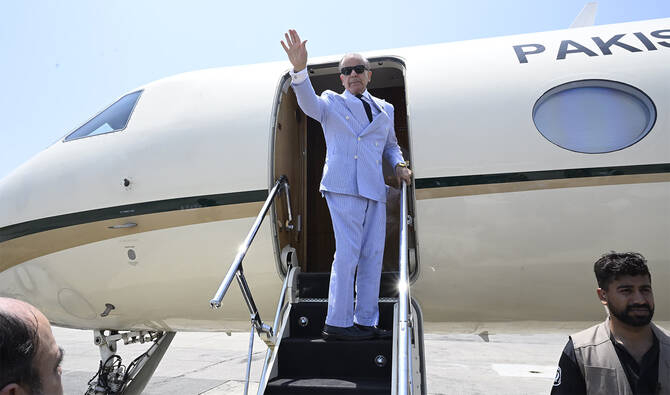
Pakistan Prime Minister Shehbaz Sharif waves in Lahore, Pakistan, on May 25, 2025, as he departs for a two-day visit to Türkiye. (Government of Pakistan)
Short Url
Updated 25 May 2025
Follow

Pakistan PM on regional diplomacy tour of Turkiye, Iran and Central Asia after India standoff

  • The development comes weeks after Pakistan and India traded missile, drone and artillery strikes before agreeing to a truce on May 10
  • During the four-day conflict, several friendly nations supported Pakistan’s demand for a probe into an attack that triggered the standoff

ISLAMABAD: Prime Minister Shehbaz Sharif on Sunday embarked on a five-day tour of Turkiye, Iran, Azerbaijan and Tajikistan to thank their leadership for supporting Islamabad during this month’s military conflict with India, Sharif’s office said.

Pakistan and India this month traded missile, drone and artillery strikes for days, killing around 70 people on both sides, before agreeing to a United States-brokered ceasefire on May 10. The conflict, the worst between the neighbors in decades, was triggered by an attack on tourists in Indian-administered Kashmir on April 22 that New Delhi blamed on Pakistan. Islamabad denies complicity.

During the standoff, several friendly nations supported Pakistan’s demand for a credible, international probe into the attack as they urged the nuclear-armed archfoes to exercise restraint and avoid miscalculation of the other’s military capabilities.

On Sunday, Sharif left for Turkiye on the first leg of his four-nation tour, accompanied by Deputy Prime Minister and Foreign Minister Ishaq Dar, Federal Minister for Information and Broadcasting Attaullah Tarar and Special Assistant Tariq Fatemi.

“During the tour, the prime minister will have wide-ranging discussions with the leaders of these countries on an entire range of issues covering bilateral relations and matters of regional and international importance,” Sharif’s office said.

“He will thank friendly countries for the support they have given to Pakistan during the recent crisis with India.”

Turkish President Tayyip Erdogan will hold talks with Pakistan’s Prime Minister Shehbaz Sharif in Istanbul on Sunday, Erdogan’s head of communications said.

“During the meeting, bilateral relations, regional and international issues, including the fight against terrorism, will be discussed,” Fahrettin Altun said on X.

Bitter rivals India and Pakistan have fought three wars, including two over the disputed region of Kashmir, since gaining independence from British rule in 1947. Both claim the Himalayan territory in its entirety but rule it in part. The conflict had raised fears that it could spiral into a full-blown war.

Both countries have separately announced sending delegations to key capitals and friendly countries to present their stance on this month’s standoff before the world, in a bid to gain world support.

During his visit aimed at furthering Pakistan’s diplomatic outreach, Sharif will also attend an International Conference on Glaciers in Dushanbe, Tajikistan on May 29-30, according to the Sharif’s office.

The conference aims to advance global efforts in climate adaptation and resilience, with a specific focus on addressing glacial melting.

Pakistan is highly vulnerable to climate change, facing numerous impacts like rising temperatures and increased frequency of extreme weather events.

Officials say unusually high temperatures in Pakistan’s northern areas have resulted in rapid melting of glaciers, warning that the prolonged phenomenon could lead to water shortages and threaten lives in the long run.


Pakistan demands ‘equitable’ climate finance for vulnerable states at UN forum

Updated 4 sec ago
Follow

Pakistan demands ‘equitable’ climate finance for vulnerable states at UN forum

  • Pakistan repeatedly suffers from deadly climate disasters, including floods this year that killed over 1,000 people during monsoon
  • Pakistan minister stresses role of international cooperation, private sector engagement for environmental sustainability

ISLAMABAD: Pakistan’s Minister for Climate Change Dr. Musadik Malik on Saturday called for an “equitable, accessible” climate finance for vulnerable nations, saying that climate action must be treated as a shared global responsibility.

Malik was speaking at a high-level conference titled: “The Bottom Line: Why Tackling Environmental Degradation Is Critical to the Future of the Global Financial System” held on the sidelines of the United Nations Environment Assembly (UNEA) in Nairobi. 

Pakistan has suffered repeated climate-inducted disasters frequently over the years. Devastating floods this year claimed over 1,000 lives in the country during the monsoon season. Super floods in 2022 cost the country an estimated $30 billion in damages. 

“Federal Minister for Climate Change and Environmental Coordination Dr. Musadik Malik has stressed that environmental degradation poses systemic risks to the global financial system and called for more accessible and equitable climate finance for vulnerable countries,” state-run Associated Press of Pakistan (APP) reported. 

Participants highlighted the importance of policy coherence, effective regulatory frameworks and whole-of-government approaches to create enabling conditions for sustainable finance.

Pakistan has been pushing for easy access and terms of financing for developing countries that suffer from climate change effects over the past few years at global events such as the Conference of the Parties (COP) and World Economic Forum. 

Dr. Malik noted that countries contributing least to global emissions were among those facing the “most severe” impacts of climate change. 

Pakistan contributes less than 1 percent to the total greenhouse gas emissions.

“The minister underscored the role of international cooperation and responsible private sector engagement in ensuring that financial stability and environmental sustainability reinforce each other,” the APP report said. 

The summit brought together global leaders, policymakers, financial regulators and experts to discuss how governments are steering private finance toward pathways that strengthen economic and financial stability. 

Discussions also focused on mobilizing private capital for high-impact sectors and integrating environmental risks into financial decision-making processes.