


RIYADH: What if traditional crafts were not relics of the past but blueprints for the future? Saudi artist Fatimah Al-Nemer, whose work is on show at Riyadh’s Naila Art Gallery, transforms ancestral materials into contemporary narratives, blending palm fronds, clay, and wool with concept and meaning.
For Al-Nemer, heritage is not something to simply preserve behind glass. It is something to touch, reshape and retell. And traditional crafts are far more than manual skills; they are living archives.
“In the Arabian Peninsula, people adapted to their environment by turning clay, palm fronds, and wool into tools for survival and then into objects of timeless beauty,” she told Arab News.

Saudi Arabia’s traditional crafts, shaped over generations, carry stories that Fatimah Al-Nemer reinterprets through contemporary art techniques. (Supplied)
These crafts, shaped over generations, carry stories that Al-Nemer reinterprets through contemporary art.
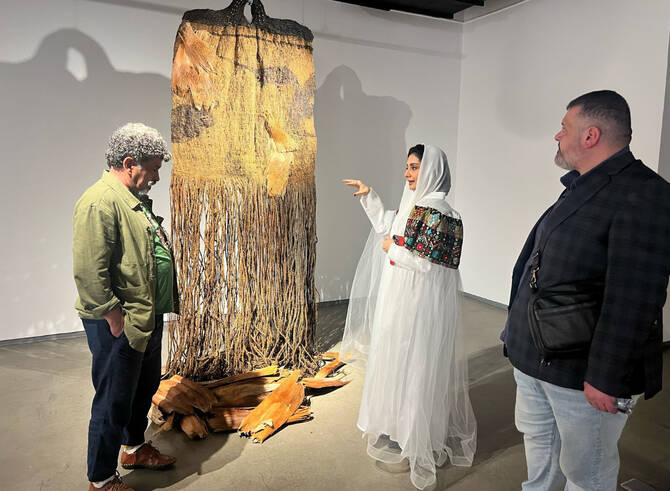
Her project, Al-Kar, exemplifies this approach. Named after the traditional climbing tool used by date harvesters, the piece was created in collaboration with Saudi craftswomen.
Al-Nemer transformed humble palm fibers into a three-meter-long rug, elevating simple material into a conceptual installation.
HIGHLIGHTS
• Through her work, Fatimah Al-Nemer dissolves the boundaries between craft and art, heritage and modernity.
• Those curious about the artist’s work can view some of her pieces at solo exhibition ‘Memory of Clay,’ held at Naila Art Gallery until May 30.
“This is not merely an aesthetic celebration,” she said. “It’s a rewriting of our communal identity. Our heritage is rich — not only in materials, but in stories.”

Artist Fatima Al-Nemer with her artworks. (Supplied)
Her work goes beyond decorative craft; she treats traditional practices as conceptual frameworks, weaving narratives through textiles, clay and palm fiber.
Her collaborations with artisans ensure that generational knowledge is embedded in each piece. “The material is never separate from the experience,” she added. “It becomes witness — marked by the presence of women, place and memory.”
Participation in international exhibitions has expanded Al-Nemer’s artistic outlook, allowing her to view local materials like clay and textiles as globally resonant.
This is not merely an aesthetic celebration. It’s a rewriting of our communal identity. Our heritage is rich — not only in materials, but in stories.
Fatimah Al-Nemer, Saudi artist
“The global art scene recontextualizes challenges like the marginalization of craft, and transforms them into dialogues about identity and memory,” she said.
For Al-Nemer, craftswomen are not merely implementers, but collaborators. “They carry manual intelligence honed across generations,” she added, commending institutions like Saudi Arabia’s Heritage Commission and Herfa Association that are now empowering artisans in alignment with the Kingdom’s cultural transformation.

A person contemplates an artwork by Fatima Al-Nemer. (Supplied)
“Craft is no longer confined to the past — it is a living contemporary practice with global relevance,” she said.
Those curious about the artist’s work can view some of her items at solo exhibition “Memory of Clay,” held at Naila Art Gallery until May 30.
The exhibition offers a contemplative journey into themes of memory, belonging and identity transformation, using clay as a visual and cultural symbol.

Artist Fatimah Al-Nemer answers questions from the audience at her exhibition, "Memory of Clay," which runs in Riyadh until May 30. (Supplied)
Featuring 12 works created through mixed media and a combination of traditional and contemporary techniques, Al-Nemer reimagines ancient Saudi crafts through a modernist lens, presenting clay not simply as raw material, but as a timekeeper and silent witness to human evolution.
“Clay is not just a medium,” she said. “It is a mirror of our collective memory, shaped as we are shaped, cracking to reveal hidden layers of nostalgia and wisdom.”
This philosophy materializes in the tactile depth, earthy hues and intricate details that define her works — each piece echoing the raw pulse of life.
To young Saudi women hoping to innovate through craft, Al-Nemer offers this message: “Believe in the value of what you hold. The world doesn’t just want the product — it wants the story behind it.”
With expanding institutional support and evolving creative spaces, the artist sees an opportunity: “Craft can thrive as both art and enterprise as long as authenticity remains at its core.”
Through her work, Al-Nemer dissolves the boundaries between craft and art, heritage and modernity.
Every thread and every texture becomes a testament to identity — crafted by hand, read by the eye and understood by the heart.


