

Pakistan PM to begin five-day tour Sunday of Central Asia, Turkiye and Iran

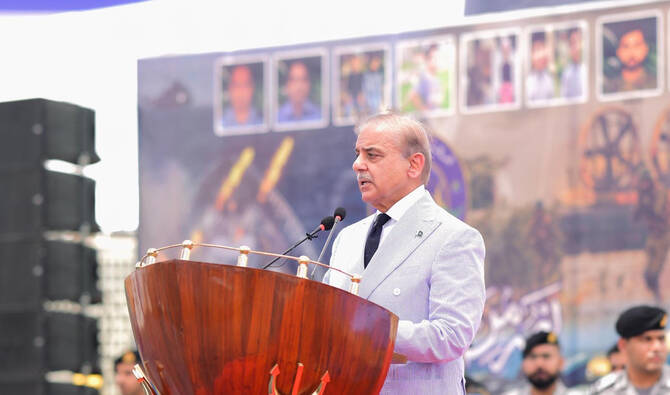
Pakistan Prime Minister Shehbaz Sharif addresses the officers and sailors of Pakistan Navy at Naval Dockyard in Karachi on May 19, 2025. (Photo courtesy: Handout/PMO)
Short Url
Updated 24 May 2025
Follow

Pakistan PM to begin five-day tour Sunday of Central Asia, Turkiye and Iran

  • The development comes two weeks after Pakistan and India traded missile, drone and artillery strikes before agreeing to a truce on May 10
  • During the four-day conflict, several friendly nations supported Pakistan’s demand for a probe into an attack that triggered the standoff

ISLAMABAD: Prime Minister Shehbaz Sharif will embark on Sunday on a five-day tour of Turkiye, Iran, Azerbaijan and Tajikistan to hold discussions about matters of regional and international importance, the Pakistani foreign office said, weeks after a military conflict between Pakistan and India.

Pakistan and India this month traded missile, drone and artillery strikes for days, killing 70 people, before agreeing to a US-brokered ceasefire on May 10.

The conflict was triggered by an attack on tourists in Indian-administered Kashmir on April 22 that New Delhi blamed on Pakistan. Islamabad denies complicity.

During the conflict Several friendly nations supported Pakistan’s demand for a credible, international probe into the attack as they urged the nuclear-armed archfoes to exercise restraint.

“The prime minister will have wide-ranging discussions with the leaders of these countries on an entire range of issues covering bilateral relations and matters of regional and international importance,” the Pakistani foreign office said.

“He will also have the opportunity to express the deepest appreciation and acknowledgment for the support extended to Pakistan by the friendly countries during the recent crisis with India.”

Bitter rivals India and Pakistan have fought three wars, including two over the disputed region of Kashmir, since gaining independence from British rule in 1947. Both claim the Himalayan territory in its entirety but rule it in part.

The latest conflict between the two was the deadliest in more than two decades and raised fears that it could spiral into a full-blown war.

During his visit aimed at furthering Pakistan’s diplomatic outreach, Sharif will also attend the International Conference on Glaciers in Dushanbe, Tajikistan, according to the Pakistani foreign office.

The conference, to be held on May 29-30, aims to advance global efforts in climate adaptation and resilience, with a specific focus on addressing glacial melting.

Pakistan is highly vulnerable to climate change, facing numerous impacts like rising temperatures and increased frequency of extreme weather events.

Officials say unusually high temperatures in Pakistan’s northern areas have resulted in rapid melting of glaciers, warning that the prolonged phenomenon could lead to water shortages and threaten lives in the longer run.


Pakistani student launches ‘Urdu ChatGPT’ AI model

Updated 5 sec ago
Follow

Pakistani student launches ‘Urdu ChatGPT’ AI model

  • Developer says “Qalb” is largest large language model built exclusively for Urdu
  • Project highlights push to localize artificial intelligence for non-English users

ISLAMABAD: A Pakistani student studying in the United States has launched an artificial intelligence model designed exclusively for the Urdu language, a development its creator says could help bridge longstanding gaps in access to advanced digital tools for millions of speakers worldwide.

The project, called Qalb, is positioned as an Urdu-first large language model at a time when most generative AI systems are primarily trained on English and other widely used global languages. Supporters of language-specific models argue they can improve accuracy, cultural relevance and accessibility for users in education, business and public services.

Urdu is spoken by more than 230 million people globally, including in Pakistan, India and diaspora communities, but remains under-represented in advanced AI systems. Efforts to localize artificial intelligence have increasingly been seen as critical for widening participation in digital economies, particularly in developing countries.

“Qalb is now recognized as the world’s largest Large Language Model created exclusively for the Urdu language,” Taimoor Hassan, the project’s developer, was quoted this month in a report in state-run news agency APP. 

“Trained on a massive dataset of 1.97 billion tokens and benchmarked across seven-plus international evaluation frameworks, Qalb outperforms existing Urdu-focused AI models on key real-world performance indicators, setting a new standard for natural language processing in Pakistan,” Hassan said.

“This is a development model and in the next phase we would soon launch App for mobile and web so that people could use and benefit from Qalb ChatGPT.”

Hassan completed his undergraduate degree in computer science at FAAST University’s Peshawar campus and is currently studying for a master’s degree in computer science and software engineering at Auburn University in the United States. According to APP, he is a serial entrepreneur who has previously launched and exited multiple startups and has represented Pakistan at international technology forums.

“I had the opportunity to contribute in a small way to a much bigger mission for the country,” Hassan said.

“Together with my undergraduate roommates and teammates, Jawad Ahmed and Muhammad Awais, we are committed to continuously fine-tuning localized models for niche industries, which we believe can become a major breakthrough for Pakistan.”

Both collaborators are also graduates of FAAST University Peshawar Campus and are currently studying in Germany, APP reported.

The team behind Qalb said the model is intended to support local businesses, startups, educational platforms and voice-based digital services, arguing that meaningful innovation is no longer limited to large technology firms.

“Technology is no longer locked behind big budgets or big teams. With the right mindset, even a small group can build products that educate, automate, and serve millions,” Hassan told APP.