ROVANIEMI, Finland: A fighter jet roaring through the grey sky breaks the tranquility of a boreal forest in northern Finland, one more sign of a growing military presence that is challenging the ability of reindeer herders to exercise their livelihood.
“Military activity has increased massively here since Finland joined NATO,” reindeer herder Kyosti Uutela said on a tour in Rovajarvi, the largest artillery practice range in western Europe, on a day when no ground exercises were underway.
Located 100 kilometers (60 miles) from the Russian border, Rovajarvi covers an area of 1,070 square kilometers on land that also makes up part of the reindeer husbandry district that Uutela heads.
Finland, which shares a 1,340-kilometer border with Russia, dropped decades of military non-alignment to join NATO in 2023 in response to Russia’s invasion of Ukraine.
And in 2024, a defense cooperation agreement between the United States and Finland came into force.
“Training activities and exercises have increased since the beginning of the war in Ukraine” because of the worsened security situation, the Finnish Defense Forces told AFP in a statement.
“This is naturally also reflected in Rovajarvi,” it said, saying the firing range provided unique training possibilities for international troops thanks to its size, terrain and seasonal changes.
Last year, Finland participated in 103 military exercises at home and abroad, up from 89 in 2023.
Ascending a small hill where the forest has been clear-cut and trenches dug for training purposes, Uutela said the spot “had been lost” as a grazing ground.
“The use of heavy army tanks and the presence of thousands of soldiers in the forest destroy the lichen pastures,” Uutela said, referring to the reindeer’s main source of food.
“Reindeer will not be able to live here anymore,” he said.
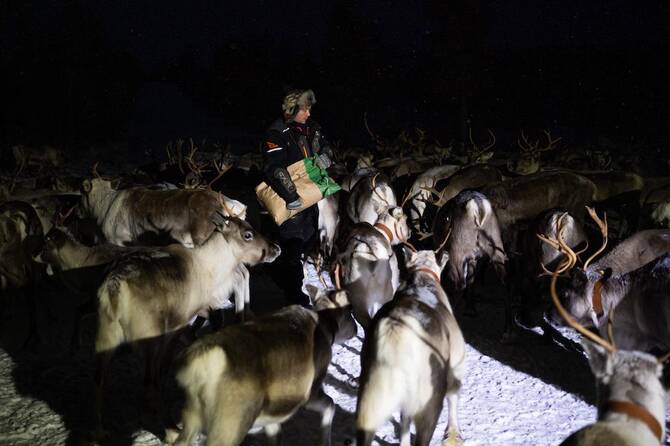
Finland has 4,305 reindeer owners and around 184,000 reindeer, living in 57 reindeer husbandry districts that cover 36 percent of the country’s total area.
A part of them belong to the indigenous Sami population that lives in Sapmi, which straddles northern regions of Finland, Sweden, Norway and Russia.
The non-Sami people such as Uutela who also practice reindeer husbandry include herders living near the Rovajarvi range, outside the Sapmi homeland.
Full-time herders sell reindeer meat, pelts and handicrafts as their main source of income, and husbandry has been an integral part of the indigenous Sami culture for generations.
Riikka Poropudas, another herder in Rovajarvi, said the military presence in the area had increased “radically” since Finland’s NATO accession, forcing herders to feed their reindeer in fenced areas more often than before.
Finland’s Defense Forces said the needs of reindeer husbandry were “taken into account in the planning of exercises, for example in terms of the times and locations,” adding that they were in daily contact with Rovajarvi herders.
But Poropudas worries that a large live-fire and combat exercise involving around 6,500 soldiers from Finland, Sweden and Britain this month would disturb her reindeer.
The calving season is at its busiest in mid-May.
“The activities stress both female reindeer and newborn calves, and drive them away from their natural pastures,” she said.
Tuomas Aslak Juuso, acting president of the Sami parliament in Finland, said climate change and land use changes – including the militarization of the Arctic – posed special challenges for the roughly 1,200 Sami reindeer herders in Finland.
“Our way of reindeer husbandry depends fully on the herding model and the reindeer being able to graze freely on natural pasture lands,” he said.
But the effects of climate change on winter conditions already mean that herders increasingly have to provide their reindeer with supplementary feed “in order to avoid mass deaths.”
A large international military exercise conducted in Finnish Sapmi in 2023 had been “quite a negative experience for the Sami people,” Juuso said.
“The local reindeer herders had not been informed beforehand, grazing conditions for that spring were damaged and tractors damaged the lichen cover, which may never grow back,” he said.
“When these things are planned, there should be early consultation with the Sami and responsibility for damage and harm.”


![]()

Growing Arctic military presence worries Finland’s reindeer herders
Short Url
https://arab.news/vjn34
Growing Arctic military presence worries Finland’s reindeer herders
- Finland, which shares a 1,340-kilometer border with Russia, dropped decades of military non-alignment to join NATO in 2023
- Finland has 4,305 reindeer owners and around 184,000 reindeer, living in 57 reindeer husbandry districts

Latest updates





© 2026 SAUDI RESEARCH & PUBLISHING COMPANY, All Rights Reserved And subject to Terms of Use Agreement.