In Finnish Lapland, tourists cross the Arctic Circle to fill Santa’s sack with cash

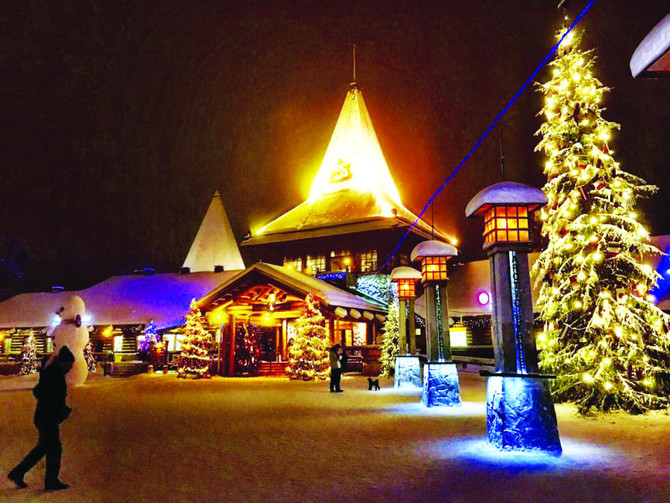
A view of the Santa Claus office in Rovaniemi, Finland where the festive period brings plenty of profitable cheer for local businesses. (Reuters)
Updated 17 December 2017
Follow

In Finnish Lapland, tourists cross the Arctic Circle to fill Santa’s sack with cash

Rovaniemi, Finland: In the run-up to Christmas, tourists from around the world flock to the Santa Claus Village, an amusement park in Finnish Lapland, where temperatures can hit nearly -15 degrees Celsius (5 Fahrenheit).
They buy soft toys and souvenirs from pricey gift shops while a bearded Santa receives hundreds of admirers every day throughout December before embarking on his world tour from the valleys of Finland to the skyscrapers of New York and beyond to deliver gifts.
Holding their winter beanie hats in their hands, visitors wait patiently in line for a brief encounter with “Joulupukki” — the Finnish word for Santa Claus — and a photo opportunity in exchange for hard currency.
“We’ve seen other Santas but they weren’t the real one. But we’re told that is the real one,” said Mary Gleadall, an eight-year-old tourist from Southampton in the UK, visiting the amusement park with her parents, brother and sister.
According to Christmas lore, Santa lives in a secret place in the middle of the snowy pines of the North Pole. But the question is, where?
Since 2010, Rovaniemi, the capital of Finnish Lapland, has marketed itself as Santa’s “official home.”
Situated a few miles from the city, the Santa Claus Village is located in front of a huge gas station.
Tourists rush to cross the Arctic Circle, marked by a white line, to meet Santa Claus in his wooden home with a pointed roof.
But entering his private cottage is out of the question as Mother Claus is reportedly protective of their privacy.
In a large room, the white-bearded old man sits in an armchair next to a chest full of letters.
Each year, he receives more than 300,000 visitors, a deluge he embraces with humility.
“I’m very happy. I’m not exhausted but, of course, I get tired once in a while,” he said.
And how does Santa Claus regain his energy?
“I love to take nap every once and then. Fifteen minutes’ sleeping and then all is very good,” he said.
Shizuka Kawahara and Saki Itoi, Japanese tourists in their thirties, flew for more than 24 hours to hug Santa for a few seconds in a precious moment immortalized with a photograph taken by an elf.
The price for one shot starts at €30 ($35). Photographing with one’s own camera is forbidden as it would ruin the magic of the moment, says the staff of the house.
Four-year-old Harry Gleadall, Mary’s brother, approaches Santa without fear.
He quickly states his list of what he wants for Christmas: Transformers and some more transformers, before he skeptically shakes Santa’s hand.
“But what if it wasn’t the real Santa Claus?” Harry asks with concern.
Eager to set the record straight — and justify the long trip — his mother quickly assures him that the chubby red-clothed man is indeed the real deal.
After a tour around the shop which sells hand-made “Lapland” emblems and tons of souvenirs, the family is back in the village square, surrounded by wooden homes, Christmas carols piped out of nearby speakers.
In this winter wonderland, tourists have the opportunity to go on a reindeer sleigh ride.
A snow “safari” of 400 meters costs €14 per child and €18 per adult, an exotic experience for many foreigners who seek to discover the Arctic landscapes steeped in pink light.
The -13 degrees Celsius temperature does not discourage the plucky visitors bundled up in their ski suits.
“Everything that was told to me during childhood, it’s come true,” said Perpetua, a tourist from Dubai, describing the break from the year round desert climate as “heaven.”
“We expected magic and this is what we found,” added Max, an Italian tourist. “Everything seems to be magic — the lights, the place, everything here.”
But Miriana, a 24-year-old Italian on a university exchange program in southern Finland, was less convinced.
“The place is really nice. But I think nevertheless that it’s a bit commercial,” she said.
— AFP


Using space science to protect Saudi Arabia’s environment

Updated 9 sec ago
Follow

Using space science to protect Saudi Arabia’s environment

  • Kingdom is harnessing satellite technology to forecast disasters, boost agriculture

RIYADH: Learning space science has delivered significant environmental benefits worldwide, helping many countries better understand and manage climate challenges. 

Saudi Arabia is now taking steps not only to explore the galaxy but also to invest in future generations who can apply space science to pressing environmental issues at home.

Last November, the Space Academy, part of the Saudi Space Agency, launched a series of seminars designed to enhance knowledge and develop skills in space science and technology, with a particular focus on Earth observation.

Running for nearly a month, the program formed part of a broader strategy to nurture national talent, raise scientific awareness, and build data capabilities that support innovation and research across the Kingdom.

Developing space sector can eventually help reduce some of the critical climate issues such as drought and air pollution. (AFP)

As efforts to strengthen the sector continue, important questions remain: How can space science translate into tangible environmental benefits? And how large is the global space economy?

In an interview with Arab News, Fahad Alhussain, co-founder of SeedFord, highlighted the scale of the opportunity and its environmental impact.

“To be frank, the slogan that we always use in space is that ‘saving the Earth from the space.’ It is all about this,” Alhusain told Arab News.

“You can recall a lot of related environmental issues like global warming, related to forests, related to the damage that happens to the environment. Without space, it would be almost impossible to see the magnitude of these damages.”

According to Alhussain, satellites have transformed how experts observe environmental changes on Earth, offering a comprehensive view that was previously impossible.

“By collecting data and using satellites… You can better analyze and measure so many things that help the environment,” said Fahad Alhussain. (Supplied)

He said that “the transformation of technology allows even the non-optical ways of measuring, assessing, and discovering what is going on in the environment … you can even anticipate fire before it happens in the forest.”

“You can detect the ice-melt down, you can get huge amount of information and can see it through the weather maps…there is a huge section in the economy for the environment,” Alhussain commented.

A 2022 report by Ryan Brukardt, a senior partner at McKinsey & Company, published by McKinsey Quarterly, found that more than 160 satellites currently monitor Earth to assess the impacts of global warming and detect activities such as illegal logging.

Brukardt cited NASA as an example of how advanced satellite tools are used to track environmental changes, including shifts in ocean conditions, cloud cover, and precipitation patterns. He also noted that satellite data can help governments determine when immediate action is needed, particularly in response to wildfires.

FASTFACT

Did You Know?

  • Satellites collect massive amounts of data, and AI is used to help interpret this information more efficiently and predict future outcomes.
  • The global space economy surpassed $600 billion in 2024 and is projected to exceed $1 trillion by 2030.
  • Saudi Arabia has established three key entities: the Supreme Space Council, the Saudi Space Agency, and the Communications, Space, and Technology Commission.

Beyond disaster response, satellites offer vital insights for agriculture. According to Brukardt’s report, scientists can use space-based data to monitor crop development and anticipate threats to harvests, such as drought or insect infestations.

These wide-ranging applications explain the rapid growth of the global space economy. 

According to World Economic Forum research, the sector is projected to reach $1.8 trillion by 2035, nearly tripling from $630 billion in 2023.

A deeper understanding of space and its applications offers Saudi Arabia, and the world, better tools to anticipate climate challenges, protect ecosystems, and safeguard biodiversity. (Supplied)

For Saudi Arabia, expanding space science capabilities could help address the country’s arid conditions by monitoring desertification and identifying sources of air pollution. Early detection of droughts, heatwaves, and crop stress could support more effective environmental planning and response.

Space-based data could also play a critical role in tracking environmental changes in the Red Sea and surrounding coastal ecosystems, strengthening marine conservation efforts and supporting the Sustainable Development Agenda.

As Alhussain emphasized, advancing knowledge in space science and satellite technology enables experts to measure environmental damage accurately and predict disasters before they occur, allowing for more effective responses.

By investing in space science education and research, the Kingdom can build national expertise, strengthen environmental protection policies, enhance food and water security, and contribute to global efforts to combat climate change—while also benefiting from the rapidly expanding space economy.

Ultimately, a deeper understanding of space and its applications offers Saudi Arabia, and the world, better tools to anticipate climate challenges, protect ecosystems, and safeguard biodiversity.

“By collecting data and using satellites, you can better analyze and measure so many things that help the environment,” said Alhussain.
“There will be patterns where you can warn people, scientists and decision makers to do something about it.”