

Pakistan ranks seventh in civilian harm, second in IED casualties worldwide — report

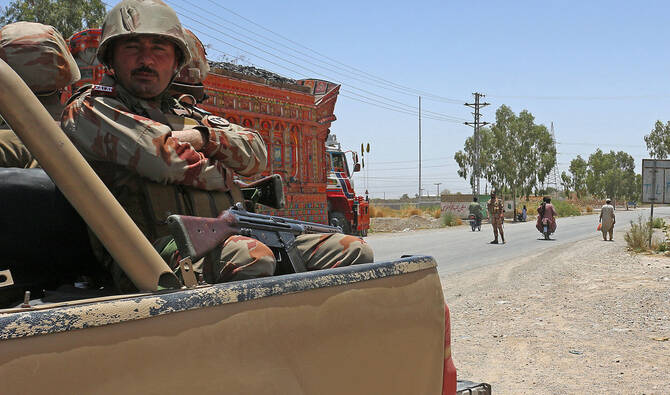
Security personnel guard along a street near the site of a school bus bombing in the Khuzdar district of Balochistan province on May 21, 2025. (AFP)
Short Url
Updated 24 May 2025
Follow

Pakistan ranks seventh in civilian harm, second in IED casualties worldwide — report

  • UK-based Action on Armed Violence monitor says Pakistan witnessed 790 civilian casualties in 248 incidents last years
  • The Baloch Liberation Army killed and injured 119 civilians, followed by Daesh (45 casualties) and Pakistan Taliban (10)

ISLAMABAD: Pakistan ranked seventh in the world for civilian casualties from explosive weapons and second most affected nation in terms of casualties from improvised explosive devices (IEDs) last year, UK-based monitor Action on Armed Violence (AOAV) said this week.

In its annual report, the AOAV said it had recorded 67,026 deaths and injuries as a result of the use of explosive weapons around the world, which was the highest since 2010.

The report said 89% of 59,524 civilians were either killed or wounded by explosive weapons in 2024, adding that 41% of them, or 24,147 individuals, were killed in incidents of explosive violence.

Pakistan was the seventh most affected country for civilians harmed by explosive weapons last year, with 790 civilian casualties (210 killed) in 248 incidents, a 9% decrease from 2023. However, there was a 11% increase in incidents compared to 218 in 2023.

“The majority of civilian harm was attributed to non-state actors, who were reportedly responsible for 76% (603) of civilian casualties. In particular, the Balochistan Liberation Army (BLA) killed and injured 119 civilians in Pakistan last year,” the report read.

“The Islamic State (Daesh) affiliate in the region, Islamic State – Khorasan Province (IS-KP), was the reported perpetrator of 45 civilian casualties in Pakistan last year, down from 194 recorded civilian casualties in 2023. The Tehreek-e-Taliban Pakistan (TTP) killed and injured 10 civilians last year, down from 32 in 2023.”

Unknown non-state actors accounted for 54% of civilian casualties (423), down from 541 recorded in 2023, in Pakistan. The BLA was the reported perpetrator of 15% (119) civilian casualties, marking a 440% increase from 22 in 2023.

Pakistan is currently battling twin insurgencies: one led my religiously motivated groups, including the TTP, mainly in its Khyber Pakhtunkhwa (KP) province and the other by ethno-nationalist Baloch separatist groups like the BLA in Balochistan.

Islamabad has frequently accused Afghanistan and India of supporting the TTP, BLA and other militant groups who have mounted their attacks in Pakistan in recent years. Kabul and New Delhi deny the accusations.

In terms of IEDs, Lebanon saw the highest level of harm globally, with 3,373 civilians killed and injured across only 16 incidents, accounting for 58% of civilian casualties from IED attacks globally, according to the report.

Pakistan saw the second highest level of civilian harm due to IED attacks, with AOAV recording 485 civilian casualties (139 fatalities) in 132 incidents.

“This is a 30% decrease in civilian casualties, but an 8 % increase in incidents,” the monitor said.

Other countries which saw elevated levels of civilian harm from IEDs in 2024 included Nigeria (385 civilian casualties), Iran (378), Somalia (270), Syria (253), Afghanistan (170), and Myanmar (84).


Pakistan warns citizens in Iran to keep travel documents ready amid intensifying protests

Updated 6 sec ago
Follow

Pakistan warns citizens in Iran to keep travel documents ready amid intensifying protests

  • Iranian universities reschedule exams, allow foreign students to leave the country for one month
  • Donald Trump pledges support for Iranian protesters as ‘activists’ report more than 2,500 deaths

ISLAMABAD: Pakistan’s top diplomat to Iran on Tuesday urged Pakistani nationals to keep their travel documents handy and advised students to plan ahead after Iranian universities rescheduled examinations to allow international students to leave, as weeks-long nationwide protests further intensified.

Iran has been gripped by protests since late December after shopkeepers in Tehran’s Grand Bazaar shut their businesses to protest worsening economic conditions, triggered by the Iranian rial plunging to record lows against the US dollar.

The demonstrations quickly spread beyond the capital, with unrest reported in most of the country’s 31 provinces and involving traders, students and other groups.

Authorities have responded with arrests, use of force and Internet and mobile network disruptions, which rights groups say are aimed at curbing coordination and limiting coverage of the protests.

At least 100 Pakistani citizens, including students and pilgrims, have returned home through the Pakistan-Iran border in the southwestern province of Balochistan, a Pakistani official told Arab News on Tuesday, though many are still believed to be in the neighboring state.

“I urge all Pakistani citizens in Iran to keep their travel documents, particularly immigration-related documents such as passport and ID cards, readily available with them,” Ambassador Mudassir Tipu said in a post on X. “Those who have expired documents, or their documents are not in their possession, they may kindly urgently approach us for timely and expeditious assistance.”

In a separate post, he said Iranian universities had rescheduled examinations and allowed international students to leave the country for one month, advising Pakistani students to make their plans accordingly.

On Jan. 1, Pakistan advised its citizens to avoid traveling to Iran, citing safety concerns linked to the protests. The Pakistani embassy in Tehran also set up a crisis management unit to provide round-the-clock assistance to citizens.

Iran eased some restrictions on Tuesday, allowing international phone calls via mobile networks for the first time in days, but maintained limits on Internet access and text messaging as the death toll from the protests rose to at least 2,571 people, according to the Associated Press that quoted “activists.”

In a message on Truth Social, US President Donald Trump urged Iranian protesters to continue their anti-government demonstrations, saying “help is on its way,” without providing details. Shortly afterward, Ali Larijani, secretary of Iran’s Supreme National Security Council, accused the United States and Israel of responsibility for the deaths of Iranian civilians.

Iranian state television said officials would hold funerals on Wednesday for “martyrs and security defenders” killed during the unrest, which has intensified over the past week.