

Pakistan president in Bahrain to boost trade, defense and security ties

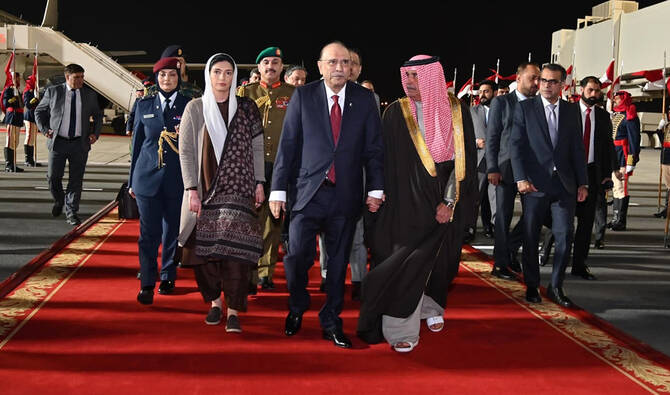
President Asif Ali Zardari and First Lady Bibi Aseefa Bhutto Zardari being received by Commander of the Bahrain National Guard Sheikh Mohammed bin Isa Al Khalifa and Minister of Foreign Affairs Sheikh Dr Abdullatif bin Rashid Al Zayani upon arrival at the airport on January 13, 2025. (PID).
Short Url
Updated 14 January 2026
Follow

Pakistan president in Bahrain to boost trade, defense and security ties

  • Asif Ali Zardari will meet Bahrain’s king and crown prince, discuss regional issues of mutual interest
  • Trade volume between Pakistan and Bahrain has increased from $500 million to $1 billion in recent years

ISLAMABAD: Pakistan President Asif Ali Zardari arrived in Bahrain late Tuesday on a four-day visit to enhance bilateral cooperation in trade, defense and security, Pakistani state media reported.

Pakistan and Bahrain have maintained close diplomatic, trade, investment and defense relations and have lately been focusing on strengthening their cooperation in key economic sectors.

The Pakistan president’s visit will be focused on bilateral, regional and international issues of mutual interest for both nations, according to the foreign office in Islamabad.

He will hold talks with King Hamad bin Isa Al-Khalifa and Crown Prince Salman bin Hamad, and address a reception held at the headquarters of the Economic Development Board in Manama.

“The visit seeks to reinforce Pakistan’s longstanding cooperation with the brotherly Gulf nation while expanding opportunities for collaboration in trade and economic partnership, defense and security and people-to-people ties,” the Radio Pakistan broadcaster said.

Islamabad and Manama established diplomatic ties in 1971. In recent years, the bilateral trade volume between the two countries has ranged between $500 million to around $1 billion, according to Pakistan’s foreign ministry.

Major exports from Pakistan to Bahrain include meat, vegetables, rice, tobacco and textile. Imports from Bahrain, on the other hand, include petroleum products, ferrous wastes and scrape and aluminum.

Both have established a Joint Ministerial Commission (JMC) at the level of foreign ministers to discuss trade and economic ties, take decisions mutually and supervise the implementation of these decisions. So far, only two sessions of the JMC have been held and the last one was held in Bahrain in July 2021.

Zardari’s visit takes place amid increasing economic engagement between the two nations following the Pakistan-Bahrain Investment Summit in May 2025. Both sides signed contracts worth $13 million during the summit.


Pakistan bowler Tariq and his unusual delivery courts controversy at the T20 World Cup

Updated 7 sec ago
Follow

Pakistan bowler Tariq and his unusual delivery courts controversy at the T20 World Cup

  • The 28-year-old offspinner’s unconventional bowling action has already mesmerized some of the big names in shortest format of game
  • It has seen Tariq taking three wickets against an inexperienced the US in Sri Lanka this week in what was his first T20 World Cup game

ISLAMABAD: With a momentary pause in his delivery and his statue-like pose at the crease, Pakistan spin bowler Usman Tariq has created plenty of attention at cricket’s Twenty20 World Cup.
Just enough, it seems, to throw off opposing batters.

With it has come a fair share of controversy — that his pause-and sling style of bowling is an illegal delivery, or in cricket parlance, chucking. He’s already been reported twice, but cleared, by Pakistani cricket authorities.

The 28-year-old offspinner’s unconventional bowling action has already mesmerized some of the big names in shortest format of the game and has seen him taking three wickets against an inexperienced United States in Sri Lanka this week in what was his first T20 World Cup game.

As is often the case in cricket, the reasons for Tariq’s potential illegal delivery are complicated.

First there is the so-called “15-degree debate” — that bowlers cannot exceed the ICC’s 15-degree elbow flex limit, which is nearly impossible for on-field umpires to judge accurately in real time.

Another talking point has been the pause in Tariq’s delivery stride. Some critics, including former India cricketer Shreevats Goswami, compare it to a soccer penalty run-up that would be ruled illegal if the shooter stops midway.

BAFFLING THE BATTERS

Batters like Cameron Green of Australia and South African Dewald Brevis are a few notable players that were flummoxed by Tariq’s bowling action.

Power-hitter Brevis fell to Tariq’s only second ball in T20 international cricket in November. Green shook his head in disbelief and mocked Tariq’s bowling action close to the boundary line — but later apologized — when he walked back after slicing a wide delivery straight to the cover fielder during Pakistan’s 3-0 sweep of Australia at Lahore.

Tariq’s rise in T20 cricket has also seen him taking a hat-trick at Rawalpindi when he took 4-18 against Zimbabwe during the tri-series in November. He has taken 11 wickets off his 88 balls in only four T20 internationals.

It was no surprise when selectors included Tariq in the 15-man T20 World Cup squad, knowing that pitches in Sri Lanka would suit slow bowlers more than pacemen.

Tariq’s journey to top-level cricket wasn’t a smooth one. He was twice reported for suspect bowling action during country’s premier domestic T20 tournament — the Pakistan Super League — over the last two seasons, but on both occasions he was cleared after testing at the

National Cricket Academy in Lahore.

“I have two elbows in my arm,” Tariq said. “My arm bends naturally. I have got this tested and cleared. Everyone feels I bend my arm and all that. My bent arm is a biological issue.”

Tariq has also featured in the Caribbean Premier League and with his deceptive bowling action he was the tournament’s second-highest wicket taker for champions Trinbago Knight Riders.


LONG PAUSE A PROBLEM

“The batters are struggling to read Tariq because of the long pause the moment he steps on the bowling crease,” former Pakistan captain Sarfaraz Ahmed, who has played with Tariq in the PSL’s Quetta Gladiators, told The Associated Press.

“The long pause disturbs all the concentration of batters and when he bowls a fastish (delivery, after a long pause), or even a slow ball, it leaves the batters clueless.”

Less than three months ago, Tariq said he had dreamed about playing against archrival India. And after Pakistan withdrew its boycott of Sunday’s game in the T20 World Cup, Tariq’s dream could come true if Pakistan uses five spinners against India.

“I wish there’s a match against India and I can win the game for Pakistan single-handedly,” Tariq said then. “My coaches have injected this thing in me that ‘you have to win matches single-handedly’.”

On Sunday against India, Tariq could do just that.