MOSCOW: Fans paid tribute on Friday in Moscow’s Bolshoi Theatre to late ballet supremo Yuri Grigorovich, who died this week at the age of 98.
Born in the Soviet city of Leningrad to a ballet family, Grigorovich’s career — as a dancer and choreographer — spanned 80 years.
For much of it, he was the artistic powerhouse behind the Bolshoi, which he was said to have run with an iron fist.
Grigorovich made his name staging classics such as The Nutcracker, Swan Lake and The Stone Flower.
The latter was his most famous piece, based on folk tales from the Urals accompanied by composer Sergei Prokofiev’s music.
He then led the Bolshoi between 1964 and 1995.
“This man was a gift from God,” Agnessa Balieva, 78, a former star dancer at the Bolshoi, told AFP when she came to pay tribute to Grigorovich.
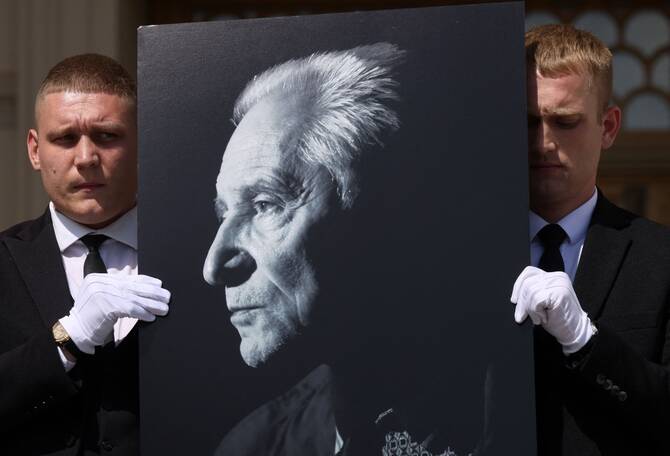
The choreographer’s coffin was covered in garlands in front of the stage of the Bolshoi, alongside a large black and white portrait of him, while music from his ballets was played.
“He was a great man, a genius, a legend,” said Ilia Krivov, a 42-year-old former Bolshoi dancer.
He said Grigorovich had elevated male ballet to “an unprecedented level.”
“Grigorovich was the soul of the Bolshoi,” said Svetlana Staris, a journalist and poet, hailing a figure who “revolutionized ballet.”


Moscow bids farewell to late ballet supremo Grigorovich
https://arab.news/27gev
Moscow bids farewell to late ballet supremo Grigorovich


Makkah museum displays world’s largest Qur’an
MAKKAH: The Holy Qur’an Museum at the Hira Cultural District in Makkah is showcasing a monumental handwritten copy of the Holy Qur’an, recognized as the largest Qur’an of its kind in the world.
The manuscript measures 312 cm by 220 cm and comprises 700 pages, earning the museum recognition from Guinness World Records for displaying the world’s largest Qur’an, the Saudi Press Agency reported.
The manuscript is a magnified reproduction of a historic Qur’an dating back to the 16th century, the SPA stated.
The original copy measures 45 cm by 30 cm, with the chapters written primarily in Thuluth script, while Surah Al-Fatiha was penned in Naskh, reflecting the refined artistic choices and calligraphic diversity of the era.
The Qur’an is a unique example of Arabic calligraphy, gilding and bookbinding, showcasing Islamic art through intricate decorations, sun-shaped motifs on the opening folio, and elaborately designed frontispiece and title pages that reflect a high level of artistic mastery.
The manuscript was endowed as a waqf in 1883. Its original version is currently preserved at the King Abdulaziz Complex for Endowment Libraries, serving as a lasting testament to Muslims’ enduring reverence for the Qur’an and the richness of Islamic arts across the centuries.


