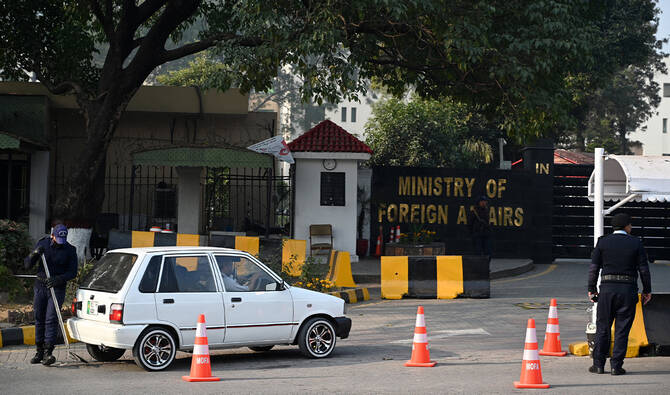

ISLAMABAD: The Pakistani foreign office (FO) on Friday criticized Indian Prime Minister Narendra Modi for his remarks on denying water to Pakistan from rivers flowing through India as well as economic and military consequences for Islamabad, saying they violated “the norms of responsible statecraft.”
Modi said on Thursday Pakistan will not get water from rivers over which India has rights, and that Pakistan’s army and economy will have to “pay a heavy price for every terrorist attack,” upping the rhetoric in a standoff over water access.
India last month said it was suspending the Indus Waters Treaty in a slew of measures after the killing of 26 people in an April 22 attack in Indian-administered Kashmir that New Delhi blamed on Islamabad, a charge Pakistan dismisses.
In its response to Modi’s comments at an event in Rajasthan, the Pakistani foreign office said such statements not only reflect a “deliberate attempt to mislead the public but also violate the norms of responsible statecraft.”
“Resorting to threats and boasting about military action against a sovereign nation is a grave breach of the United Nations Charter and established principles of international law,” it said.
“This dangerous approach undermines regional peace and stability.”
Any move to stop Pakistan accessing the water would have a devastating impact. The Indus treaty, brokered by the World Bank in 1960, guarantees water for 80 percent of Pakistan’s farms from three rivers that flow from India. The nuclear-armed neighbors have already clashed in their worst military fighting in nearly three decades before agreeing to a ceasefire on May 10.
Islamabad maintains the treaty is legally binding and no party can unilaterally suspend it, with its Attorney General Mansoor Usman Awan saying that Pakistan is willing to talk about or to address any concerns India may have.
The foreign office said Pakistan remains a consistent and proactive partner in the global fight against militancy and any insinuation seeking to associate Pakistan with “acts of terrorism is factually incorrect and patently misleading.”
“It is a tactic often employed to divert attention from India’s own internal challenges, particularly its repressive policies [in Kashmir],” it said on Friday.
India and Pakistan share a troubled relationship since they got independence from British rule in 1947, and have fought three wars, two of them over the Himalayan region of Kashmir, which they both claim in full but rule in part.
India accuses Pakistan of backing armed separatists in Kashmir. Pakistan denies this and says it only offers diplomatic and political support to Kashmiris.
Pakistan’s prime minister and military have also accused “Indian terror proxies” of involvement in a suicide bomb blast on an army school bus in Pakistan’s restive Balochistan province that killed five people, including three children, on Wednesday. India rejected the allegation.
Both nations have retaliated since the April attack by halting trade, closing borders and suspending most visas.
The Pakistani foreign office urged the Indian leadership to exercise restraint, saying such escalatory statements only exacerbate tensions.
“India should demonstrate maturity by resolving outstanding disputes through peaceful dialogue and diplomacy,” it said.
“Pakistan remains firmly committed to peaceful coexistence, regional stability, and constructive engagement. However, our desire for peace should not be misconstrued as weakness... Any misadventure or aggression will be met with a resolute and proportionate response. Pakistan has demonstrated its resolve in the past and will do so again, if required.”