
BANFF, Alberta: Top finance officials from the world’s seven wealthiest democracies set aside stark differences on US tariffs after two days of talks and agreed to counter global “economic imbalances,” a swipe at China’s trade practices.
In a communiqué issued Thursday, the Group of Seven finance ministers and central bank governors, meeting in the Canadian Rockies, left out their traditional defense of free trade and toned down their references to Russia’s war in Ukraine, compared with last year. But they did agree that further sanctions on Russia could be imposed if the two countries don’t reach a ceasefire.
The communiqué said the G7 members would continue to monitor “nonmarket policies and practices” which contribute to imbalances in global trade. The statement did not mention China but nonmarket policies typically refer to that country’s export subsidies and currency policies that the Trump administration charges gives it an advantage in international trade.
Treasury Secretary Scott Bessent appears to have succeeded in steering the communiqué largely in the direction the Trump administration sought, particularly regarding China’s trade practices.
The high-profile gathering of officials from the United States, Canada, United Kingdom, Japan, Germany, France, and Italy also appeared to be more congenial than an earlier meeting of G7 foreign ministers in March. Yet that meeting, also in Canada, occurred as President Donald Trump was in the midst of threatening stiff tariffs on Canada and suggesting it could become the 51st state.
Canada is president of this year’s G7 and the sessions this week are intended to lay the groundwork for a meeting of the heads of state on June 15-17 in Kananaskis, Canada. The White House said Thursday that Trump will attend that gathering.
“Throughout our G7 presidency, the tone of the discussions has become progressively more constructive,” Tiff Macklem, governor of the Bank of Canada, said at a news conference at the conclusion of the summit.
Yet that unity appears to have been achieved by jettisoning many items that in the past had been agreed to by the G7 countries. In addition to leaving out any mention of trade, the communiqué dropped sections on combating climate change and cooperating on international tax policy, issues the Trump administration has dismissed.
“There will always be tension around tariffs,” said Francois-Philippe Champagne, Canada’s finance minister. “But there are also places where you find common ground. ... This year our focus was to return to the G7 core mission, restoring global growth and stability.”

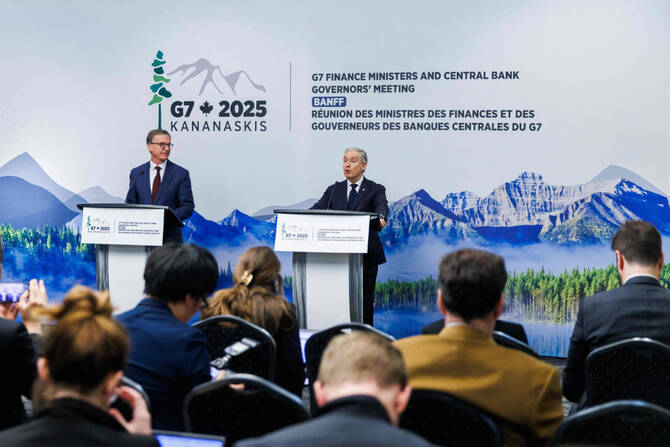
Tiff Macklem (L), governor of the Bank of Canada, looks on as Fracois-Philippe Champagne, Canada's minister of finance and national revenue, speaks at their closing press conference during the G7 Finance Ministers and Central Bank Governors’ Meeting in Banff, Alberta, Canada on May 22, 2025. (AFP)
The shift comes as Trump has slapped widespread tariffs on imports, including a 10 percent global duty on all goods, even those from the other G7 allies. Trump has also imposed 25 percent tariffs on steel, aluminum, and cars, and on April 2 imposed much steeper tariffs on about 60 nations, which he then paused until early July.
Valdis Dombrovskis, European Union Trade Commissioner, said that trade was “obviously a difficult topic” during the negotiations. The EU, which participates in the G7 but doesn’t serve as one of the rotating presidents, pushed for stronger language that would have highlighted the economic harms from tariffs.
“The US administration is having a somewhat different view of the situation,” Dombrovskis told reporters. He added that details about US tariffs weren’t discussed because the G7 members are negotiating individually with the Trump administration about duties.
On Ukraine, the communiqué condemned “Russia’s continued brutal war against Ukraine,” yet that language was milder than last year’s, which referred to Russia’s “illegal, unjustifiable, and unprovoked full-scale invasion.” Trump officials in the past have pushed to avoid antagonizing Russia while seeking peace talks.
Champagne, however, called the invasion “illegal” in Thursday’s news conference.
Bessent also successfully included an agreement in the statement that “no country or entity” that supported Russia’s war efforts would be able to profit from Ukraine’s reconstruction, a restriction that would bar Chinese companies from participating.
Dombrovskis said the EU had proposed to lower the current price cap on Russian oil — previously agreed to as part of early sanctions slapped on Russia in the wake of its 2022 invasion — to $50, from $60, but the communiqué says little about specific measures.
Still, the EU was largely satisfied with the G7’s agreements on Ukraine, Dombrovskis said, including the willingness to impose more sanctions. The group also agreed to continue freezing Russia’s financial assets until they can be used to help pay for Ukraine’s reconstruction.
Mark Sobel, a former top Treasury Department official and senior adviser to the Center for Strategic and International Studies, criticized the communiqué as “feeble.”
The statement “closes its eyes to the elephants in the room — the word ‘tariffs’ or a reference to destructive US trade policies are nowhere to be found,” Sobel said.
“On Ukraine, the G7 will ‘explore options’ if a ceasefire isn’t reached when the time for action is now,” he added. “This risible communiqué cannot hide the fissures in the G7 and hardly bodes well for the larger fractures looming for the upcoming G7 leaders’ summit.”
Still, John Kirton, a political scientist at the University of Toronto and director of the G7 Research Group, said it was a positive sign that a communiqué had even been issued. “That was in considerable doubt to the very end,” he said.
Yet both Sobel and Kirton noted there was no reference to US budget deficits and their role in the “global imbalances” the ministers seek to combat. The federal budget deficit, by contributing to higher US demand, worsens the US trade deficit that the Trump administration seeks to reduce.
The communiqué said that “economic policy uncertainty has declined from its peak,” a view that Kirton said was “puzzling,” given that the US Congress is considering a tax and spending package that has unnerved financial markets this week, pushing up the interest rate on US Treasury securities.
“There’s great uncertainty out there in financial markets,” Kirton said. “The dollar is going down, and we don’t know when that will end.”
Bessent held several bilateral meetings on the sidelines of the G7, including with Champagne and Japan’s Finance Minister Katsunobu Kato.
Bessent and Kato discussed trade and currencies, the Treasury Department said, with both sides agreeing that “exchange rates should be market-determined.” The US has often criticized Japan in the past for intervening in currency markets to lower the yen’s value.
Yet the two sides “did not discuss foreign exchange levels,” Treasury said, a sign the US isn’t pressuring Japan about the yen’s current value.