

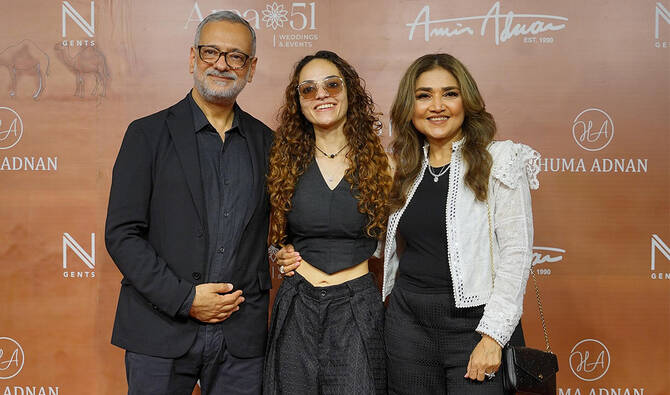

KARACHI: The name Amir Adnan has been synonymous with menswear in Pakistan for over 35 years.
Adnan launched the eponymous men’s fashion wear brand in 1990 and several sub-brands since, and is widely credited for glamorizing the long-sleeved sherwani outer coat in modern times.
Now, it’s time for his daughter Parishae Adnan to take the helm of Adnan’s fashion empire as CEO and transition the company, Shapar Private Limited, into a future rooted in climate sustainability and cultural integrity.
Last week, Parishae, a 30-year-old managerial economics graduate, launched the company’s summer collection, Nakhlistan, which means oasis, a show she has conceptualized and that she exhibited as a formal celebration of her appointment as CEO in May 2024.
“It absolutely feels incredible, I feel a lot of gratitude, taking the legacy forward,” Parishae told Arab News in an interview last week.
Adnan said it was always clear that his children would take over the business.
“My children were raised while we were working in the workshops, and they’ve been seeing this all along. My eldest daughter, Parishae, she worked with me for three years and now she’s become the CEO of the company,” he told Arab News.
“It’s not common, especially in this industry that we are working in, the fashion industry, to see legacy go on from one generation to another.”
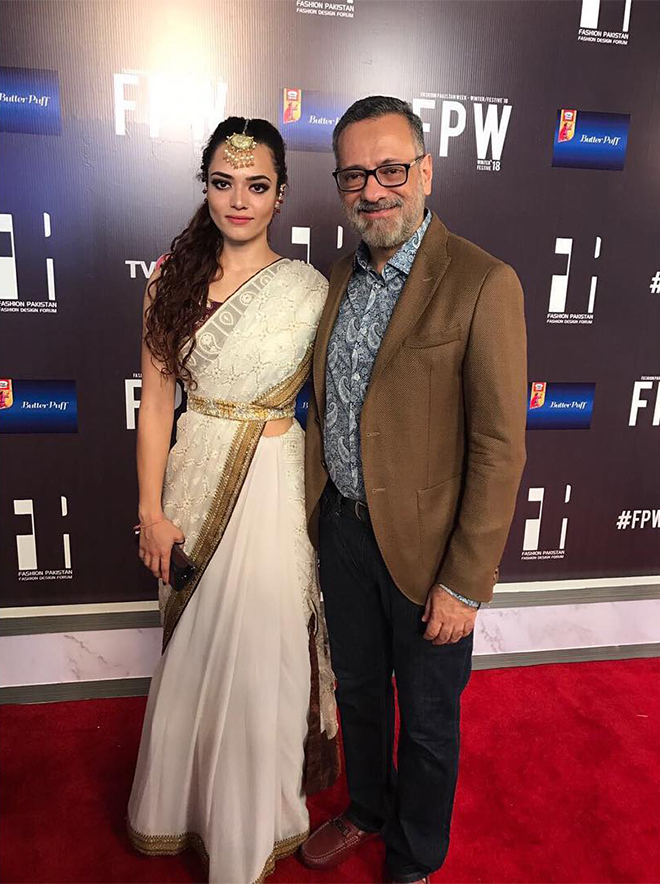
The picture shared by Parishae Adnan on September 28, 2018, shows Parishae Adnan (left) posting for a picture with her father, Amir Adnan, at Fashion Pakistan Week 2018. (Parishae Adnan)
And Parishae has plans for her father’s company, with her major aim being to introduce and integrate environmentally conscious practices into its operations.
“We need to do anything, even if it’s a little small step,” said Parishae, who explored fields like acting, hospitality, IT, and supply chain before finally embracing fashion designing.
“One of the first things I did was I changed our packaging material, making it recyclable.”
In 2021, she launched the ‘House of Parishae,’ a collection grounded in sustainable couture, with her debut show featuring 35 pieces created entirely from upcycled clothing, extending the life cycle of garments and promoting conscious consumption.
“The idea that couture, high end couture luxury can come out of upcycling or recycling, it’s not an idea that was digestible to the public in Pakistan,” the designer said, pointing to inspirations like Stella McCartney and Alexander McQueen.
“People here usually don’t go for that concept for their event wear. They don’t want to spend so much money if it’s going to be recycled or upcycled.”
But Parishae is resolved to take her vision forward — all the while staying true to what she has in common with her father: a deep connection to Pakistan’s cultural identity.
The designs of Adnan, who was born in Lahore to a bureaucratic father and a mother from the royal family of Dhaka, often draw inspiration from the sartorial heritage and timeless attire of South Asian nobles.
“If I go back in time and I look at my forefathers, photographs or paintings, they actually wore what I’m making right now, literally,” Adnan said.
Parishae too sees cultural identity as central to her vision, especially in an increasingly globalized and digitally connected world.
“As globalization is on a rise, it is even more important in this day and age to understand where your roots are coming from and it’s even more important to keep an identity, a cultural identity, in order for you to realize who you are and where you belong to,” she said.
“I wanted to be a pioneer for change, not in the West because they already have that. It’s actually trying to help us here because you never know, there might be a next generation that looks at this story and gets inspired by it and says, ‘Let’s go, it’s been done before, we can do it better’.”
And her father is proud.
“For every parent, whether you’re a father or a mother, it’s always your dream to see your children outdo you,” Adnan said.
“For me to see my daughter excel in my lifetime ... is one of the best gifts I could have asked from Allah.”


