

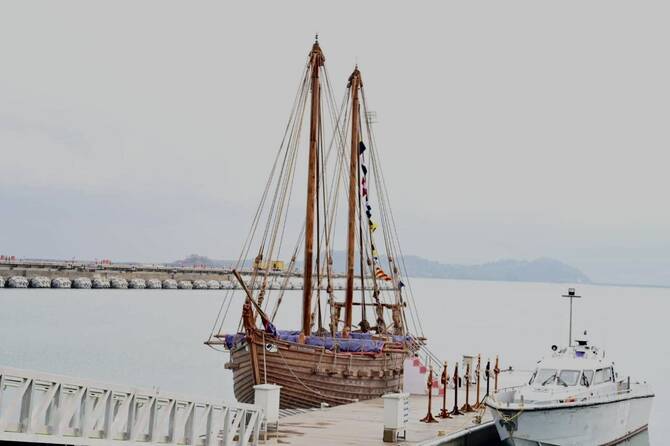
Indian Navy inducts first vessel built in ancient shipbuilding style

The INSV Kaundinya was inducted to the Indian Navy at at the Naval Base Karwar in Karnataka on May 21, 2025. (Indian Navy)
Short Url
Updated 22 May 2025
Follow

Indian Navy inducts first vessel built in ancient shipbuilding style

  • Ship design is based on 5th-century artwork found in Ajanta Caves
  • The ship’s first transoceanic voyage is planned from Gujarat to Oman

New Delhi: The Indian Navy inducted on Wednesday its first vessel constructed using traditional shipbuilding techniques dating back to the 5th century.

The 21-meter wooden ship is a stitched ship, a type of boat that is carvel-built, with its planks stitched together using cords or ropes. The technique was popular in ancient India in constructing ocean-going vessels.

Named Kaundinya, the ship is a recreation of a vessel inspired by a painting from the Ajanta Caves — a UNESCO World Heritage Site in Maharashtra state, where ancient Buddhist rock-cut monuments feature exquisite murals dating from the 2nd century B.C.E. to the 5th century C.E.

“The whole concept was to kind of connect to our ancient methodology of how the construction takes place and also, subsequently, connect to the historical maritime routes which Indian seafarers took during that particular time,” Cdr. Vivek Madhwal, spokesperson of the Indian Navy, told Arab News.

Funded by the Ministry of Culture, the project was launched in July 2023 and constructed by artisans from Kerala, who were led by master Indian shipwright Babu Sankaran. The vessel was completed in February this year.

The INSV Kaundinya’s induction into the Indian Navy took place in the presence of Culture Minister Gajendra Singh Shekhawat at the Naval Base Karwar in Karnataka, on the country’s western coast along the Arabian Sea.

The ship will sail its first transoceanic voyage from Gujarat to Oman.

“That is one of the routes which was used by the ancient seafarers,” Madhwal said, adding that new routes will be considered in the future, after the first journey.

The Indian Navy collaborated with the Department of Ocean Engineering at the Indian Institute of Technology-Madras to conduct model testing of the vessel’s hydrodynamic behavior at sea. The navy has also tested the wooden mast system, which was constructed without the use of contemporary materials.

“Every aspect of the ship had to balance historical authenticity with seaworthiness, leading to design choices that were both innovative and true to the maritime traditions of ancient India,” the Indian Ministry of Defense said in a statement.

“The combination of a stitched hull, square sails, wooden spars, and traditional steering mechanisms makes the vessel unlike any ship currently in naval service anywhere in the world.”


Fragrance artisans weave heritage into Jazan Festival experience

Updated 8 sec ago
Follow

Fragrance artisans weave heritage into Jazan Festival experience

Riyadh: Perfumes are emerging as living connections to ancestral memory at the Jazan Festival 2026, which opened on Friday, the Saudi Press Agency reported.

A narrative rooted in botanical origins is unfolding as veteran craftswomen showcase decades of accumulated wisdom, transforming the contents of native plants into small vessels that distill the human bond with terrain.

Aromas wafting through the space suggest imagery of regional ecosystems — fragrant vegetation cultivated across highland and lowland zones, harvested during optimal periods, then subjected to extended drying and distillation processes before materializing as perfumes and essences embodying geographical character, the Saudi Press Agency reported.

Arranged fragrance containers resemble nature’s output, composed by skilled practitioners versed in harvest timing, plant dormancy requirements and scent extraction methods, yielding products preserving organic integrity and territorial identity.

Craftswoman Fatima bint Mohammed Al-Faifi has dedicated two decades to perfume production, characterizing regional practice as social custom interwoven throughout daily existence — deployed in guest reception, featured at celebrations, accompanying community gathering — elevating scent to cultural signature, the Saudi Press Agency reported.

Festival attendees are discovering aromatic botanicals, absorbing production methodology explanations and discerning nuanced olfactory distinctions, demonstrating how craftsmanship blends persistence with expertise, tradition with innovation.

Perfume artisan involvement aligns with Jazan Festival’s initiative repositioning traditional crafts as dynamic, evolving culture while spotlighting women’s contributions safeguarding regional inheritance and expressing this through modern methods, the Saudi Press Agency reported.