

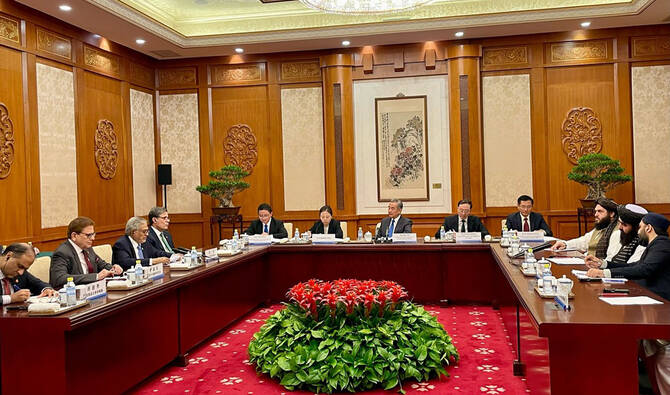

ISLAMABAD: Pakistan and Afghanistan plan to upgrade diplomatic ties and will work to extend the China-Pakistan Economic Corridor (CPEC) into Afghanistan, Beijing said on Wednesday after hosting an informal meeting between Islamabad and the Afghan Taliban administration.
The announcement comes as Pakistani Deputy Prime Minister Ishaq Dar was in China on a three-day visit for trilateral talks with Chinese Foreign Minister Wang Yi and Afghanistan’s Acting Foreign Minister Amir Khan Muttaqi in Beijing.
Islamabad and Kabul had agreed in principle to send ambassadors to each other’s capitals as soon as possible, Wang said after his talks with Muttaqi and Dar.
The two countries “clearly expressed” willingness to upgrade the level of their diplomatic relations, Wang said according to a Chinese foreign ministry statement.
The officials also decided to hold the 6th Trilateral Meeting of Foreign Ministers in Kabul at a mutually agreeable date.
“Pakistan, China and Afghanistan have agreed to deepen cooperation on Belt and Road Initiative (BRI) and extend the China-Pakistan Economic Corridor to Afghanistan,” Radio Pakistan reported after Dar concluded his Beijing visit.
The Belt and Road Initiative, also known as the One Belt One Road or the New Silk Road, is China’s large-scale infrastructure development project aimed at connecting the world through land and sea trade routes. It involves investing in infrastructure like ports, railways, roads, and energy projects in over 150 countries. CPEC is a flagship of the BRI scheme under which China has pledged over $60 billion in infrastructure, energy, industrial, and agricultural projects in Pakistan.
Relations between Pakistan and Afghanistan have plummeted in recent months due to a surge in militant attacks that Islamabad blames on Afghan-based insurgents. Kabul denies it allows its territory to be used against other nations.
In December, the Afghan Taliban said bombardment by Pakistani military aircraft in Afghanistan’s eastern Paktika province had killed at least 46 people, most of whom were children and women.
Pakistan has not confirmed the strikes but said at the time it was carrying out “anti-terrorist operations” against militants with safe havens in Afghanistan, a charge Kabul denied.
In a statement on Wednesday, Pakistan’s foreign office said it “welcomed positive momentum in bilateral ties, including enhanced diplomatic engagement, trade, and transit facilitation.”
Afghanistan’s acting foreign minister “emphasized the importance of political and economic relations with both countries and expressed hope for further progress in these areas in the future.”
Tensions appeared to ease after a rare meeting between Muttaqi and Dar in Kabul last month where the Taliban’s acting foreign minister expressed concern over the deportation of tens of thousands of Afghans from Pakistan. Pakistan has expelled more than 80,000 Afghan nationals since the end of March as part of a renewed surge in a repatriation drive that began in 2023.
Wednesday’s meeting in Beijing signaled a further thaw, with all agreeing to a trilateral foreign ministers’ dialogue in Kabul as soon as possible.
Pakistan and Afghanistan have embassies in each other’s capitals, but they are led by charge d’affaires, not ambassadors. China was the first country to accept an ambassador from the Taliban-run administration in Kabul though it does not formally recognize its government. Several other states, including the UAE, followed.
During the talks, China and Pakistan voiced support for the reconstruction and development of Afghanistan, and are willing to expand trade exchanges with Afghanistan, said Wang.
The meeting also agreed on security cooperation, combating terrorist forces and safeguarding regional peace and stability, he said.
With inputs from Reuters




