

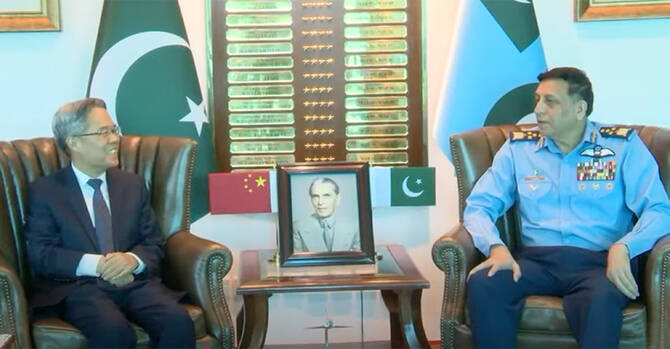

KARACHI: Beijing’s ambassador to Islamabad met the Pakistani air chief on Tuesday evening, with the two leaders vowing to “bolster collective response mechanisms to emerging threats,” the Pakistan army said in a statement, a little over a week after Islamabad’s worst military standoff with New Delhi in decades gave Chinese weapons a rare battle test.
The most striking claim from four days of fighting earlier this month was the contention of the Pakistan Air Force (PAF) that its Chinese-supplied jets had shot down six Indian aircraft — including three French-made Rafale fighters — with some observers seeing this as a symbol of Beijing’s rising military might.
Pakistan accounts for around 63 percent of China’s arms exports, according to Stockholm International Peace Research Institute (SIPRI).
In the recent fighting with India, Pakistan used the J10-C Vigorous Dragon and JF-17 Thunder planes, armed with air-to-air missiles. It was the first time the J10-C has been used in active combat. Islamabad’s air defenses also used Chinese kit — including the HQ-9P long-range surface-to-air missile system — and deployed Chinese radar as well as armed and reconnaissance drones.
On Tuesday evening, Chinese Ambassador to Pakistan, Jiang Zaidong, called on Air Chief Marshal Zaheer Ahmed Baber Sidhu, Chief of the Air Staff, Pakistan Air Force, and engaged in a “comprehensive and in-depth discussion on a range of matters including corporate-level engagements, defense cooperation and the evolving geostrategic environment in the region.”
“They underscored the importance of cohesive & collaborative approaches in responding to emerging challenges, emphasizing the necessity of maintaining peak operational readiness and swift coordination amidst the prevailing regional security dynamics,” the Pakistan army said in a statement released after the meeting.
Sidhu commended China’s role in assisting Pakistan’s defense modernization and technological advancement.
“Both the dignitaries reaffirmed their pledge to institutionalize regular high-level exchanges through expanded joint operational exercises and exploration of multilateral frameworks that bolster collective response mechanisms to emerging threats,” the Pakistan army said.
The statement said the Chinese ambassador lauded the “unmatched operational excellence” demonstrated by PAF personnel during the recent standoff with India, terming it a reflection of PAF’s “high standards and unwavering commitment to national defense.”
“He praised Pakistan Air Force for its exemplary professionalism and commendable utilization of Chinese-origin equipment & technology to thwart enemy aggression,” the Pakistan army said.
“The dignitary also acknowledged PAF’s operational effectiveness and strategic acumen in employing indigenous solutions and advanced systems to safeguard national interests and deter potential threats under the current leadership.”
The ambassador assured “full technical assistance” to PAF to bolster its aerial defense capabilities, adding that continued focus on homegrown technological development would further elevate the country’s defense capabilities.
Nuclear-armed neighbors Pakistan and India halted their worst fighting in nearly three decades after agreeing to a ceasefire on May 10, following diplomacy and pressure from the United States.
On Tuesday, China’s Foreign Minister Wang Yi sad Beijing welcomed and supported efforts by Pakistan and India to handle their differences through dialogue and to achieve a “comprehensive and lasting” ceasefire.
With inputs from AFP and Reuters


