National Water Co. completes $106m in upgrades ahead of Hajj

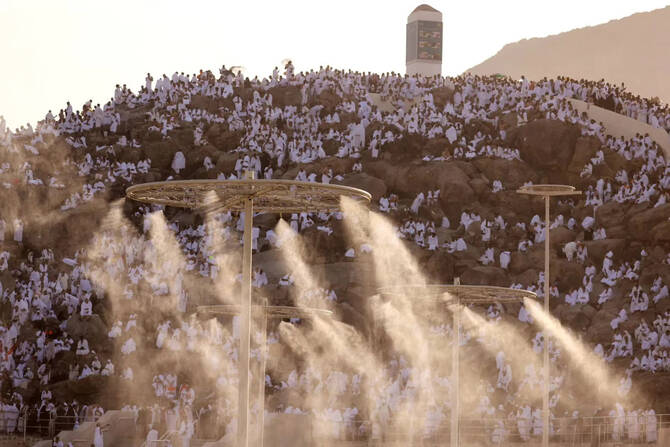
National Water Co. projects are part of efforts to refine water and environmental services for millions of pilgrims expected during Hajj. (Supplied)
Short Url
Updated 20 May 2025
Follow

National Water Co. completes $106m in upgrades ahead of Hajj

  • Upgrades will boost operational efficiency, expand network coverage and enhance real-time monitoring capabilities

JEDDAH: The National Water Co., through its Western Cluster, has completed 18 infrastructure and operational projects ahead of the Hajj season in Makkah and the holy sites, valued at SR400 million ($106 million).

The projects are part of efforts to refine water and environmental services for residents, visitors and the millions of pilgrims expected during Hajj.

Upgrades will boost operational efficiency, expand network coverage and enhance real-time monitoring capabilities.

Capital works include the construction of a 190,000-cubic meter steel water tank along with the development and rehabilitation of water storage facilities, main pipelines, valve rooms and distribution networks.

These efforts are designed to support supply sustainability and reliability, particularly during peak pilgrimage hours.

Operational upgrades include the installation of advanced monitoring systems such as pressure gauges, meters and network sensors. Pumps and isolation valves across water, wastewater, fire and cooling systems have also been modernized to boost performance.

More than 1,200 technical, engineering and administrative staff have been assigned to oversee operations and maintain uninterrupted service during the Hajj season. The company said it will provide round-the-clock water supply to the Prophet’s Mosque and key religious and historical sites in Madinah.

To safeguard water quality, all storage units and connections to pilgrim accommodation are subject to testing. Monitoring is conducted through teams at central and mobile laboratories, which can analyze more than 1,000 water samples per day.

Water flow in Madinah’s central area will be managed using a smart operation system connected to the Supervisory Control and Data Acquisition monitoring and control room, allowing real-time oversight throughout the Hajj season.


Saudi Arabia has told Iran not to attack it, warns of possible retaliation, sources say

Updated 08 March 2026
Follow

Saudi Arabia has told Iran not to attack it, warns of possible retaliation, sources say

Saudi Arabia has told Tehran that while it favors a diplomatic settlement to Iran’s conflict with the United States, continued attacks on the kingdom and ​its energy sector could push Riyadh to respond in kind, four sources familiar with the matter told Reuters.

The message was conveyed before a speech on ‌Saturday in which Iranian President Masoud Pezeshkian apologized to neighboring Gulf states for Tehran’s actions – an apparent attempt to defuse regional anger over Iranian strikes that hit civilian targets.

Two days earlier, Saudi Foreign Minister Prince Faisal bin Farhan spoke to Iranian Foreign Minister Abbas Araghchi and set out Riyadh’s position with clarity, the sources said.

Saudi Arabia is open to any form of mediation aimed at de‑escalation and a negotiated settlement, the sources quoted ​the minister as saying, underlining that neither Riyadh nor other Gulf states had let the US use their airspace or territory to launch airstrikes on Iran.

But Prince ​Faisal was also quoted by the sources as saying that if Iranian attacks persisted against Saudi territory or energy infrastructure, Saudi Arabia would ⁠be forced to permit US forces to use their bases there for military operations. Riyadh would retaliate if attacks on the kingdom’s critical energy facilities continued, he said.

The sources said ​the kingdom had remained in regular contact with Tehran through its ambassador since the US and Israeli military campaign against Iran began on February 28 following the collapse of talks on ​Iran’s nuclear program.

The Saudi and Iranian foreign ministries did not respond to requests for comment.

Drone and missile attacks on Gulf states

The United Arab Emirates, Kuwait, Qatar, Bahrain and Saudi Arabia have all come under heavy drone and missile fire from Iran over the past week.

Iran’s Supreme Leader, Ayatollah Ali Khamenei, was killed on the first day of the war. Tehran responded by hitting Israel and Gulf Arab states hosting US military installations, ​and Israel has attacked Lebanon’s Iran-backed Hezbollah armed group.

Araghchi said in an interview on Saturday that he remained in constant contact with his Saudi counterpart and other Saudi officials, adding ​that Riyadh had assured Tehran it was fully committed to not allowing its territory, waters or airspace to be used for attacks against Iran.

Pezeshkian said Iran’s temporary leadership council had approved suspending attacks on ‌nearby countries – unless ⁠an attack on Iran came from those nations.

“I personally apologize to neighboring countries that were affected by Iran’s actions,” he said.

To what extent Pezeshkian’s remarks signal a change is unclear. There were further reports of strikes directed at Gulf states on Saturday.

Also, in a sign of possible divisions within Iran’s leadership, Khatam Al-Anbiya Central Headquarters – the unified combatant command of the Iranian armed forces – said in a statement afterwards that US and Israeli bases and interests across the region would remain targets.

The command said Iran’s armed forces respected the sovereignty and interests of ​neighboring states and had not taken action against ​them so far. But it said US ⁠and Israeli military bases and assets on land, at sea and in the air across the region would be treated as primary targets and face “powerful and heavy” strikes by Iran’s forces.

US President Donald Trump said in a social media post that Iran had “apologized and surrendered to its Middle ​East neighbors, and promised that it will not shoot at them anymore. This promise was only made because of the relentless US ​and Israeli attack.”

Two Iranian ⁠sources confirmed that a call had taken place in which Riyadh warned Tehran to halt attacks on Saudi Arabia and neighboring Gulf states. Iran, they said, reiterated its position that the strikes were not aimed at Gulf countries themselves but at US interests and military bases hosted on their territory.

One Iranian source said that Tehran had in response demanded that US bases in the region be ⁠closed and ​some Gulf states stop sharing intelligence with Washington that Iran believes is being used to carry out attacks against it.

Another ​Iranian source said some military commanders were pressing to continue the strikes, accusing the US of using bases in Gulf states and these countries’ airspace to conduct operations against Iran.

Iran had in recent years mended fences with its ​Gulf neighbors, including former regional archrival Saudi Arabia. The diplomatic campaign imploded in the blitz of drones and missiles launched by Iran’s Revolutionary Guards in the past week.