

British pilgrims sailing from London to Saudi Arabia for Hajj

1 / 5
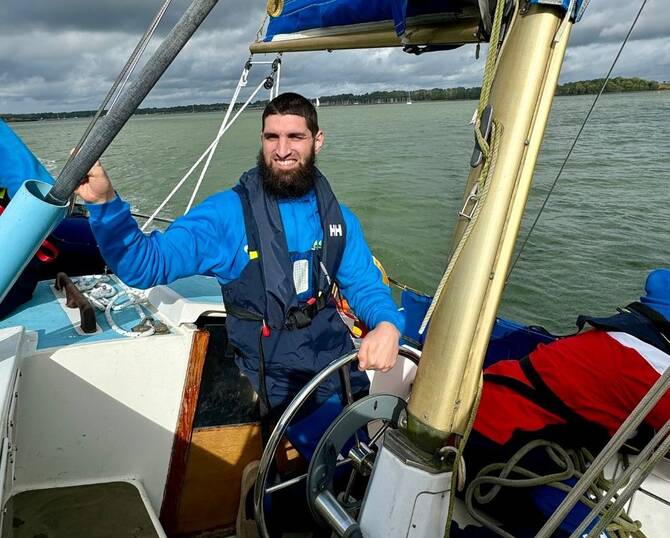
A group of British adventurers are taking part in an extraordinary sailboat journey from the UK to Makkah to perform Hajj. (Supplied)
2 / 5
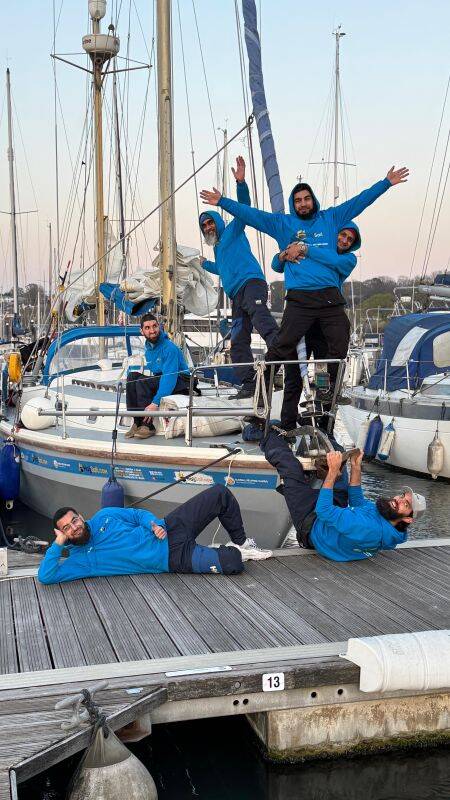
A group of British adventurers are taking part in an extraordinary sailboat journey from the UK to Makkah to perform Hajj. (Supplied)
3 / 5
A group of British adventurers are taking part in an extraordinary sailboat journey from the UK to Makkah to perform Hajj. (Supplied)
4 / 5
A group of British adventurers are taking part in an extraordinary sailboat journey from the UK to Makkah to perform Hajj. (Supplied)
5 / 5
A group of British adventurers are taking part in an extraordinary sailboat journey from the UK to Makkah to perform Hajj. (Supplied)
Short Url
Updated 20 May 2025
Follow

British pilgrims sailing from London to Saudi Arabia for Hajj

  • Group of five had no sailing experience before training for 7,400 km journey
  • Pilgrimage has overcome challenges including a leak in the boat, and has raised thousands for charity

JEDDAH: A group of British adventurers are taking part in an extraordinary sailboat journey from the UK to Makkah to perform Hajj.

The group of five from London, aged between 27 and 47, set off on the inspiring 7,400 km adventure from the English Channel on April 1 and expect to reach Saudi Arabia later this week.

Sailors Abdul Wahid, Tauseef Ahmed, Jody McIntyre, Dobbir Uddin and Taher Akhtar have made several stops across Europe and North Africa, sharing the highs and lows of sea life with their growing community of followers on social media.

Experiencing moments of faith, joy and frustration, and facing winds and storms in their sails, the 55-day adventure is also raising funds for orphan care charity Global Helping Hands.

The group recently docked in Ismailia city in northeastern Egypt, and plan on making their way to towards the sacred lands of Saudi Arabia later this week.

Speaking to Arab News from Ismailia, 38-year-old Wahid said the inspiration for the journey came from the mixed influences of his Muslim faith and the maritime history of the UK.

“It is kind of merging our religion Islam with the country we are residing, and reviving this long-forgotten way to Hajj,” he said.

According to Wahid, none of the group’s members had sailing experience before the trip.

“We undertook this journey with no prior experience, therefore, we went through a very intensive training for 6 months,” he said.

“We had to go into the sea for a week in order to get the training we needed and we managed to get to a very completive level internationally.”

The adventure route led the group to go through the English Channel; the Port of Marseille in France; the Mediterranean islands Corsica, Sardinia, Sicily and Crete; the Strait of Messina; the Suez Canal in Egypt and finally the Red Sea leading to Jeddah.

The group has spent almost two months being completely disconnected, off-grid and facing storms on the 1978 Westerly 33 Ketch.

“One of the weirdest highlights is the fact that we are here in the sea because we dreamed of a journey at sea — and made it a reality,” said Wahid.

“Imagine, this time last year we had no sailing experience just a rough plan and here we are about to end our journey.”

He added: “It was terrifying challenge for us but at the end of the day, alhamdulillah, we had a great reward and we are safe.”

Ahmed said: “One of the challenges we faced was in the French Canal where there was a blockage of 24 km and we had to lift the boat to the truck despite our delay which took about four days.”

He added: “Another serious challenge we faced, when we woke up in the morning and we were sinking because of a leak in the boat. Alhamdulillah, we were able to fix it and went on as per our schedule.”

Surrounded by blue water, picturesque scenes, and the sporadic sight of marine life, Wahid described the most unforgettable moments of their journey: “We encountered dolphins three times during our journey. 

“We caught a glimpse of unusual shapes in the water. Soon, we realized that what we were seeing was a small pod of dolphins, playing and swimming in front of us. That was really an amazing scene.”

Through the journey, the group aims to raise funds to support orphans in various countries, including Lebanon, Pakistan, Palestine, Uganda, and for Syrian refugees, offering much-needed assistance to the most vulnerable.

The group has received more than £200,000 ($266,000) so far.

“This amount will support orphans in many places,” Wahid said. “The second goal of this journey is for Da’wah purposes.

“We want to showcase to the world the beauty of pilgrimage in Islam in its original essence, in ancient ways it was performed weather it was walking, horse-riding or in this case sailing.”

The expedition is set to complete its final sea passage, lasting up to a week, from Port Suez, Egypt to Jeddah in coordination with BWA Yachting Club KSA, the Red Sea Authority and with the support of JYC facilities.


Is sourdough Saudi Arabia’s latest craft food?

Updated 07 February 2026
Follow

Is sourdough Saudi Arabia’s latest craft food?

  • Saudi home bakers point to a practice that was once routine, not artisanal
  • Naturally fermented bread reflects a broader shift toward process-driven, premium food culture

ALKHOBAR: Sourdough has started to shift from a niche interest into a mainstream feature of home kitchens, cafes and specialty bakeries across the Kingdom.

The rise of sourdough is part of a wider shift in Saudi Arabia’s food landscape, where artisanal production and slower preparation methods are gaining traction.

Specialty coffee seems to have set the early template for this transition, normalizing premium pricing, craftsmanship and an interest in process.

The rise of sourdough is part of a wider shift in Saudi Arabia’s food landscape, where artisanal production and slower preparation methods are gaining traction. (Supplied/creativecommons)

Bread is now undergoing a similar shift, with fermentation replacing extraction and roasting as the central point of differentiation.

In both cases, the appeal is rooted in the product’s perceived authenticity, reduced additives, and a clearer link between raw ingredients and final consumption.

Home bakers in Riyadh, Jeddah and the Eastern Province have adapted natural yeast cultures to the Saudi environment, adjusting feeding schedules, hydration ratios, and fermentation times to accommodate higher temperatures and lower humidity in the summer months.

HIGHLIGHTS

• Home bakers in Riyadh, Jeddah and the Eastern Province have adapted natural yeast cultures to the Saudi environment.

• They adjust feeding schedules, hydration ratios, and fermentation times to accommodate higher temperatures and lower humidity in the summer months.

Cafes and specialty bakeries have responded by adding sourdough loaves, baguettes and focaccia to their menus, often positioned as premium alternatives to conventional commercial bread.

For younger home bakers, the appeal lies in the craft and the learning curve rather than nostalgia. “It feels more real and more intentional,” home baker Sarah Al-Almaei told Arab News. She began experimenting with natural yeast at home after watching starter tutorials online.

The technical aspect — hydration percentages, fermentation control and starter maintenance — has become content in its own right, with TikTok and Instagram compressing trial-and-error learning into short videos and recipe cards.

But the practice of maintaining a natural yeast culture is not new in Saudi Arabia. Long before sourdough became a global trend, Saudi households kept what was commonly referred to as the “mother dough,” a natural yeast starter fed and used daily.

“We used to maintain it every day and bake with it,” said Hessa Al-Otaibi, 56, a Saudi home baker with more than four decades’ experience. “People today call it sourdough. For us, it was simply bread.”

Her comment highlights a cultural continuity that has remained largely unrecognized, partly because the practice was not framed as artisanal or health-oriented, but as a routine household function.

The modern sourdough trend differs in its market positioning. While the older model was practical and domestic, the current model is commercial, aesthetic and often health-coded. Bakeries justify higher pricing through longer fermentation times, higher ingredient costs and smaller batch production.

Consumers justify their purchases through digestibility, perceived health benefits, flavor and product integrity.

“Once you get used to it, it’s hard to go back,” said Amina Al-Zahrani, a regular buyer of sourdough from specialty bakeries in Alkhobar.

Digestibility and texture are often cited as reasons for substitution, especially among buyers who report discomfort from standard commercial bread.

Another consumer, Majda Al-Ansari, says sourdough has become part of her weekly routine, noting that availability and quality have improved significantly in the past year.

The social media component has played an outsized role in accelerating adoption. Home bakers document starter feeding cycles, cold proofing and first bakes, turning a once-private domestic process into visible public content.

This has also created micro-markets of home-based sellers, where individual bakers offer loaves to local buyers, often fulfilling orders through direct messaging.

What remains to be seen is how far the trend will scale. If specialty bakeries continue to expand and consumers maintain willingness to pay premium prices, sourdough could establish a long-term place in Saudi food culture.

If not, it may revert to a smaller niche of committed home bakers and specialty cafes. For now, however, sourdough occupies an unusual position: both a newly fashionable trend and a quiet continuation of an older Saudi baking practice.