


BEIRUT: The Lebanese government still faces one final — and perhaps the most security sensitive — electoral challenge: the elections in the South and Nabatieh governorates.
These elections, scheduled for their fourth phase this coming Saturday, will be held during ongoing Israeli incursions south and north of the Litani River.
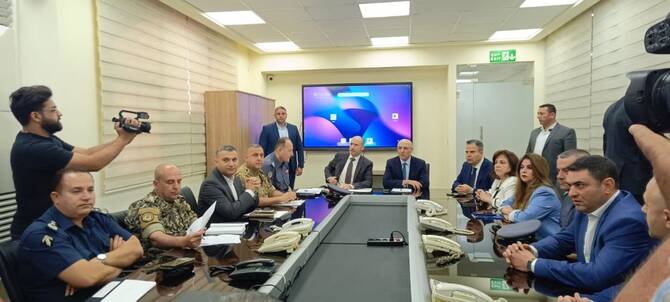
Interior Minister Ahmad Hajjar, in the southern city of Sidon on Tuesday, affirmed that “the government is mindful of the potential for Israeli violations and assaults during the municipal elections scheduled for Saturday. However, the decision remains clear and resolute regarding the continuation of the electoral process regardless of the circumstances.”
The minister emphasized to Mansour Daou, the governor of South Lebanon, and representatives of the security, military, and judicial agencies in the South, “the state’s commitment to ensuring that the elections are conducted with integrity and safety,” underscoring their significance as part of the reconstruction process for the people of the South.
In the lead-up to the elections, an Israeli military drone targeted a motorcycle on the road between Mansouri and Majdalzoun in the Tyre district, resulting in reports from the Ministry of Health indicating that “nine individuals were injured, including two children, with three of the injured in critical condition.”
Another Israeli drone launched a bomb at fishermen off the coast of Ras Al-Naqoura.
Attention in the south is focused on two issues: observing the extent to which people will participate in the elections, particularly those whose homes were destroyed and displaced to other villages; and monitoring Hezbollah’s ability to maintain its popularity in the south, where the devastation and rubble are still visible to the public. To date, no reconstruction has occurred in any facilities either north or south of the Litani River, because Israel has turned the border area into a devastated and desolate zone, maintaining its occupation of five strategic hills and daily thwarting any attempts to establish readymade rooms for logistical purposes to assist the affected population.
The latest data from the Lebanese Ministry of Health, as of May 12, indicates that since the ceasefire between Israel and Hezbollah took effect on Nov. 27, “Israel has killed 156 individuals and injured 376 others, with a total of 3,138 air and maritime violations recorded.”
According to the Israeli army, “by the end of April, around 140 Hezbollah members had been eliminated, with the vast majority of assassinations (more than 50 percent) taking place south of the Litani River. Assassinations north of the Litani River and in the Bekaa region accounted for 48 percent of the operations; 33.3 percent north of the Litani River and 14.7 percent in the Bekaa.”
The Israeli army claimed that “the majority of the assassinated members belonged to Hezbollah’s Aziz, Nasr and Badr units.” In a new study, the Israeli Alma Center stated: “Those individuals were involved in the rehabilitation of infrastructure on the ground.”


