

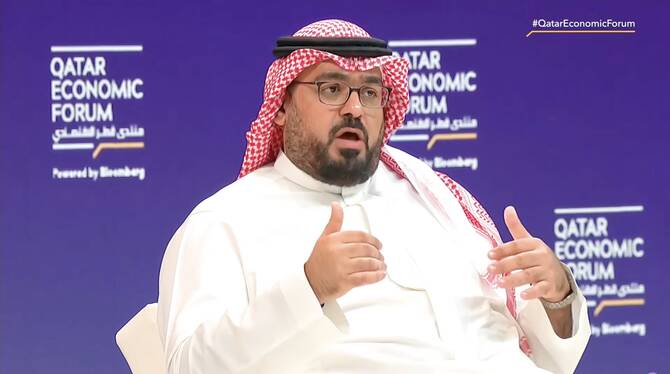

RIYADH: Saudi Arabia is well-prepared to handle fluctuations in global oil prices, thanks to its strong fiscal planning frameworks, according to the Kingdom’s Minister of Economy and Planning, Faisal Alibrahim.
Speaking at the Qatar Economic Forum during a panel discussion titled “The Geoeconomics of Growth: Finance & Economy Minister Outlook,” Alibrahim said Saudi Arabia has built resilient economic structures designed to adapt to multiple oil price scenarios.
The comments come as oil-producing nations continue to navigate price volatility amid shifting global demand and energy transition efforts.
“We’re always ready for scenarios, multiple scenarios, and we have the buffers. We have the long-term fiscal planning and medium-term frameworks that help us adjust depending on what scenario actually plays out,” the minister said.
The world’s largest oil exporter is accelerating its economic diversification under the Vision 2030 reform agenda. Non-oil exports surged to a record $137 billion in 2024 — a 113 percent increase since the initiative was launched in 2016.
According to data from the Ministry of Finance, non-oil revenues accounted for 43.1 percent of total government income in the first quarter of 2025, representing a 2.06 percent increase compared to the same period last year.
Alibrahim noted that the Saudi budgets are no longer driven by oil. “Today, they’re driven by our priorities,” he added. “On the energy markets and oil, we’ve always been solving for long-term market stability that guarantees that investments will continue to flow to provide the right kind of supply that the global economy needs, and of course, as part of that is OPEC+ discipline.”
The minister noted that Gulf Cooperation Council countries, including Saudi Arabia, are prioritizing long-term growth over short-term gains. “We’re always thinking about not the next 12 months, but a longer-term horizon, and that’s what most of the GCC countries are doing as well,” he added.
Alibrahim also underscored Saudi Arabia’s commitment to Vision 2030 and beyond, stating that Gulf nations are undergoing similar transformations. “What we’re undertaking in Vision 2030 and beyond Vision 2030 is a long-term, big-picture plan that is all about restructuring the Saudi economy,” he said.
Highlighting the region’s economic progress, the minister pointed out that non-oil economies in the GCC grew by 3.7 percent in 2024 — nearly double the global growth rate. “There’s an acknowledgement that we’ve been for a while operating below our potential,” he said, emphasizing the increasing opportunities from economic restructuring.
On foreign investment, Alibrahim described it as a “long-term game,” with Saudi Arabia targeting FDI inflows worth 5.7 percent of the gross domestic product by 2030. The Kingdom has implemented over 900 reforms to improve its business environment, he noted.
Alibrahim also referenced recent geopolitical developments, including US President Donald Trump’s recent visit to Riyadh — part of a broader push for regional dialogue.
“We saw President Trump in Riyadh last week. We saw the result of dialogue, what it led to, including lifting the sanctions on Syria,” he said, signaling growing momentum for economic reintegration.
On May 13, Trump began his four-day trip to the Middle East, his first major international visit of his second term. His first stop was Saudi Arabia, where he secured a $600 billion investment commitment from the Kingdom. During his speech at the Saudi-US Investment Forum, Trump announced the lifting of US sanctions on Syria following talks with Crown Prince Mohammed bin Salman.
The discussion shifted to Syria’s role in regional stability, with Turkish Finance Minister Mehmet Simsek stating: “Having a stable, peaceful, and prospering Syria on its own is a huge gain for the region.” Qatar’s Finance Minister Ali bin Ahmed Al-Kuwari echoed this sentiment, emphasizing the importance of Syria’s economic recovery for regional prosperity.
Aibrahim also addressed Saudi Arabia’s international engagements, including recent diplomatic efforts with the US and China, stressing the need for stronger global economic ties. “It’s in the interest of both (the US and China) that we remain strong partners,” he said.


