

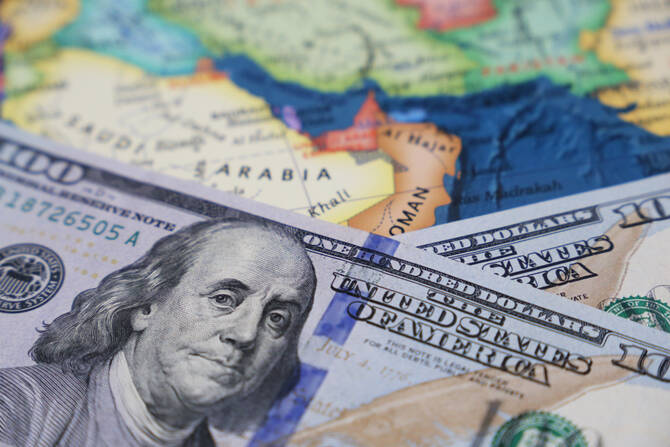
Foreign investment in Saudi capital market reaches $58bn amid global ranking gains  

The rise reflects sustained global interest in the Kingdom’s financial markets. Shutterstock
Short Url
Updated 20 May 2025
Follow

Foreign investment in Saudi capital market reaches $58bn amid global ranking gains  

  • Total foreign ownership in the main market reached SR423 billion
  • Kingdom earned international recognition for its capital market performance and reform agenda

RIYADH: Net foreign investments in Saudi Arabia’s capital market rose to SR218 billion ($58.1 billion) in 2024, a 10.1 percent increase over the prior year, highlighting sustained international interest in the Kingdom’s financial system.   

Total foreign ownership in the main market reached SR423 billion, accounting for 11 percent of total free float shares, according to the Capital Market Authority’s annual report.  

The rise reflects sustained global interest in the Kingdom’s financial markets, which have benefited from a series of regulatory reforms and broader efforts to increase market transparency and accessibility.

As part of Vision 2030, Saudi Arabia is working to diversify its economy and position itself as a regional financial hub, with capital market development seen as a key pillar in that strategy. 

The Kingdom also earned international recognition for its capital market performance and reform agenda.   

In the 2024 World Competitiveness Yearbook issued by the International Institute for Management Development, Saudi Arabia ranked first among G20 nations in four capital market indicators. 

“The Kingdom ranked first in the Capital Market Index, Stock Market Capitalization Index, Shareholders’ Rights Index, and Venture Capital Index. Overall, Saudi Arabia saw improvements in 8 out of the 12 capital market related indicators included in the report,” the report stated. 

One of the 13 Vision Realization Programs under Saudi Arabia’s Vision 2030 is the Financial Sector Development Program, which aims to deepen and enhance the financial industry.  

The program focuses on making the sector more open, transparent, and appealing to both domestic and international investors, directly supporting efforts to increase foreign participation in the Kingdom’s capital markets.  

CMA Chairman Mohammed El-Kuwaiz said the report reflects the significant transformation underway in the capital market and emphasized its strengthened global position.   

He noted that the strategic plan for 2024–2026 is aimed at deepening the market, enhancing liquidity, broadening the investor base, and improving competitiveness — all of which support the goals of Saudi Vision 2030. 


Industry leaders highlight Riyadh’s Metro, infrastructure as investment catalysts

Updated 29 December 2025
Follow

Industry leaders highlight Riyadh’s Metro, infrastructure as investment catalysts

RIYADH: Saudi Arabia’s capital, Riyadh, is experiencing a transformative phase in its real estate sector, with the construction market projected to reach approximately $100 billion in 2025, accompanied by an anticipated annual growth rate of 5.4 percent through 2029.

The Kingdom is simultaneously advancing its data center capacity at an accelerated pace, with an impressive 2.7 GW currently in the pipeline. This expansion underscores the critical role of strategic land and power planning in establishing national infrastructure as a cornerstone of economic growth.

These insights were shared by leading industry experts during JLL’s recent client event in Riyadh, which focused on the city’s macroeconomic landscape and emerging trends across office, residential, retail, hospitality, and pioneering sectors, including AI infrastructure and Transit-Oriented Development.

Saud Al-Sulaimani, Country Lead and Head of Capital Markets at JLL Saudi Arabia, commented: “Riyadh is positioned at the forefront of Saudi Arabia’s Vision 2030, offering unparalleled opportunities for both investors and developers. National priorities are continuously recalibrated to ensure strategic alignment of projects and foster deeper collaboration with the private sector.”

He added: “Recent regulatory developments, including the introduction of the White Land Tax and the rent freeze, are designed to stabilize the market and are expected to drive renewed focus on delivering premium-quality assets. This dynamic environment, coupled with evolving construction cost considerations in select segments, is fundamentally reshaping the market landscape while accelerating progress toward our national objectives.”

The event further underscored the transformative impact of infrastructure initiatives. Mireille Azzam Vidjen, Head of Consulting for the Middle East and Africa at JLL, highlighted Riyadh’s transit revolution. She detailed the Riyadh Metro, a $22.5 billion investment encompassing 176 kilometers, six lines, and 84 stations, providing extensive geographic coverage, with a depth of 9.8 km per 100 sq. km. This strategic development generates significant TOD opportunities, with properties in proximity potentially commanding a 20-30 percent premium. JLL emphasized the importance of implementing climate-responsive last-mile solutions to enhance mobility and accessibility, particularly given Riyadh’s extreme temperatures.

Gaurav Mathur, Head of Data Centers at JLL, emphasized the rapid expansion of the Kingdom’s AI infrastructure, signaling a critical area for technological investment and innovation.

Focusing on the construction sector, Maroun Deeb, Head of Projects and Development Services, KSA at JLL, explained that the industry is actively navigating complexities such as skilled labor availability, material costs, and supply chain dynamics.

He highlighted the adoption of Building Information Modeling as a key driver for enhancing operational efficiency and project delivery.