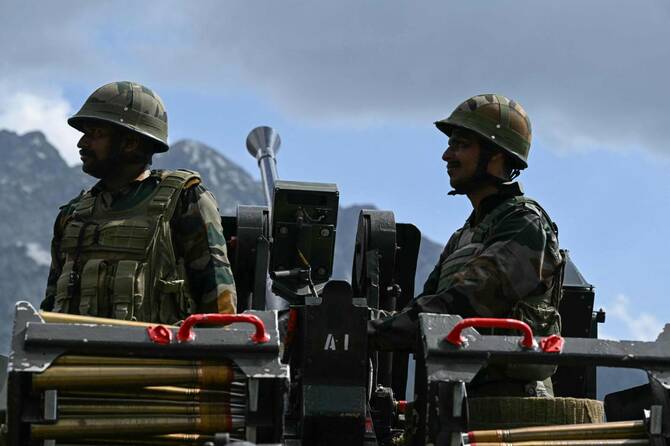
ISLAMABAD: Pakistan and India have agreed to withdraw troop reinforcements deployed during their recent conflict back to their peacetime positions by the end of May, a senior Pakistani security official told AFP on Tuesday.
More than 70 people were killed in the four-day conflict, which was sparked by an attack on tourists by gunmen in Indian-administered Kashmir last month that New Delhi accused Islamabad of backing -- a charge it denies.
The military confrontation involving intense tit-for-tat drone, missile, aerial combat and artillery exchanges came to an abrupt end after US President Donald Trump announced a surprise ceasefire, which is still holding.
"Troops will be withdrawn to pre-conflict positions by the end of May," the senior security official told AFP on condition of anonymity as he was not authorised to speak to the media.
The official said both countries agreed a phased withdrawal of the additional troops and weaponry deployed, mostly on the already heavily militarised de facto border in Kashmir, known as the Line of Control (LoC).
It comes after the Indian army last week said both sides agreed to take "immediate measures to ensure troop reduction from the borders and forward areas".
"All of these steps were initially planned to be completed within 10 days, but minor issues caused delays," the Pakistani official added.
Kashmir is claimed in full by both India and Pakistan, which have fought several wars over Muslim majority region since their 1947 independence from British rule.
The latest conflict began on May 7 when India launched strikes against what it said were "terrorist camps" in Pakistan, triggering an immediate response from Islamabad.


Pakistan, India agree to withdraw troops by end May
https://arab.news/gza8r
Pakistan, India agree to withdraw troops by end May

- More than 70 people were killed in the four-day conflict
- The military confrontation involving intense tit-for-tat drone, missile, aerial combat and artillery exchanges


IAEA board meets over Ukraine nuclear safety concerns
- The war in Ukraine “continues to pose the world’s biggest threat to nuclear safety,” Grossi said
- The mission will assess 10 substations “crucial to nuclear safety,” according to Grossi
VIENNA: The UN nuclear watchdog’s board of governors on Friday discussed nuclear safety in Ukraine, with several countries expressing “growing concern” following Russian attacks on the power grid.
Energy supplies to Ukraine’s nuclear plants have been affected as Russia has pounded its neighbor’s power sector since the start of its 2022 invasion, prompting fears of a nuclear disaster.
The war in Ukraine “continues to pose the world’s biggest threat to nuclear safety,” Rafael Grossi, director general of the International Atomic Energy Agency (IAEA), said when opening the board meeting.
The extraordinary meeting that lasted four hours was called after 13 countries led by the Netherlands expressed in a letter seen by AFP a “growing concern about the severity and urgency of nuclear safety risks” following a series of attacks.
Ukrainian ambassador Yurii Vitrenko told reporters before the meeting that it was “high time” for the IAEA board to discuss the situation.
A weeks-long IAEA expert mission to Ukrainian substations and power plants is under way and expected to wrap up next month, Vitrenko said.
The mission will assess 10 substations “crucial to nuclear safety,” according to Grossi.
Russian Ambassador Mikhail Ulyanov dismissed the board’s gathering as “absolutely politically motivated,” adding there was “no real need to hold such a meeting today.”
Last week, Ukraine’s Chernobyl nuclear power plant temporarily lost all off-site power.
Europe’s biggest nuclear power plant, Zaporizhzhia, occupied by Russian forces since March 2022, has also been repeatedly affected by fighting.
Earlier this month, Russia and Ukraine agreed to a localized ceasefire to allow repairs on the last remaining backup power line supplying Zaporizhzhia.
The line was damaged and disconnected as a result of military activity in early January.
The Zaporizhzhia plant’s six reactors have been shut down since the occupation. But the site still needs electricity to maintain its cooling and security systems.
Moscow and Kyiv have repeatedly accused each other of risking a nuclear catastrophe by attacking the site.


