Israel’s Elbit Systems posts profit jump on Gaza war, rising defense budgets

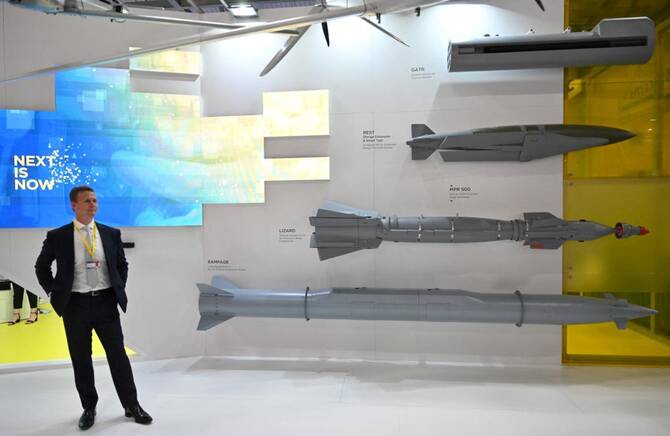
Models of long-range missiles are pictured at the Elbit systems display stand at the Farnborough Airshow, in Farnborough, on July 19, 2022. (AFP)
Short Url
Updated 20 May 2025
Follow

Israel’s Elbit Systems posts profit jump on Gaza war, rising defense budgets

  • More than 32 percent of Elbit’s revenue came from Israel, where the country has been fighting Hamas

TEL AVIV: Israel’s largest defense firm Elbit Systems reported higher first-quarter profit on Tuesday, boosted by sales to Israel’s military during its war against Palestinian militant group Hamas in Gaza and as global defense spending rises.
Elbit said it earned $2.57 per diluted share excluding one-time items in the first quarter of 2025, up from $1.81 a year earlier.
The results were boosted by a 20 percent increase in aerospace sales, largely of precision guided munitions from which revenue rose 22 percent to $1.9 billion.
More than 32 percent of Elbit’s revenue came from Israel, where the country has been fighting Hamas since October 7, 2023. The company has supplied munitions, drones, guided rocket systems, reconnaissance capabilities and other systems.
As numerous global conflicts boosted national defense budgets, Elbit’s backlog of orders reached $23.1 billion. Some 66 percent of the backlog is from outside Israel, while 51 percent of the orders are scheduled to be fulfilled during 2025 and 2026.
“Elbit is well positioned to capture and benefit from the opportunities of increasing defense budgets globally and particularly in Europe,” said CEO Bezhalel Machlis. “We are continuing to invest in increasing our production capacity and optimizing our supply chains in order to address our backlog and the high demand for our products.”
Elbit said it would pay a quarterly dividend of 60 cents a share, the same as in the fourth quarter.


Gaza families struggle to recover from days of torrential rains that killed 12 people

Updated 7 sec ago
Follow

Gaza families struggle to recover from days of torrential rains that killed 12 people

  • The downpour, which dumped more than 150 milliliters (9 inches) of rain on some parts of Gaza over the past week, turned dirt lanes to mud and flooded tents in camps for displaced people

DEIR AL-BALAH, Gaza Strip: Palestinians in Gaza struggled to recover Tuesday from torrential rains that battered the enclave for days, flooding camps for the displaced, collapsing buildings already badly damaged in the two-year war and leaving at least 12 dead, including a two-week-old baby.
The downpour, which dumped more than 150 milliliters (9 inches) of rain on some parts of Gaza over the past week, turned dirt lanes to mud and flooded tents in camps for displaced people.
The Gaza Health Ministry, part of the Hamas-run government, said Tuesday the two-week-old died of hypothermia as a result of the weather. The baby was brought to the hospital a few days ago and was transferred to intensive care but died on Monday.
In Gaza City, a man died Tuesday after a home already damaged during Israeli strikes, collapsed because of the heavy rainfall, according to Shifa Hospital.
Members of the Al-Hosari family said 30 people lived in the building, but just nine were home when it collapsed. The man who was killed was a worker who had come to fix the walls, they said. Five people were injured.
The Health Ministry said the remaining 10 people were killed last week, also from buildings collapsing from the rain and heavy winds.
Emergency workers warned people not to congregate in damaged buildings due to concerns of collapse, though so much of the territory has been reduced to rubble, there are few places to escape the rain. In July, the United Nations Satellite Center estimated that almost 80 percent of the buildings in Gaza have been destroyed or damaged.
“When we hear the news that there is a storm, our whole lives change, we start thinking about where to stay, to go, where to put our mattresses and blankets, and where to keep our children safe and warm,” said Mohammed Gharableh, a father displaced from the southern city of Rafah.
“During every storm like this, water penetrates our tents, and our mattresses and blankets get soaked,” he added.
In Israel, areas near Gaza received between 60 mm to 160 mm (2 to 6 inches) of rain in the past week, according to the Israel Meteorological Service, which in some cases is more than twice the average amount of rain for this time of year.
Aid groups say despite two months of a ceasefire, not enough shelter material has been getting into Gaza to help Palestinians deal with the winter. Recently released Israeli military figures suggest it hasn’t met the ceasefire stipulation of allowing 600 trucks of aid into Gaza a day, though Israel disputes that finding.
The vast majority of Gaza’s 2 million people have been displaced, and most people live in vast tent camps stretching along the coast, or set up among the shells of damaged buildings. The buildings lack adequate flooding infrastructure and people use cesspits dug near tents as toilets.
The Israeli military body in charge of coordinating aid to Gaza, called COGAT, said close to 270,000 tents and tarps have entered Gaza over the past few months as well as winter items, shelter equipment, and sanitation supplies.
But some aid groups disputed the figures and said more supplies, especially winter items, are desperately needed.
Shelter Cluster, an international coalition of aid providers led by the Norwegian Refugee Council, last week said it has tracked just 68,000 tents that have entered Gaza via the UN, non-governmental organizations, and various countries. Many of the tents aren’t properly insulated for winter, it says.