Hungarian lawmakers approve bill to quit International Criminal Court

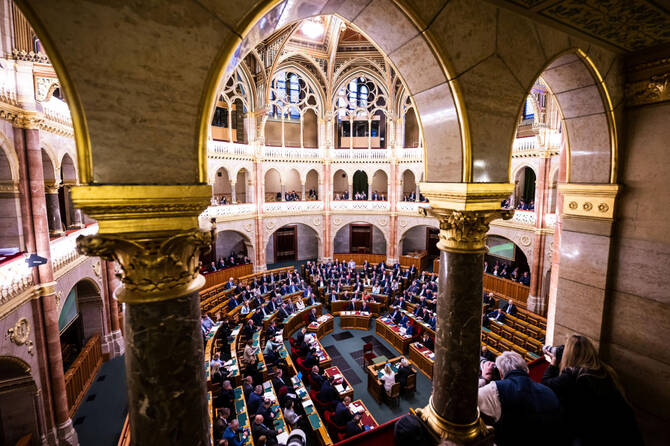
A general view of the Hungarian parliament as it votes to start the withdrawal process from the International Criminal Court (ICC) in Budapest, Hungary, May 20, 2025. (REUTERS)
Short Url
Updated 20 May 2025
Follow

Hungarian lawmakers approve bill to quit International Criminal Court

  • The government announced the move after Benjamin Netanyahu arrived in Hungary in defiance of an ICC arrest warrant

Hungary’s parliament approved a bill on Tuesday that will start the country’s year-long withdrawal process from the International Criminal Court, which Prime Minister Viktor Orban’s government said has become “political.”
Orban’s government announced the move on April 3, shortly after Israeli leader Benjamin Netanyahu arrived in Hungary for a state visit in a rare trip abroad in defiance of an ICC arrest warrant. The ICC’s Presidency of the Assembly of State Parties expressed concern at the move.
The International Criminal Court was set up more than two decades ago to prosecute those accused of war crimes, crimes against humanity and genocide.
Orban last month said the ICC was “no longer an impartial court, a rule-of-law court, but rather a political court.”
Hungary has rejected the idea of arresting the Israeli prime minister and has called the warrant “brazen.”
Hungary is a founding member of the ICC and ratified its founding document in 2001. However, the law has not been promulgated.
The bill to withdraw from the ICC passed on Tuesday with 134 members voting in favor and 37 against.
“Hungary firmly rejects the use of international organizations — in particular criminal courts — as instruments of political influence,” the bill, submitted by Deputy Prime Minister Zsolt Semjen, said on parliament’s website.
Netanyahu called Hungary’s decision to leave the ICC a “bold and principled decision.”
The Israeli prime minister faces an ICC arrest warrant over allegations of war crimes in Gaza as Israel expands its military operation in the Palestinian enclave. Netanyahu has denied the allegations.
A country’s withdrawal from the ICC comes into effect one year after the United Nations Secretary-General receives a written notification of the decision.


Saudi ambassador becomes first foreign envoy to meet Bangladesh’s new PM

Updated 4 sec ago
Follow

Saudi ambassador becomes first foreign envoy to meet Bangladesh’s new PM

  • Tarique Rahman took oath as PM last week after landslide election win
  • Ambassador Abdullah bin Abiyah also meets Bangladesh’s new FM

Dhaka: Saudi Arabia’s ambassador to Dhaka became on Sunday the first foreign envoy to meet Bangladesh’s new Prime Minister Tarique Rahman since he assumed the country’s top office.

Rahman’s Bangladesh Nationalist Party made a landslide win in the Feb. 12 election, securing an absolute majority with 209 seats in the 300-seat parliament.

The son of former Prime Minister Khaleda Zia and former President and BNP founder Ziaur Rahman, he was sworn in as the prime minister last week.

The Saudi government congratulated Rahman on the day he took the oath of office, and the Kingdom’s Ambassador Abdullah bin Abiyah was received by the premier in the Bangladesh Secretariat, where he also met Bangladesh’s new foreign minister.

“Among the ambassadors stationed in Dhaka, this is the first ambassadorial visit with Prime Minister Tarique Rahman since he assumed office,” Saleh Shibli, the prime minister’s press secretary, told Arab News.

“The ambassador conveyed greetings and best wishes to Bangladesh’s prime minister from the king and crown prince of Saudi Arabia … They discussed bilateral matters and ways to strengthen the ties among Muslim countries.”

Rahman’s administration succeeded an interim government that oversaw preparations for the next election following the 2024 student-led uprising, which toppled former leader Sheikh Hasina and ended her Awami League party’s 15-year rule.

New Cabinet members were sworn in during the same ceremony as the prime minister last week.

Foreign Minister Khalilur Rahman is a former UN official who served as Bangladesh’s national security adviser during the interim government’s term.

He received Saudi Arabia’s ambassador after the envoy’s meeting with the prime minister.

“The foreign minister expressed appreciation for the Saudi leadership’s role in promoting peace and stability in the Middle East and across the Muslim Ummah. He also conveyed gratitude for hosting a large number of Bangladeshi workers in the Kingdom and underscored the significant potential for expanding cooperation across trade, investment, energy, and other priority sectors, leveraging the geostrategic positions of both countries,” the ministry said in a statement.

“The Saudi ambassador expressed his support to the present government and his intention to work with the government to enhance the current bilateral relationship to a comprehensive relationship.”

Around 3.5 million Bangladeshis live and work in Saudi Arabia. They have been joining the Saudi labor market since 1976, when work migration to the Kingdom was established during the rule of the new prime minister’s father.

Bangladeshis are the largest expat group in the Kingdom and the largest Bangladeshi community outside Bangladesh and send home more than $5 billion in remittances every year.