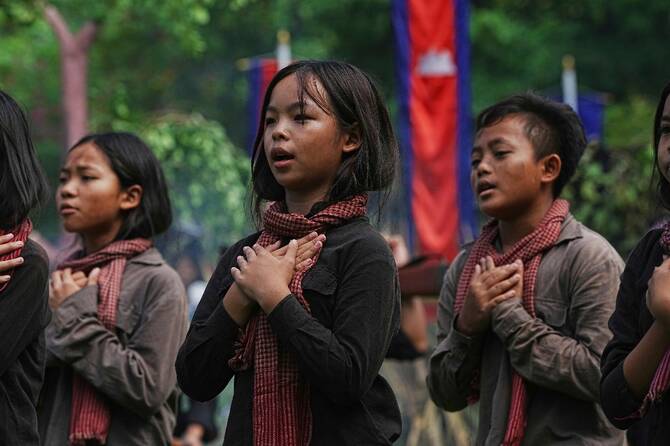
PHNOM PENH: Cambodian students wearing all black and wielding bamboo clubs and wooden rifles staged a dramatic re-enactment on Tuesday of a genocide that killed two million people in the 1970s.
A quarter of Cambodia’s population died of starvation, forced labor or torture or were slaughtered in mass killings under Pol Pot’s Khmer Rouge between 1975 and 1979.
The Khmer Rouge atrocities are commemorated at museums and sites including Choeung Ek, a notorious former “Killing Field” in Phnom Penh, where an annual Day of Remembrance event is held.
Hundreds gathered at Choeung Ek, where about 15,000 people died between 1975 and 1979, holding prayers in front of a display of victims’ skulls.
Students brandishing mock weapons then acted out slitting victims’ throats, shooting or clubbing them in a re-enactment of Khmer Rouge attacks on civilians.
Some attendees cried at the confrontingly vivid re-enactment.
“My tears fell when I watched the performance,” attendee and survivor Chruok Sam, 70, told AFP.
He lost 12 family members under the Khmer Rouge and said the performance showed “exactly the same” as what he had experienced in 1975.
He hoped the re-enactment would help young generations learn more about what he called “the most heinous and cruel regime on Earth.”
Another survivor, 63-year-old Em Ry, said she was still scared and had never been able to forget Pol Pot’s time in power.
She was forced to work all day and only ate a “spoonful of corn,” she said, and lost several family members including her grandmother.
Prime Minister Hun Manet, who was at the opening of a new cement plant in central Kampong Speu province, urged people not to forget the past.
“We must move on, but we cannot forget our painful past,” he said.
Cambodia marked the 50th anniversary last month of the Khmer Rouge’s bloody march into Phnom Penh.
A special tribunal sponsored by the United Nations convicted three key Khmer Rouge figures before ceasing operations in 2022. Other former cadres still live freely.
Pol Pot, nicknamed “Brother Number One,” died in 1998 before he was brought to trial.

Cambodian students re-enact bloody Khmer Rouge crimes
https://arab.news/w6jsd
Cambodian students re-enact bloody Khmer Rouge crimes
- A quarter of Cambodia’s population died of starvation, forced labor or torture or were slaughtered in mass killings under Pol Pot’s Khmer Rouge between 1975 and 1979
Kabul shakes as 5.8-magnitude earthquake hits eastern Afghanistan
- The 5.8-magnitude quake struck a mountainous area around 130 kilometers northeast of Kabul
- Earthquakes are common in Afghanistan, particularly along the Hindu Kush mountain range
KABUL: A strong earthquake rocked eastern Afghanistan including the capital Kabul on Friday, AFP journalists and residents said.
The 5.8-magnitude quake struck a mountainous area around 130 kilometers (80 miles) northeast of Kabul, the United States Geological Survey said.
The epicenter was near several remote villages and struck at 5:39 p.m. (1309 GMT), just as people in the Muslim-majority country were sitting down to break their Ramadan fast.
“We were waiting to do our iftars, a heavy earthquake shook us. It was very strong, it went on for almost 30 seconds,” said Zilgay Talabi, a resident of Khenj district near of the epicenter.
“Everyone was horrified and scared,” Talabi told AFP, saying he feared “landslides and avalanches” may follow.
Power was briefly cut in parts of the capital, while east of Kabul an AFP journalist in Nangarhar province also felt it.
Earthquakes are common in Afghanistan, particularly along the Hindu Kush mountain range, near where the Eurasian and Indian tectonic plates meet.
Haqmal Saad, spokesman for the Panjshir province police, described the quake as “very strong” and said the force was “gathering information on the ground.”
Mohibullah Jahid, head of Panjshir Natural Disaster Management agency, told AFP he was in touch with several officials in the area.
The district governor had told him there were reports of “minor damage, such as cracks in the walls, but we have not received anything serious, such as the collapse of houses or anything similar,” Jahid said.
Residents in Bamiyan and Wardak provinces, west of Kabul, told AFP they also felt the earthquake.
In Pakistan’s Khyber Pakhtunkhwa province, rescue service official Bilal Ahmad Faizi said the quake was felt in border areas.
In August last year, a shallow 6.0-magnitude quake in the country’s east wiped out mountainside villages and killed more than 2,200 people.
Weeks later, a 6.3-magnitude quake in northern Afghanistan killed at least 27 people.
Large tremors in western Herat, near the Iranian border, in 2023, and in Nangarhar province in 2022, killed hundreds and destroyed thousands of homes.
Many homes in the predominantly rural country, which has been devastated by decades of war, are shoddily built.
Poor communication networks and infrastructure in mountainous Afghanistan have hampered disaster responses in the past, preventing authorities from reaching far-flung villages for hours or even days before they could assess the extent of the damage.


