

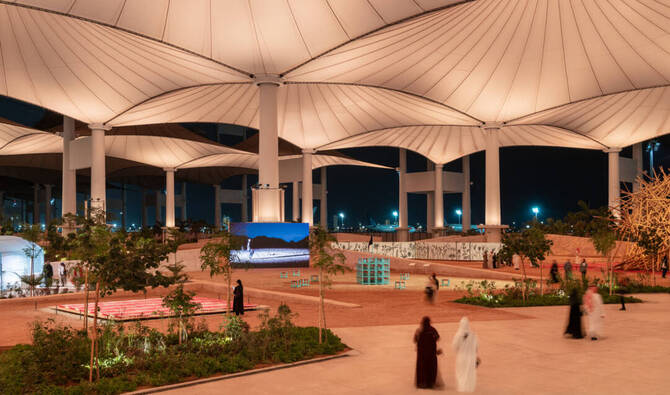
Key reflections as Jeddah’s Islamic Arts Biennale comes to a close

The second Islamic Arts Biennale prepares for its finale on May 25. (Supplied)
Short Url
Updated 20 May 2025
Follow

Key reflections as Jeddah’s Islamic Arts Biennale comes to a close

JEDDAH: As the second Islamic Arts Biennale prepares for its finale on May 25, Donya Abdulhadi, the executive director of marketing and communications at the Diriyah Biennale Foundation says its true achievement lies not only in visitor numbers, but in the cultural and educational legacy it continues to build.

“The Islamic Arts Biennale was ranked as one of the most highly visited biennales in 2023, but it is the cultural impact, influence and legacy of our work that matters the most to us,” she told Arab News.

The foundation — which oversees the Islamic Arts Biennale, the Diriyah Contemporary Art Biennale, and JAX District — alternates annually between its two flagship biennales: the Diriyah Contemporary Art Biennale, held in Riyadh’s JAX District, and the Islamic Arts Biennale, staged at the Western Hajj Terminal in Jeddah.

Launched in 2023, the Islamic Arts Biennale is the first biennale in the world dedicated to Islamic arts.

The debut Islamic Arts Biennale welcomed over 600,000 visitors, while the second edition of the Contemporary Art Biennale saw more than double the attendance of its first iteration and a 600 percent increase in digital engagement, according to organizers. 

Abdulhadi explained that the foundation measures success through cultural impact. “We assess our impact through several factors, including our success in nurturing creative expression and lifelong learning,” she said.

The foundation has seen a significant rise in institutional collaboration, too. Since the launch of its biennales, the number of partner institutions lending cultural and historical works has tripled. In turn, the number of total loans to exhibitions has nearly doubled.

Among the highlights of this iteration was the unprecedented display of rare objects such as items from the Vatican Apostolic Libraries shown alongside the Kiswah, the covering that adorns the Kaaba in Makkah. 

Between editions, the foundation remains active through initiatives such as “PlayBack,” a digital audio archive of past programming, and “PaperBack,” Saudi Arabia’s first art book fair, which welcomed more than 10,000 visitors last year. 

“Supporting generations of artists and creatives remains one of the most important ways in which we deliver cultural impact as a foundation,” she continued. “Our Biennales and the JAX District act as springboards for Saudi and international artists to be invited to the world’s most prestigious stages, but also as platforms for artists to evolve their own roles as creatives,” she concluded.


Review: ‘Sorry, Baby’ by Eva Victor

Eva Victor appears in Sorry, Baby by Eva Victor, an official selection of the 2025 Sundance Film Festival. (Supplied)
Updated 27 December 2025
Follow

Review: ‘Sorry, Baby’ by Eva Victor

  • Victor makes a deliberate narrative choice; we never witness the violence of what happens to her character

There is a bravery in “Sorry, Baby” that comes not from what the film shows, but from what it withholds. 

Written, directed by, and starring Eva Victor, it is one of the most talked-about indie films of the year, winning the Waldo Salt Screenwriting Award at Sundance and gathering momentum with nominations, including nods at the Golden Globes and Gotham Awards. 

The film is both incisive and tender in its exploration of trauma, friendship, and the long, winding road toward healing. It follows Agnes, a young professor of literature trying to pick up the pieces after a disturbing incident in grad school. 

Victor makes a deliberate narrative choice; we never witness the violence of what happens to her character. The story centers on Agnes’ perspective in her own words, even as she struggles to name it at various points in the film. 

There is a generosity to Victor’s storytelling and a refusal to reduce the narrative to trauma alone. Instead we witness the breadth of human experience, from heartbreak and loneliness to joy and the sustaining power of friendship. These themes are supported by dialogue and camerawork that incorporates silences and stillness as much as the power of words and movement. 

The film captures the messy, beautiful ways people care for one another. Supporting performances — particularly by “Mickey 17” actor Naomi Ackie who plays the best friend Lydia — and encounters with strangers and a kitten, reinforce the story’s celebration of solidarity and community. 

“Sorry, Baby” reminds us that human resilience is rarely entirely solitary; it is nurtured through acts of care, intimacy and tenderness.

A pivotal scene between Agnes and her friend’s newborn inspires the film’s title. A single, reassuring line gently speaks a pure and simple truth: “I know you’re scared … but you’re OK.” 

It is a reminder that in the end, no matter how dark life gets, it goes on, and so does the human capacity to love.
