

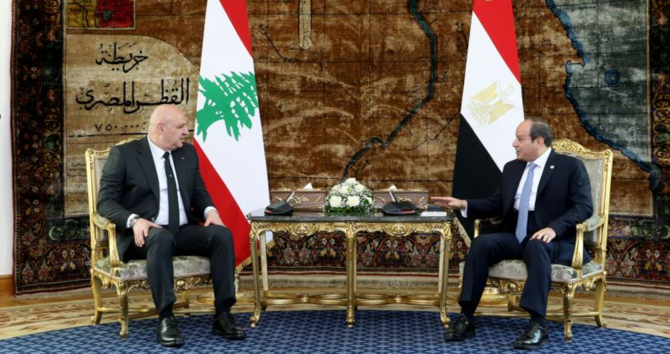

BEIRUT: Egypt rejects repeated Israeli violations of Lebanese sovereignty and its occupation of parts of the country, and supports Lebanon’s reconstruction efforts, President Abdel-Fattah El-Sisi said on Monday as he received a visit in Cairo from his Lebanese counterpart, Joseph Aoun.
The two leaders discussed ways in which bilateral relations might be strengthened and Egypt can support stability in Lebanon, as well as broader challenges to regional peace.
During a joint press conference following their talks, El-Sisi said that his country remains firm in its support of Lebanon’s internal stability and efforts to safeguard its full sovereignty.
He said Egypt continues to call on Israeli authorities to withdraw their forces immediately and unconditionally from Lebanese territory, respect the 1949 Armistice Agreements with Arab states, and fully implement UN Security Council Resolution 1701. Resolution 1701 was adopted in 2006 with the aim of resolving the conflict that year between Israel and the Lebanese group Hezbollah.
El-Sisi said his country will not interfere in internal Lebanese affairs but is keen to have a strong relationship with the nation. The president added that he wants Egypt to support reconstruction efforts in Lebanon, called on the wider international community also to assume its responsibilities in this process, and affirmed the need to enhance the nation’s internal stability and preserve its full sovereignty.
“On the political level, there should be a voice that supports Lebanon and its president, namely when it comes to calling for the withdrawal of the Israeli army from the five occupied hills, and addressing the remaining issues calmly and regularly in accordance with the Lebanese president’s wish in order to preserve the country’s security and stability,” El-Sisi said.
Turning to the situation in Palestine, he stressed the need to end Israeli hostilities in Gaza immediately. He called for the mobilization of the international community to implement a Gaza reconstruction plan without any displacement of the population, and to enable Palestinian authorities to carry out their role in fully managing the territory.
Aoun praised the depth of the Lebanese-Egyptian relationship, saying it is built on “freedom and openness.” He affirmed the commitment of his nation to Resolution 1701, which he said preserves his country’s sovereignty and territorial unity, and emphasizes the importance of the UN Interim Force in Lebanon’s role in the south of the country.
He called for a halt to Israel’s military offensive in Gaza and said: “We affirm the necessity to put an end to Israeli hostilities, and adhere to the provisions of the 1949 Armistice Agreement in a way that ensures security and stability in southern Lebanon and the whole region.”
The Lebanese president urged the international community to “fulfill its responsibilities, particularly in compelling Israel to adhere to the ceasefire agreement, reached under US and French sponsorship, in order to maintain security and stability in Lebanon and the region, withdraw from all Lebanese territories up to our internationally recognized and demarcated borders, and facilitate the return of Lebanese prisoners.”
Aoun also emphasized his nation’s “commitment to establishing the best possible relations” with neighboring Syria, and highlighted the importance of “coordination and cooperation between the two countries to address shared challenges, particularly concerning the issue of Syrian refugees.”
He underscored “the necessity of ensuring the safe and dignified return of the refugees to their homeland,” and urged the governments of Syria and Lebanon “to act swiftly through joint committees that have been agreed upon to achieve this, thereby safeguarding the interests of both nations and their peoples.”
He affirmed Lebanon’s support for all efforts to preserve Syrian unity and sovereignty and address the aspirations of its people. He welcomed recent decisions to lift international sanctions against the country, following the fall of the Assad regime, and expressed hopes that this will contribute to its recovery and wider regional stability.
Returning to the situation in his own country, Aoun said Lebanon needs “stability and lasting peace in our region, built on justice by granting all rights to their rightful owners. This is what the Arab countries approved in the Beirut Peace Initiative in 2002 and this is what we look forward to embodying as soon as possible.”
This peace would include “the establishment of a sovereign, independent Palestinian state,” he added, and a battle against “extremism and terrorism, poverty and hunger, ideas of elimination and desires of exclusion,” to “achieve development and prosperity for our people.
“I affirm that Lebanon cannot be outside such an equation. It is not in the interest of any Lebanese person, nor any country or people in our region, to exclude itself from the path of a comprehensive and just peace.”
Aoun called for “the establishment of a system for common Arab interests, one of the first pillars of which would be a body regulating the common interests of our countries and peoples, as a prelude to establishing a common regional market that would begin between two countries and gradually expand across sectors and geographies.”
Aoun’s office said that during his talks with El-Sisi the two leaders agreed to convene a joint high-level committee meeting, chaired by the countries’ prime ministers in Cairo on a date to be announced, to examine Lebanon’s needs and establish a working mechanism to help achieve them.
El-Sisi said he wishes to see Egyptian companies operating in Lebanon and providing assistance, as the Lebanese market represents a promising destination for trade and investment.
The Egyptian minister of electricity and renewable energy, Mahmoud Esmat, highlighted the cooperation between the two countries in the electricity sector, and El-Sisi said Lebanon “must be assisted in repairing its (power) grid and in everything that can help secure electricity.” This will be discussed further during the upcoming high-level ministerial committee meeting, he added.
Aoun’s visit to Egypt formed part of his strategic Arab outreach following his election as president in January. The trip to Cairo followed visits to Saudi Arabia and other Gulf states in what Lebanese presidential sources described as a concerted effort to “forge a new chapter in Lebanon-Arab world relations.”


