

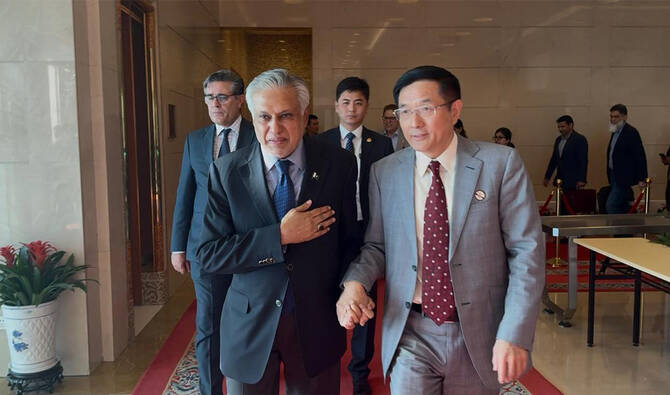

ISLAMABAD: Pakistan’s deputy prime minister and foreign minister, Ishaq Dar, on Monday arrived in Beijing on a three-day visit to China to discuss “evolving regional situation in South Asia,” the Pakistani foreign ministry said, days after India and Pakistan traded strikes on each other’s territory.
The development comes amid a ceasefire between Pakistan and India after a four-day military conflict between the nuclear-armed neighbors this month saw the use of fighter jets, missiles, drones and artillery, leaving around 70 people, including civilians, dead on both sides of the border.
Dar will hold in-depth discussions with Foreign Minister Wang Yi on the evolving situation and its “implications for peace and stability” in South Asia, while the two sides will also review the entire spectrum of Pakistan-China bilateral relations, according to the Pakistani foreign ministry.
“Whatever matters are there, we [will] review and discuss them. These are political, local, regional, multilateral and even global issues,” Dar told reporters before leaving for Beijing.
This month’s military conflict between India and Pakistan was triggered by a gun attack on tourists in Indian-administered Kashmir’s Pahalgam town, which killed 26 people on April 22. India blamed the assault on Pakistan. Islamabad denies the charge and has called for a credible, international probe into it.
The standoff began after India hit what it said were “terrorist camps” in multiple Pakistani cities with missiles on May 7. Pakistan responded swiftly and said it had downed six Indian fighter jets. The strikes continued over a course of four days, with both countries pounding the other’s defense installations and infrastructure.
“The entire world knows that all the allegations hurled against us were wrong,” Dar said. “Even China knows the entire world knows.”
Separately, PM Shehbaz Sharif has decided to send a high-level diplomatic delegation to important world capitals to expose ‘Indian propaganda’ against Islamabad, Pakistani state media reported.
“The delegation will visit London, Washington, Paris and Brussels to highlight India’s disinformation campaign and its attempts to destabilize regional peace,” the Radio Pakistan broadcaster said, adding Sharif has tasked ex-foreign minister Bilawal Bhutto-Zardari with leading the body.
“It will also underscore Pakistan’s sincere efforts for peace and stability in the region.”
Bitter rivals India and Pakistan have fought three wars, including two over the disputed region of Kashmir, since gaining independence from British rule in 1947. Both claim the Himalayan territory in its entirety but rule it in part.
Analysts and diplomats have long feared that a conflict between the arch-foes could escalate into the use of nuclear weapons, in one of the world’s most dangerous and most populated nuclear flashpoint regions.
China, which borders both Pakistan and India, this month urged the arch-foes to exercise restraint as did other world powers and friendly nations.
Pakistan’s foreign ministry said Dar’s visit is part of the ongoing high-level exchanges between Pakistan and China
“It also underscores the two countries’ shared commitment to further strengthen the All-Weather Strategic Cooperative Partnership,” it added.


