

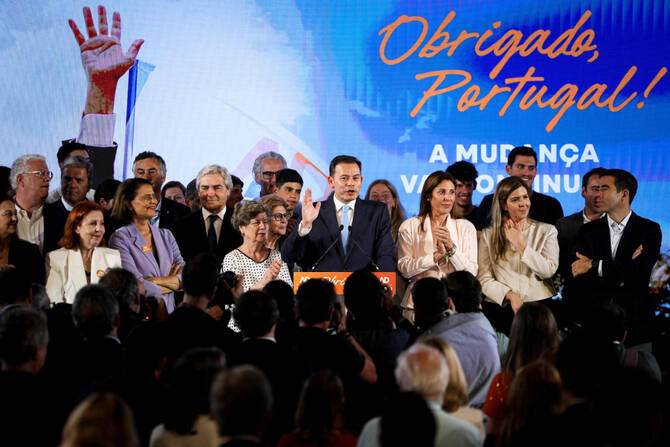

LISBON: Portugal’s incumbent center-right party won the most seats in the country’s third general election in three years on Sunday but again fell short of a parliamentary majority, while support for the far-right Chega rose.
The outcome threatens to extend political instability in the NATO and European Union member state as the bloc faces growing global trade tensions and works to strengthen its defenses.
Near complete official results showed that Prime Minister Luis Montenegro’s Democratic Alliance (AD) captured 32.7 percent of the vote in Sunday’s poll with the Socialist Party (PS) and Chega virtually tied in second place.
That would boost the AD’s seat tally in the 230-seat parliament to 89, short of the 116 seats required for a ruling majority.
The Socialists had 23.4 percent, their worst result in decades, trailed closely by Chega (“Enough“) with 22.6 percent wich would give each party 58 seats.
Even with the backing of upstart business-friendly party Liberal Initiative (IL) which won nine seats, the AD would still need the support of Chega to reach a majority to pass legislation.
But Montenegro, 52, a lawyer by profession, has refused any alliance with Chega, saying it is “unreliable” and “not suited to governing.”
“It is not clear that there will be increased governability following these results,” University of Lisbon political scientist Marina Costa Lobo told AFP, calling Chega “the big winner of the night.”
Support for Chega has grown in every general election since the party was founded in 2019 by Andre Ventura, a former trainee priest who later became a television football commentator.
It won 1.3 percent of the vote in a general election in 2019, the year it was founded, giving it a seat in parliament — the first time a far-right party had won representation in Portugal’s parliament since a coup in 1974 toppled a decades-long rightist dictatorship.
Chega became the third-largest force in parliament in the next general election in 2022 and quadrupled its parliamentary seats last year to 50, cementing its place in Portugal’s political landscape.
Like other far-right parties that have gained ground across Europe, Chega has tapped into hostility to immigration and concerns over crime.
There are still four seats left to be assigned representing Portuguese who live abroad, but those results will not be known for days.
Sunday’s election was triggered after Montenegro lost a parliamentary vote of confidence in March after less than a year in power.
He called for the vote following allegations of conflicts of interest related to his family’s consultancy business, which has several clients holding government contracts.
Montenegro denied any wrongdoing, saying he was not involved in the day-to-day operations of the firm.
The AD formed a minority government after the last election. It passed a budget that raises pensions and public sector wages, and slashes income taxes for young people, because the PS abstained in key votes in parliament.
But relations between the two main parties soured after the confidence vote, and it is unclear if a weakened PS will be willing to allow the center-right to govern this time around.
Socialist leader Pedro Nuno Santos, a 48-year-old economist, had accused Montenegro of engineering the election “to avoid explaining himself” about the firm’s activities to a parliamentary enquiry.
After the results were announced, he said he would call an internal party election to pick a new leader.
Montenegro has criticized the immigration policies of the previous Socialist government, accusing it of leaving Portugal in “bedlam.”
Under the Socialist Party, Portugal became one of Europe’s most open countries for immigrants.
Between 2017 and 2024, the number of foreigners living in Portugal quadrupled, reaching about 15 percent of the total population.
Montenegro has since toughened immigration policy, and during the campaign his government announced the expulsion of some 18,000 irregular migrants, leading critics to accuse it of pandering to far-right voters.


