

Asaan museum breaks ground in Diriyah ceremony

1 / 6
Groundbreaking ceremony at Diriyah Sales Center was attended by senior representatives from the Mohammed bin Salman Foundation (Misk), Diriyah Company, and design partners Zaha Hadid Architects. (Supplied)
2 / 6
Exterior day view of Asaan Museum’s entrance, showcasing the architectural fusion of heritage and modernity. (Supplied)
3 / 6
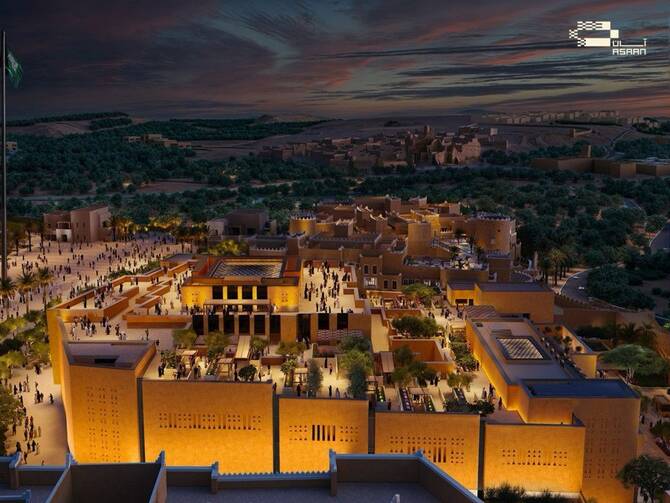
A nighttime rendering of Asaan Museum in Diriyah, designed to blend contemporary architecture with traditional Najdi elements. (Supplied)
4 / 6
Representatives from Misk, Zaha Hadid Architects, Diriyah Company, and Asaan pose following a ceremony in Diriyah. (AN photo by Waad Hussain)
5 / 6
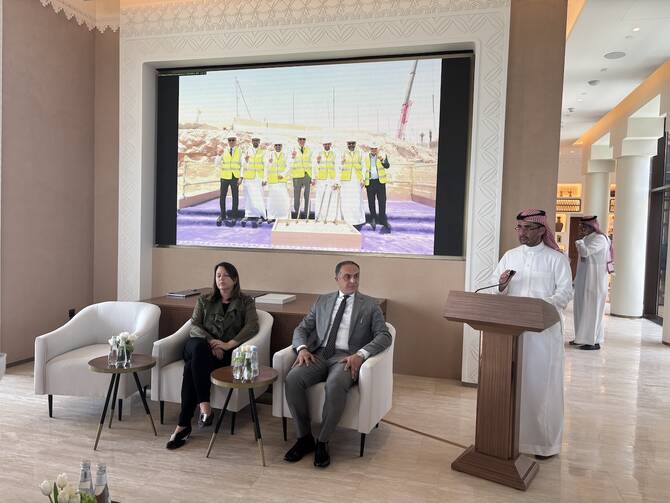
Khaled Al-Saqer, CEO of Asaan, delivers opening remarks during the groundbreaking ceremony, with representatives from Diriyah Company and Zaha Hadid Architects in attendance. (AN photo by Waad Hussain)
6 / 6
A close-up of commemorative heritage stones presented to speakers at the Asaan groundbreaking ceremony. (AN photo by Waad Hussain)
Short Url
Updated 18 May 2025
Follow

Asaan museum breaks ground in Diriyah ceremony

  • New 40,000 sq. meter cultural landmark is backed by Misk Foundation

RIYADH: Construction on Asaan, the Misk Heritage Museum, officially began in Diriyah on Sunday, marking a key milestone in Saudi Arabia’s cultural development and coinciding with the celebration of International Museum Day.

The groundbreaking ceremony at Diriyah Sales Center was attended by senior representatives from the Mohammed bin Salman Foundation (Misk), Diriyah Company, and design partners Zaha Hadid Architects.

Cultural institutions were also present in a show of support for the museum’s mission.

Spanning 40,000 sq. meters, the museum is envisioned as a living institution that reflects Saudi identity through immersive exhibitions and cultural experiences.

It will highlight traditional arts, crafts, oral histories, and social customs in a space designed to bring Saudi heritage to life.

In a statement to Arab News, Khaled Al-Saqer, CEO of Asaan, said the architectural vision for the project was rooted in a deep cultural responsibility.

“The vision was to preserve and pass on Saudi heritage from generation to generation,” Al-Saqer said. “With the rapid advancements in technology, we wanted to make sure there is no gap between current and future generations and their connection to their historical roots.

“At Asaan, we are developing heritage in a new way — one that bridges this gap and ensures our cultural legacy is protected and passed forward.”

He emphasized that Asaan is not just about preserving artifacts, but about inspiring deeper engagement with Saudi heritage.

Designed by Zaha Hadid Architects, the museum draws inspiration from traditional Najdi design, combining organic forms with modern lines to reflect the authenticity and evolution of Saudi architecture.

The structure itself is intended to be a cultural statement, rooted in local tradition yet open to global dialogue.

The museum will feature a conservation lab to support the restoration and preservation of heritage artifacts.

It will serve as a center for knowledge exchange and training, preparing future generations of Saudi museum professionals.

Asaan is part of the Misk Foundation’s broader mission to promote creativity, heritage appreciation, and knowledge sharing through platforms that empower Saudi youth and cultural institutions.


Saudi mine-clearance project in Yemen destroys 4,235 explosive devices in a day

Updated 22 January 2026
Follow

Saudi mine-clearance project in Yemen destroys 4,235 explosive devices in a day

  • Project Masam aims to rid Yemen of all mines to help ensure the highest standards of safety and security for the Yemeni people

LONDON: Saudi Arabia’s Project Masam cleared 4,235 mines, unexploded ordnance and other explosive devices in a single day from Bab Al-Mandab region in southwestern Yemen, as part of its mission to protect civilians.

Osama Al-Gosaibi, the project’s director general, said it aims to rid Yemen of all mines to help ensure the highest standards of safety and security for the Yemeni people.

On Wednesday, the project’s teams destroyed 33 anti-tank mines, 31 anti-personnel mines, 86 miscellaneous shells, 2,750 assorted rounds, 1,291 breakers and valves used in devices, 12 grenades, two Katyusha rockets, a missile, 15 shell arrows, and 14 other explosive devices.

Masam’s teams are tasked with clearing villages, roads and areas around schools to facilitate the safe movement of civilians and delivery of humanitarian aid.

The project trains local people to become demining engineers, provides them with modern equipment to do the job, and also offers support to Yemenis injured by explosive devices.