

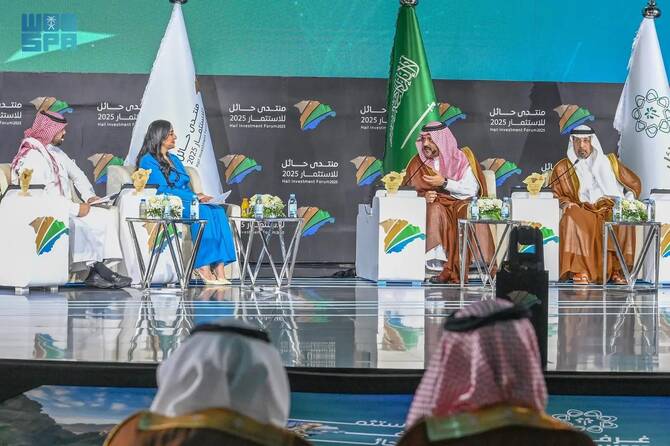

JEDDAH: Saudi Arabia’s Hail region signed investment agreements worth SR8.5 billion ($2.27 billion) during its flagship investment forum, as the Kingdom intensifies efforts to unlock regional growth and attract private sector capital.
The deals, signed across key sectors including agriculture, mining, tourism, and logistics, are part of a broader package of more than SR50 billion in identified investment opportunities unveiled at the Hail Investment Forum, the Saudi Press Agency reported.
Saudi Arabia has been focusing on the untapped potential of smaller towns and regional municipalities, attracting investors and entrepreneurs. This shift from traditional urban centers marks a new era of diversification as the country pursues a more resilient and inclusive economy, reflecting the evolving priorities of Saudi Vision 2030.
“The emir of Hail region witnessed the launch of a package of agreements, initiatives and projects amounting to SR8.5 billion, in qualitative partnerships between government agencies and investment entities to enhance the region’s growth and stimulate its economic environment,” the SPA report stated.

Inaugurating the forum, Prince Abdulaziz bin Saad bin Abdulaziz, governor of Hail region, spoke about the unwavering support the region receives from the wise leadership.
In his speech, Prince Abdulaziz emphasized that the Hail region holds competitive and strategic advantages that make it an attractive environment for investment across various sectors, marking the beginning of a new phase of investment and sustainable development throughout the region and its governorates.
The forum, held under the theme “Be Part of the Promising Future,” was organized by the Hail Chamber in partnership with the regional governorate. It attracted senior officials, including Minister of Investment Khalid Al-Falih and Deputy Minister of Environment, Water and Agriculture Mansour Al-Mushaiti.
A total of 125 investment opportunities, including 14 strategic projects worth more than SR34.2 billion, were presented in support of the local business sector.
Hani Al-Khalifa, chairman of the Hail Chamber, said the forum promotes the region’s economic competitiveness and investment landscape.

Hassan Al-Huwaizi, chairman of the Federation of Saudi Chambers, called the event a vital platform for presenting high-quality investment opportunities, adding that Hail’s appeal has grown due to government facilitation.
In his remarks, Al-Mushaiti described Hail as a unique destination for agricultural investment due to its rich natural resources. He noted the Agricultural Development Fund has disbursed over SR7 billion in the region, helping raise Hail’s share of the Kingdom’s agricultural gross domestic product to more than 10 percent.
The region also launched the Middle East’s first and largest trout salmon production project, expected to cut imports by 50 percent and generate SR5 billion in sales over the next decade, he said.
A new red meat investment is set to boost self-sufficiency, which reached 61 percent by end-2024. Hail is also home to one of the largest poultry production projects, now valued at more than SR11 billion following a recent SR4.5 billion expansion.
Al-Mushaiti highlighted the SR800 million in support provided by the Saudi Reef program in Hail, helping smallholder farmers through local agricultural projects worth over SR40 million. He added that 14 water and environmental projects worth SR1.2 billion, along with seven vegetation projects worth SR116 million, are underway under the Saudi Green Initiative.

Al-Falih, speaking at the event, reiterated government support for investors and pointed to Hail’s strategic advantages such as its location that connects five other regions, fertile land, diverse terrain, and developing infrastructure.
He added that foreign direct investment in the region has reached SR1.44 billion, with 177 investment licenses issued to international companies across sectors such as construction, manufacturing, tourism, food, and retail.
More than 100 investment opportunities worth SR50 billion were showcased and listed on the “Invest Saudi” platform, spanning agriculture, tourism, manufacturing, sports and more.
A memorandum of understanding was signed between the Ministry of Investment and the Hail Region Development Authority to facilitate strategic investments and promote sustainable growth in the region.
The forum also featured nine panel sessions covering 42 investment themes, focusing on tourism, quality of life, agriculture, logistics, energy, and education.


