

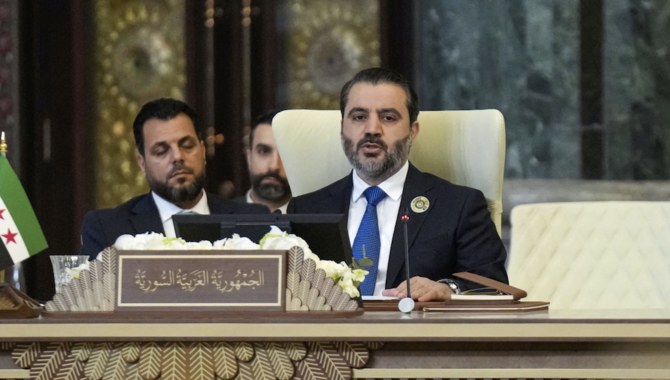
Syrian foreign minister hails sanctions relief, pushes for inclusive recovery at Arab Summit

Syria has begun taking serious steps toward national recovery and reconciliation, based on a commitment to inclusivity and sovereignty, Syrian Foreign Minister Asaad Al-Shaibani said on Saturday during his address at the 34th Arab Summit in Baghdad. (WAM)
Short Url
Updated 17 May 2025
Follow

Syrian foreign minister hails sanctions relief, pushes for inclusive recovery at Arab Summit

  • Asaad Al-Shaibani says Syria entering a new phase ‘that embraces diversity, guarantees representation, preserves dignity’
  • ‘Syria is for all Syrians, with no place for marginalization or exclusion,’ FM tells Baghdad forum

BAGHDAD: Syria has begun taking serious steps toward national recovery and reconciliation, based on a commitment to inclusivity and sovereignty, Syrian Foreign Minister Asaad Al-Shaibani said on Saturday during his address at the 34th Arab Summit in Baghdad.

Delivering his country’s remarks at the high-level gathering, Al-Shaibani said Syria was entering a new phase of “inclusive national dialogue that embraces diversity, guarantees representation, and preserves dignity.”

He added that the move marked what he described as an unprecedented effort to rebuild the nation on foundations that reject marginalization and exclusion.

“Syria is for all Syrians, with no place for marginalization or exclusion,” he declared, underlining the country’s refusal to accept “guardianship” or to serve as a battleground for external conflicts.

Al-Shaibani also welcomed the recent decision by US President Donald Trump to lift sanctions imposed on Syria, a move he hailed as a “positive and important step” on the path to national reconstruction.

He credited “sincere Arab diplomatic efforts” for helping to bring about the breakthrough.

The minister extended special thanks to Saudi Arabia and Turkiye for their role as effective mediators at a “pivotal historical moment,” and expressed deep gratitude to Qatar, the UAE, Jordan, and member states of the Gulf Cooperation Council for their support during what he called a “delicate stage” for Syria.

“Lifting the sanctions is not the end, but rather the beginning of a path that we hope will be paved with real cooperation and the integration of Arab efforts,” he said.

He also stressed the need to work together to bolster regional development, safeguard Arab national security, and enhance overall stability.

Al-Shaibani revealed that Syria was finalizing preparations for a national parliament that would represent the full spectrum of Syrian society, alongside efforts to draft a permanent constitution aimed at protecting rights, upholding sovereignty, and establishing the rule of law.

“Any project aimed at weakening or dividing the Syrian state under any pretext is categorically rejected by the Syrian state and people in all their components,” he said.


El-Sisi says Egypt in ‘state of near-emergency’ as war threatens economy

Updated 7 sec ago
Follow

El-Sisi says Egypt in ‘state of near-emergency’ as war threatens economy

  • El-Sisi said “the current crisis might have some repercussions on prices“
  • He said Egypt was attempting “sincere and honest mediation efforts to stop the war”

CAIRO: Egyptian President Abdel Fattah El-Sisi said Thursday his country was in an economic “state of near-emergency” as a result of the Middle East war, warning of runaway inflation.
The Arab world’s most populous nation has not been physically impacted by the US and Israeli war with Iran, which has seen strikes on Egypt’s wealthy Gulf allies and paralyzed trade through the vital Strait of Hormuz.
But by the close of business Thursday, the Egyptian pound had fallen to an eight-month low against the US dollar, trading at 50.2 to the USD amid reports of short-term investment outflows.
Egypt’s import-dependent economy has proven highly sensitive to fluctuations in the currency, which has lost two-thirds of its value since 2022.
At a military academy event, El-Sisi said “the current crisis might have some repercussions on prices,” warning that price-gouging traders could be tried “in military courts,” according to a statement from his spokesman.
Over the weekend, El-Sisi had warned the war could spell trouble for the Suez Canal, the region’s other vital waterway besides the Strait of Hormuz and a key source of foreign currency for Egypt.
Major shipping companies have already directed traffic away from the region, rerouting around the Cape of Good Hope off the tip of southern Africa.
El-Sisi said Thursday that Egypt was attempting “sincere and honest mediation efforts to stop the war, as its continuation will have a hefty toll.”
Cairo has in the past hosted nuclear talks between Iran and the International Atomic Energy Agency, and is a guarantor of the US-brokered Gaza peace deal between Israel and Hamas.
But Iranian Foreign Minister Abbas Araghchi said Thursday his country was “not asking for a ceasefire” or negotiations with the US.