

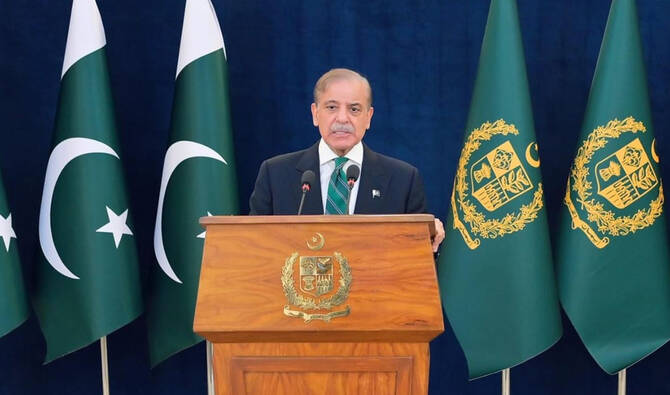
ISLAMABAD: Pakistani Prime Minister Shehbaz Sharif and World Bank Group President Ajay Banga agreed on Monday on the need to accelerate implementation and strengthen oversight of development priorities, as Islamabad seeks to deliver reforms “at speed and scale” under the World Bank’s Country Partnership Framework (CPF), Sharif’s office said.
Banga is on his first official visit to Pakistan as head of the World Bank Group and as the country works to advance a multi-year reform agenda supported by international financial institutions, including the World Bank and the International Monetary Fund.
According to a statement issued by the Prime Minister’s Office, Sharif welcomed Banga and acknowledged the World Bank Group’s long-standing partnership with Pakistan, particularly its support through the 10-year CPF announced last year. The one-of-a-kind plan will focus $20 billion in lending to the cash-strapped nation over the coming decade on development issues like the impact of climate change as well as boosting private-sector growth.
The prime minister said Pakistan was pursuing a comprehensive, domestically driven reform program aimed at achieving sustainable economic stability, the statement said, adding that the government was working across multiple sectors, including energy, agribusiness, digital development, fiscal reforms and job creation.
“Prime Minister and Mr.Banga reiterated the need to fast-track implementation and ensure strong oversight to deliver impact at speed and scale on CPF-aligned priorities,” a statement from Sharif’s office said.
“These measures would duly assist Prime Minister’s initiative to address and resolve Implementation bottlenecks in development projects.”
Sharif also reaffirmed the government’s commitment to structural reforms aimed at unlocking job-rich growth and strengthening investor confidence, according to the statement.
According to the statement, Banga welcomed Pakistan’s ongoing reform efforts and reaffirmed the World Bank Group’s commitment to deepening cooperation through what he described as a “One World Bank Group” approach, the statement said.
“Greater leverage of private resources, in addition to strong coordination with development partners, is necessary to meet the ambition of the government’s reform agenda,” the statement quoted Banga as saying.
Pakistan has relied heavily on multilateral financing and development support in recent years as it navigates balance-of-payments pressures, high inflation and the need for deep-seated structural reforms to boost growth and resilience.
The South Asian nation is currently under a $7 billion International Monetary Fund bailout program, which requires the country to boost government revenues and shore up external sources of financing, much of which comes from loans from China and Gulf nations.
Announcing the CPF last January, Sharif said in a post on social media platform X that the new plan would focus the global institution’s pledge of $20 billion in areas including clean energy and climate resilience in the ten years from 2026.
The World Bank said in a statement at the time that policy and institutional reforms to boost private sector growth and expand fiscal space for government investment in crucial areas would also be key to the CPF.
“We are focused on prioritising investment and advisory interventions that will help crowd-in much needed private investment in sectors critical for Pakistan’s sustainable growth and job creation, including energy and water, agriculture, access to finance, manufacturing and digital infrastructure,” said Zeeshan Sheikh, the World Bank’s International Finance Corporation Country Manager for Pakistan and Afghanistan in a statement.
The World Bank has currently committed about $17 billion to Pakistan for 106 projects.