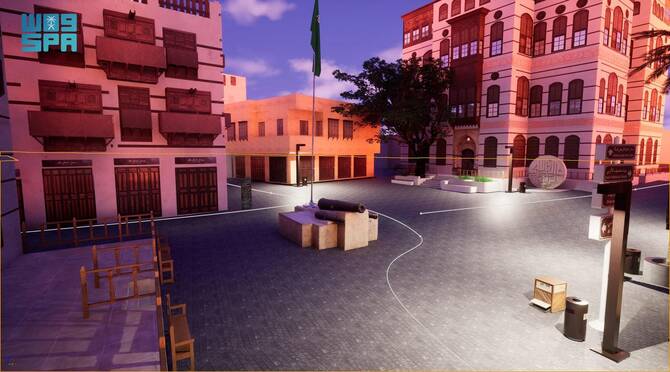
Saudi project turns heritage into virtual tourism

1 / 2
The project promotes cultural awareness and could help attract investment to the tourism sector. (SPA)
2 / 2
The project promotes cultural awareness and could help attract investment to the tourism sector. (SPA)
Short Url
Updated 17 May 2025
Follow

Saudi project turns heritage into virtual tourism

  • King Abdulaziz University drives innovation with geomatics technology in historic Jeddah

JEDDAH: King Abdulaziz University, through its Faculty of Architecture and Planning, has completed a virtual tourism project using geomatics technologies to deliver interactive tours of key tourist destinations.

The initiative enhances the visibility of cultural and heritage sites, and reflects the growing use of technologies to collect, analyze and interpret spatial data, the Saudi Press Agency reported.

Geomatics — an interdisciplinary field combining geography, engineering, geographic information systems and remote sensing — supports informed decision-making across various sectors.

The project uses virtual tourism to help position the Kingdom as a competitive global destination, according to the SPA.

It supports the digital transformation of the tourism sector in line with Vision 2030 by using advanced technologies to create immersive experiences that allow users to explore cultural and heritage landmarks remotely.

It also aligns with the Kingdom’s progress in virtual tourism, supported by the Ministry of Tourism’s digital strategy launched in February 2022.

The strategy includes nine programs and 31 initiatives aimed at improving the tourist experience through virtual and augmented reality technologies.

Rayan Sahahiri, a faculty member in the geomatics department and project supervisor, said the initiative enhances spatial analysis of historic buildings and provides an interactive platform for virtual exploration of architectural features along the Al-Alawi axis in historic Jeddah, known as Al-Balad.

He added that the project promotes cultural awareness and could help attract investment to the tourism sector, the SPA reported.

Sahahiri pointed to historic Jeddah as a fitting example, with its many heritage buildings recognized by UNESCO.

The project offers virtual tours of sites along the Al-Alawi axis, highlighting the details of traditional Islamic architecture.

Abdullah Al-Attas, also a faculty member in the geomatics department, expressed pride in the project, which was developed by Saudi geomatics graduates Abdulrahman Kateb and Mohammed Al-Marouei.

He said that beyond digital documentation, the project aims to build a comprehensive information network to support tourism investment.

It seeks to attract both local and international investors, and contribute to the development of a digital tourism ecosystem aligned with the Kingdom’s digital transformation goals.


National program identifies 165 native plants for afforestation efforts in Asir

Updated 58 min 49 sec ago
Follow

National program identifies 165 native plants for afforestation efforts in Asir

  • The survey is part of broader plans focused on restoring degraded land, using native vegetation 

JEDDAH: Saudi Arabia’s National Afforestation Program has identified more than 165 species of native plants suitable for afforestation in the Asir region, highlighting the ecological diversity of one of the Kingdom’s most environmentally varied areas, the Saudi Press Agency reported.

The findings form part of broader national efforts to expand vegetation cover, address land degradation, and support sustainability goals linked to the Saudi Green Initiative and Vision 2030.

According to the program, the identified species are distributed across a wide range of natural environments in Asir, including mountainous terrain, highlands, slopes, valleys, plains, rocky landscapes, and coastal areas stretching from the Red Sea to Tihama.

The species belong to numerous plant families, including Fabaceae, Anacardiaceae, Burseraceae, Capparaceae, Ebenaceae, Euphorbiaceae, Malvaceae, Myrtaceae, Oleaceae, and Primulaceae, among others.

Plants suitable for afforestation range from large and small trees to perennial and annual shrubs, herbs, succulents, bulbs, and climbing plants. 

Among the most notable species identified are the grey mangrove, mastic tree, mooring or ben tree, juniper, sycamore fig, wild olive, henna, wild jasmine, hawthorn, and arak.

The Saudi Arabian Botanical Society described the announcement as an important step in protecting plant diversity and strengthening the ecosystem conservation in the Kingdom. 

Munirah bin Hamad Al-Hazani, founder and president of the society, said that prioritizing native species is central to sustainable afforestation.

“Focusing on the cultivation of native plants adapted to diverse environments forms the cornerstone of sustainable afforestation projects, as it plays a pivotal role in enhancing vegetation cover, combating land degradation, and conserving natural and financial resources,” she told Arab News.

Al-Hazani added that long-term success depends on cooperation between government bodies and the nonprofit sector, alongside community involvement and environmental awareness programs.

The National Afforestation Program has increasingly emphasized community participation, working with government agencies, private companies, and nonprofit organizations to support planting initiatives and environmental education. Its approach includes promoting volunteerism and discouraging harmful environmental practices, while focusing on the use of native plants adapted to local conditions.

Parallel efforts are underway in other regions of the Kingdom to support vegetation restoration through research and infrastructure development. In Jouf, often referred to as the Kingdom’s food basket, the King Salman bin Abdulaziz Royal Reserve Development Authority has established a Central Nursery and a Wild Seeds Research and Production Station to address the growing demand for reliable sources of native seeds and seedlings.

The project was launched in 2023 under the directive of Prince Abdulaziz bin Saud bin Naif, the minister of interior and chairman of the authority’s board of directors. 

Since then, the facilities has become a key component of vegetation restoration efforts within the reserve.

The authority has focused on building operational capacity by recruiting and training specialists to manage cultivation and research activities. The research and production station includes 14 mother-seed production fields containing over 400,000 trees and shrubs. 

Planting began in late 2024, with more than 30 native plant species represented, selected for their role in the reserve’s natural ecosystem. 

The facility also includes two seed storage units with a combined capacity of 3,000 kilograms. Seeds are collected annually from multiple sites within the reserve and used for seedling production habitat rehabilitation.

The Central Nursery spans 6,000 square meters and includes 30 greenhouses spanning 1,500 square meters, as well as two shade houses used during summer months. A plant hardening facility, designed to prepare seedlings for natural environmental conditions, covers 10,000 square meters and is divided into seven sections. The nursery’s annual production capacity reaches 1.5 million seedlings, representing more than 15 native plant species. 

Together, these initiatives underscore the growing role of native plant research and propagation in Saudi Arabia’s afforestation strategy, particularly as the Kingdom works to balance environmental restoration with long-term sustainability goals.