MATHARE: Joseph Kariaga and his friends once lived the “gangster life” in Nairobi’s Mathare slum, snatching phones, mugging people and battling police. But when Kariaga's brother was shot dead by police, the young men took stock.
“We said, 'We cannot live like this. We are going to lose our lives.’ Many of our friends had died,” said Kariaga, now 27. “I reflected on my life. I had to change.”
Now the men are farmers with a social mission. Nearly a dozen of them founded Vision Bearerz in 2017 to steer youth away from crime and address food insecurity in one of Kenya’s poorest communities.
Despite challenges, Vision Bearerz makes a modest but meaningful community impact, including feeding over 150 children at lunches each week. Some residents praise the group and call the men role models.
Amid cuts to foreign funding by the United States and others, experts say local organizations like this may be the future of aid.
Vision Bearerz works on an urban farm tucked away in the muddy streets and corrugated-metal homes that make up Mathare, one of Africa's most populous slums. Estimates say about a half-million people live in this neighborhood of less than two square kilometers.
Some 2 million people, or 60% of Nairobi’s population, live in informal settlements, according to CFK Africa, a non-governmental organization that runs health and poverty reduction programs in such neighborhoods and is familiar with Vision Bearerz' work.
Lack of infrastructure is a key challenge in these communities, which are growing amid sub-Saharan Africa’s rapid urbanization and booming youth population, said Jeffrey Okoro, the group’s executive director.
Poverty pushes youth into crime, Okoro added.
“Most folks in slums such as Mathare are not able to earn enough to buy a decent meal, and kids who are under 5 are twice as likely to be malnourished,” he said. “One of the other major challenges affecting young people is gangs, and the promise of making a quick buck.”
The farmers of Vision Bearerz know this well.
“When you are born from this land, there is not much you have inherited, so you have to make it yourself,” said Ben Njoki, 28, whose face tattoos are reminders of a gang-affiliated past. “You have to use violence.”
In 2017, not long after Kariaga’s brother was killed, Njoki and other young men made a plan to change. More than a dozen people they grew up with had been killed, and they realized they would follow if they did not find an alternative to crime, said Moses Nyoike, 32, the chair of Vision Bearerz.
To keep busy, the group began collecting garbage and would split profits from trading vegetables, buying produce in another county and reselling it locally. They noticed a gap in the supply of vegetables to Mathare, and with permission from authorities they cleaned up a garbage dump and began planting.
Polluted soil, and water rationing, made it a tough start. Then, inspired by a TikTok account that showcased farming in a Colombian slum, Vision Bearerz tried their hand at hydroponics. With the help of an NGO that supports community enterprises, Growth4Change, they were able to get materials and training in urban farming methods.
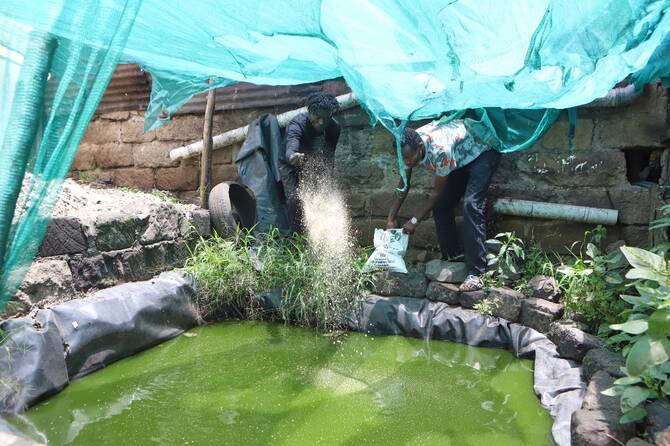
Today, Vision Bearerz grows vegetables, raises pigs and farms tilapia in a small pond. They sell a portion of what they produce, with revenue also coming from running a car wash and public toilet.
With the earnings, the group buys maize flour to make ugali, a dough-like staple food, and beans, which supplement produce from their farm in weekly lunches for children.
Vision Bearerz also runs outreach programs to warn against drug use and crime, and has sessions where women teach girls about feminine health.
“The life I was living was a lie. It didn’t add up to anything. We just lost people. Now, we are winning people in the community,” Njoki said.
Davis Gichere, 28, another founding member, called the work therapeutic.
Challenges remain. Joining Vision Bearerz requires a pledge to leave crime behind, and there have been instances of recidivism, with at least one member arrested. Lingering criminal reputations have led to police harassment in the past, and finding money to buy food for Saturday feedings is a weekly struggle.
Funding cuts across the development space, including the dismantling of the United States Agency for International Development, make the prospect of new financing dim.
At least one other group in Nairobi’s Kibera slum, Human Needs Project, does similar work of urging youth away from crime and addressing food insecurity through urban farming.
It's a model that can be scaled up or copied elsewhere, said Okoro of CFK Africa.
“The future of development is locally led organizations," he said, noting they are best suited to understanding the needs of their communities.
Kariaga still feels the pain of his brother’s death, but is proud of his new job.
“Farming can change the world,” he said, a silver-capped tooth glinting in the sun.
___


They once lived the 'gangster life.' Now they tackle food insecurity in Kenya's slums
https://arab.news/cdvnx
They once lived the 'gangster life.' Now they tackle food insecurity in Kenya's slums


Italian PM pledges to deepen cooperation with African states
- The plan, launched in 2024, aims to promote investment-led cooperation rather than traditional aid
ADDIS ABABA: Italy pledged to deepen cooperation with African countries at its second Italy-Africa summit, the first held on African soil, to review projects launched in critical sectors such as energy and infrastructure during Italy’s first phase of the Mattei Plan for Africa.
The plan, launched in 2024, aims to promote investment-led cooperation rather than traditional aid.
Italy’s Prime Minister Giorgia Meloni addressed dozens of African heads of state and governments in Ethiopia’s capital, Addis Ababa, and reiterated that a successful partnership would depend on Italy’s “ability to draw from African wisdom” and ensure lessons are learned.
“We want to build things together,” she told African heads of state. “We want to be more consistent with the needs of the countries involved.”
Ethiopian Prime Minister Abiy Ahmed said Italy had provided Africa with a gateway to Europe through these partnerships.
“This is a moment to move from dialogue to action,” he said.
“By combining Africa’s energetic and creative population with Europe’s experience, technology, and capital, we can build solutions that deliver prosperity to our continents and beyond.”
After the Italy-Africa summit concluded, African leaders remained in Addis Ababa for the annual African Union Summit.
Kenyan writer and political analyst Nanjala Nyabola said tangible results from such summits depend on preparations made by countries.
African governments often focus on “optics instead of actually making summits a meaningful engagement,” she said.
Instead of waiting for a list of demands, countries should “present the conclusions of an extended period of mapping the national needs” and engage in dialogue to determine how those needs can be met.
Since it was launched two years ago, the Mattei Plan has directly involved 14 African nations and has launched or advanced around 100 projects in crucial sectors, including energy and climate transition, agriculture and food security, physical and digital infrastructure, healthcare, water, culture and education, training, and the development of artificial intelligence, according to the Italian government.