


ISLAMABAD: Britain is working with the United States (US) to ensure a ceasefire between India and Pakistan endures and that “confidence-building measures” and dialogue take place between the nuclear-armed neighbors, Foreign Minister David Lammy said on Saturday.
The nuclear-armed South Asian arch rivals agreed on May 10 to a ceasefire, brokered by the US, in their worst fighting in nearly three decades, which followed a deadly attack on tourists that New Delhi blamed on Islamabad. Pakistan denies involvement.
Last week’s hostilities between Pakistan and India raised alarm among world powers about a full-blown war in South Asia. Britain was among several countries that called for restraint, with Prime Minister Keir Starmer saying the UK was “urgently engaging” with both sides.
“We will continue to work with the United States to ensure that we get an enduring ceasefire, to ensure that dialogue is happening and to work through with Pakistan and India how we can get to confidence and confidence-building measures between the two sides,” Lammy told Reuters in Pakistan’s capital Islamabad at the end of a two-day visit.
Asked about India’s suspension of the Indus Water Treaty, potentially squeezing Pakistan’s water supply, Lammy said: “We would urge all sides to meet their treaty obligations.”
India announced suspending the 1960 World Bank-brokered treaty, which ensures water for 80 percent of Pakistani farms, a day after the April 22 attack in Indian-administered Kashmir’s Pahalgam that killed 26 tourists.
Pakistan has said Britain and other countries, in addition to the United States, played a major role in de-escalating the fighting. Diplomats and analysts say the ceasefire remains fragile.
Trump told Fox News on Friday that he had helped stop a potential “nuclear war” between India and Pakistan, reiterating that he had offered trade to both nations if they stopped fighting.
“Also, Pakistan, great conversations with Pakistan, you know we can’t forget them, and because it does takes two to tango and with India, I felt very certain, and with Pakistan, I also talked about trade, oh, they would love to trade,” he said.
“They are brilliant people. They make incredible products and we don’t do much trade with them.”
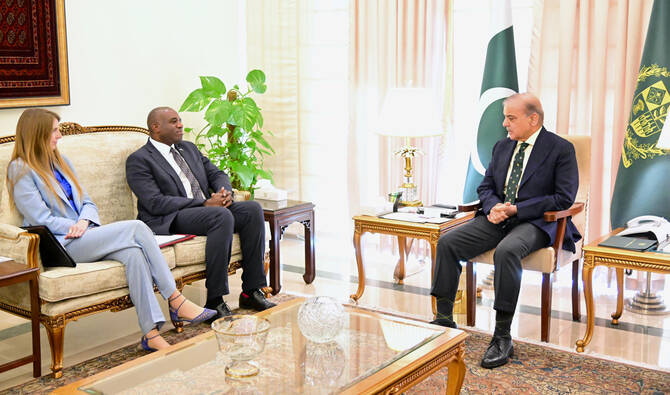
Prime Minister Shehbaz Sharif reaffirmed his desire for peace in South Asia despite a recent military standoff with India, Sharif’s office said on Saturday, following his meeting with Foreign Secretary Lammy.
“The UK Foreign Secretary congratulated the Prime Minister on the ceasefire understanding and said the UK would continue to play a constructive role for promotion of peace and stability in the region,” Sharif’s office said.
Fighting erupted last week when India launched strikes on what it said were “terrorist camps” in Pakistan following a deadly April attack in Indian-administered Kashmir that killed 26 people. New Delhi accused Islamabad of backing the militants behind the assault, an allegation Pakistan denies.
Four days of drone, missile and artillery exchanges followed, killing around 70 people, including dozens of civilians, on both sides of the border. The conflict raised fears of a broader war before a ceasefire was announced by US President Donald Trump.
This was Lammy’s first official visit to Pakistan, which came just days after one of the most serious military confrontations between Pakistan and India in decades.
The visit underscored the “robust and multifaceted partnership” between the two nations and their commitment to regional and international peace, Pakistan’s foreign ministry said.
With input from Reuters


