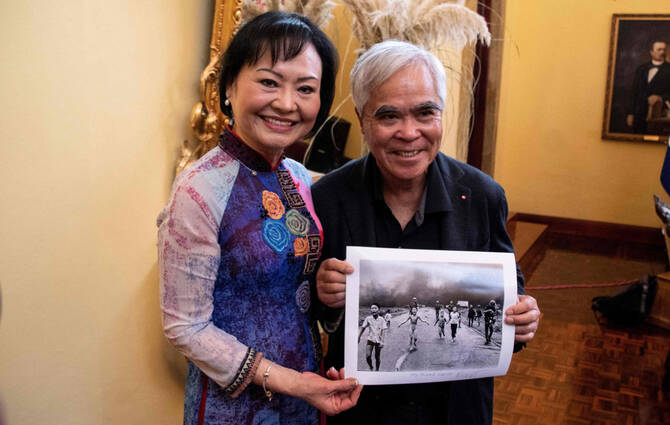
An organization that honored The Associated Press’ Nick Ut with its ” photo of the year ” in 1973 for a picture of a girl running from a napalm attack in the Vietnam War says it has “suspended its attribution” to Ut because of doubts over who actually took it.
World Press Photo’s report Friday adds to the muddle over an issue that has split the photographic community since a movie earlier this year, “The Stringer,” questioned Ut’s authorship. The photo of a naked and terrified Kim Phuc became an iconic symbol of the war’s tragedy.
After two investigations, The Associated Press said it found no definitive evidence to warrant stripping Ut’s photo credit. The AP said it was possible Ut took the picture, but the passage of time made it impossible to fully prove, and could find no evidence to prove anyone else did.
World Press Photo said its probe found that two other photographers — Nguyen Thanh Nghe, the man mentioned in “The Stringer,” and Huynh Cong Phuc — “may have been better positioned” to take the shot.
“We conclude that the level of doubt is too significant to maintain the existing attribution,” said Joumana El Zein Khoury, executive director of World Press Photo. “At the same time, lacking conclusive evidence pointing definitively to another photographer, we cannot reassign authorship, either.”
World Press Photo, an organization whose awards are considered influential in photography, won’t attempt to recover the cash award given to Ut, a spokeswoman said.
Ut’s lawyer, James Hornstein, said his client hadn’t spoken to World Press Photo after some initial contact before “The Stringer” was released. “It seems they had already made up their mind to punish Nick Ut from the start,” he said.
Gary Knight, a producer of “The Stringer,” is a four-time judge of the World Press Photo awards and a consultant to the World Press Photo Foundation.
The AP said Friday that its standards “require proof and certainty to remove a credit and we have found that it is impossible to prove exactly what happened that day on the road or in the (AP) bureau over 50 years ago.”
“We understand World Press Photo has taken different action based on the same available information, and that is their prerogative,” the statement said. “There is no question over AP’s ownership of the photo.”
Meanwhile, the Pulitzer Prize that Ut won for the photo appears safe. The Pulitzers depend on news agencies who enter the awards to determine authorship, and administrator Marjorie Miller — a former AP senior editor — pointed to the AP’s study showing insufficient proof to withdraw credit. “The board does not anticipate future action at this time,” she said Friday.


![]()

Photo group says it has ‘suspended attribution’ of historic Vietnam picture because of doubts
Short Url
https://arab.news/45rh4
Photo group says it has ‘suspended attribution’ of historic Vietnam picture because of doubts
- World Press Photo honored AP’s Nick Ut with its ” photo of the year ” in 1973
- Picture of girl running from a napalm attack became an iconic symbol of the war’s tragedy


Latest updates




© 2026 SAUDI RESEARCH & PUBLISHING COMPANY, All Rights Reserved And subject to Terms of Use Agreement.