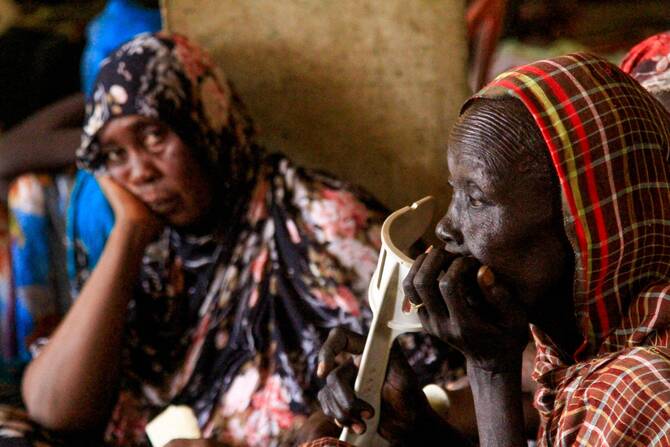
ROME: Acute food insecurity and child malnutrition rose for a sixth consecutive year in 2024, affecting more than 295 million people across 53 countries and territories, according to a U.N. report released on Friday.
That marked a 5% increase on 2023 levels, with 22.6% of populations in worst-hit regions experiencing crisis-level hunger or worse.
"The 2025 Global Report on Food Crises paints a staggering picture," said Rein Paulsen, Director of Emergencies and Resilience at the U.N. Food and Agriculture Organization (FAO).
"Conflict, weather extremes and economic shocks are the main drivers, and they often overlap," he added.
Looking ahead, the U.N. warned of worsening conditions this year, citing the steepest projected drop in humanitarian food funding since the report's inception -- put at anywhere between 10% to more than 45%.
U.S. President Donald Trump has led the way, largely shutting down the U.S. Agency for International Development, which provides aid to the world's needy, cancelling more than 80% of its humanitarian programs.
"Millions of hungry people have lost, or will soon lose, the critical lifeline we provide," warned Cindy McCain, the head of the Rome-based World Food Programme.
Conflict was the leading cause of hunger, impacting nearly 140 million people across 20 countries in 2024, including areas facing "catastrophic" levels of food insecurity in Gaza, South Sudan, Haiti and Mali. Sudan has confirmed famine conditions.
Economic shocks, such as inflation and currency devaluation, helped push 59.4 million people into food crises in 15 countries -- nearly double the levels seen prior to the COVID-19 pandemic -- including Syria and Yemen.
Extreme weather, particularly El Nino-induced droughts and floods, shunted 18 countries into crisis, affecting more than 96 million people, especially in Southern Africa, Southern Asia, and the Horn of Africa.
The number of people facing famine-like conditions more than doubled to 1.9 million -- the highest since monitoring for the global report began in 2016.
Malnutrition among children reached alarming levels, the report said. Nearly 38 million children under five were acutely malnourished across 26 nutrition crises, including in Sudan, Yemen, Mali and Gaza.
Forced displacement also exacerbated hunger. Nearly 95 million forcibly displaced people, including refugees and internally displaced persons, lived in countries facing food crises, such as Democratic Republic of Congo, Colombia.
Despite the grim overall trend, 2024 saw some progress. In 15 countries, including Ukraine, Kenya and Guatemala, food insecurity eased due to humanitarian aid, improved harvests, easing inflation and a decline in conflict.
To break the cycle of hunger, the report called for investment in local food systems. "Evidence shows that supporting local agriculture can help the most people, with dignity, at lower cost," Paulsen said.


Conflict and climate drive record global hunger in 2024, UN says
https://arab.news/cwrdr
Conflict and climate drive record global hunger in 2024, UN says


South Korea calls for resuming dialogue with North
- President Lee Jae Myung has sought to mend ties with the nuclear-armed North since taking office in June
- North Korean leader Kim Jong Un last week dashed hopes of a diplomatic thaw with Seoul
SEOUL: South Korean President Lee Jae Myung called on Sunday for dialogue with North Korea to resume, after Pyongyang last week shunned the prospect of diplomacy with its neighbor.
Since taking office in June, a dovish Lee has sought to mend ties with the nuclear-armed North, which reaffirmed its anti-Seoul approach during a party meeting last week.
“As my administration has repeatedly made clear, we respect the North’s system and will neither engage in any type of hostile acts, nor pursue any form of unification by absorption,” Lee said in a speech marking the anniversary of a historical campaign against Japan’s colonial rule.
“We will also continue our efforts to resume dialogue with the North,” he said.
North Korean leader Kim Jong Un last week dashed hopes of a diplomatic thaw with Seoul, describing its overtures as “clumsy, deceptive farce and a poor work.”
Speaking at the party congress in Pyongyang, Kim said North Korea has “absolutely no business dealing with South Korea, its most hostile entity, and will permanently exclude South Korea from the category of compatriots.”
But he also said the North could “get along well” with the United States if Washington acknowledges its nuclear status.
Speculation has mounted over whether US President Donald Trump will seek a meeting with Kim during planned travels to China.
Last year, Trump said he was “100 percent” open to a meeting.
Previous Trump-Kim summits during the US president’s first term fell apart after the pair failed to agree over sanctions relief — and what nuclear concessions North Korea might make in return.


