

UK, Pakistan foreign ministers meet after India conflict

UK Foreign Secretary David Lammy (L) shakes hands with Pakistan’s Foreign Minister Ishaq Dar in Islamabad, on May 16, 2025. (PMO)
Short Url
Updated 16 May 2025
Follow

UK, Pakistan foreign ministers meet after India conflict

  • The conflict between nuclear-armed neighbors India, Pakistan sparked global concerns that it could spiral into a full-blown war
  • Four days of intense drone, missile and artillery exchanges, killed around 70 people, including dozens of civilians, on both sides

ISLAMABAD: UK Foreign Secretary David Lammy met with his Pakistani counterpart in Islamabad on Friday, a week after the country’s most serious military confrontation with India in decades.

The latest conflict between nuclear-armed neighbors India and Pakistan had sparked global concerns that it could spiral into a full-blown war before a ceasefire was announced by United States President Donald Trump.

Lammy was received by Pakistan’s Foreign Minister Ishaq Dar at the Foreign Office, images broadcast by state television showed.
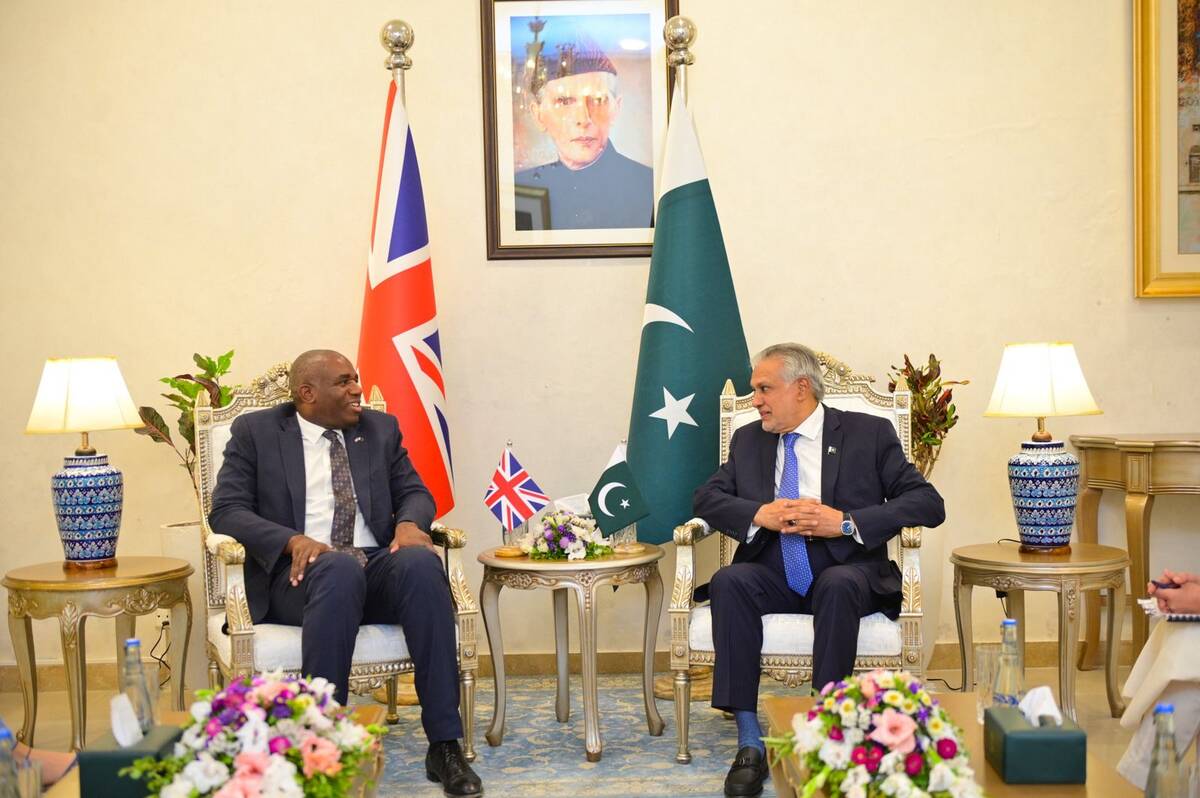


UK Foreign Secretary David Lammy (L) in a meeting with  Pakistan’s Foreign Minister Ishaq Dar in Islamabad, on May 16, 2025. (PMO)

The United Kingdom was among several nations to urge de-escalation after last week’s clashes, and Prime Minister Keir Starmer said at the time that Britain was “urgently engaging” with both countries.

Iran’s Foreign Minister Abbas Araghchi and Saudi Arabia’s Minister of State for Foreign Affairs, Adel Al-Jubeir, separately visited both countries last week offering to mediate.

Fighting began when India launched strikes on May 7 against what it called “terrorist camps” in Pakistan following an April attack in Indian-administered Kashmir which killed 26 people.

New Delhi blamed Islamabad for backing the militants it claimed were behind the attack — the deadliest on civilians in Kashmir in decades. Pakistan denies the charge.

Four days of intense drone, missile and artillery exchanges ensued, leaving around 70 people, including dozens of civilians, dead on both sides.

Both India and Pakistan are members of the International Atomic Energy Agency and have accused each other of failing to control their nuclear weapons.


Pakistan, Afghanistan border clashes kill 5, officials say

Updated 06 December 2025
Follow

Pakistan, Afghanistan border clashes kill 5, officials say

  • Afghanistan and Pakistan trade blame for “unprovoked firing” along Chaman-Spin Boldak border
  • Exchange takes place nearly a week after a fresh round of peace talks between neighbors failed

KABUL: Pakistan and Afghanistan exchanged heavy fire along their border late on Friday, officials from both countries said, killing at least five people amid heightened tensions following failed peace talks last weekend.

Afghan Taliban spokesman Zabihullah Mujahid said Pakistani forces launched attacks in the Spin Boldak district of Kandahar province.

His deputy Hamdullah Fitra told Reuters that shelling by Pakistan killed five people, including a Taliban member.

A spokesman for Pakistan’s prime minister said Afghan forces carried out “unprovoked firing” along the Chaman border.

“Pakistan remains fully alert and committed to ensuring its territorial integrity and the safety of our citizens,” spokesman Mosharraf Zaidi said in a statement.

The exchange came nearly a week after a new round of peace talks between the South Asian neighbors ended without a breakthrough, although both sides agreed to continue their fragile ceasefire.

The talks in Saudi Arabia last weekend were the latest in a series of meetings hosted by Qatar, Turkiye and Saudi Arabia to cool tensions following deadly border clashes in October.

At the heart of the dispute, Islamabad says Afghan-based militants have carried out recent attacks in Pakistan, including suicide bombings involving Afghan nationals. Kabul denied the charge, saying it could not be held responsible for security inside Pakistan.

Dozens were killed in October’s clashes, the worst violence on the border since the Taliban took power in Afghanistan in 2021.