

Pakistan plans more innovative ‘funding products’ as it issues $106 million Shariah-compliant bonds

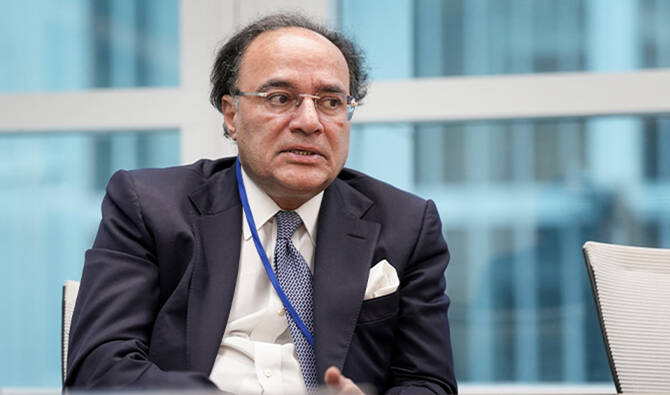
Pakistan Finance Minister Muhammad Aurangzeb speaks during a Reuters interview at the 2025 annual IMF/World Bank Spring Meetings in Washington DC, US on April 25, 2025. (Reuters/File)
Short Url
Updated 18 May 2025
Follow

Pakistan plans more innovative ‘funding products’ as it issues $106 million Shariah-compliant bonds

  • The proceeds of Green Sukuk are going to be used for key water-related infrastructure projects in the country, the finance minister says
  • Pakistan has seen erratic changes in its weather patterns leading to frequent heat waves, untimely rains, and droughts in recent years

KARACHI: Pakistan has issued the inaugural Shariah-compliant Green Sukuk bonds worth Rs30 billion ($106 million), its finance minister said on Friday, amid Islamabad’s plans to launch innovative “funding products” for local and foreign investors.

The Pakistani government this month approved the issuance of Green Sukuk that has been structured to support projects aligned with environmental sustainability, including renewable energy and green infrastructure initiatives, marking a milestone in sustainable finance.

The inaugural $106 million bonds, which will be listed on the Pakistan Stock Exchange, has brought the percentage of the South Asian nation’s Shariah-compliant bonds to about 14 percent in our overall debt profile, according to Finance Minister Muhammad Aurangzeb.

“Climate change is an existential threat for Pakistan,” the minister said at a gong ceremony at the stock market in Karachi. “The proceeds of this Green Sukuk are going to be used for key water-related infrastructure projects across Pakistan.”

Pakistan has seen erratic changes in its weather patterns which have led to frequent heat waves, untimely rains, cyclones and droughts in recent years. Scientists have blamed the events on human-driven climate change. In 2022, devastating floods, blamed on human-driven climate change, killed more than 1,700 Pakistanis, affected another 33 million and caused the country over $30 billion in economic losses.

In November, Pakistan received $500 million from the Asian Development Bank (ADB) as proceeds of a loan for the Climate Change and Disaster Resilience Enhancement Program, while the World Bank in January pledged $20 billion in loans to Pakistan under its 10-year framework that focuses among other things on the country’s increased resilience to climate-related disasters and better food security.

Last week, the International Monetary Fund (IMF) also approved $1.4 billion in climate financing for Pakistan.

“This is all there for us to use vis a vis adaptation, financing but also with very concrete reform measures which are required,” Aurangzeb said.

“One should never be complacent about the financing because the gap that we talk about is a very big gap but we should at least use the financing that is available for now.”

Pakistan is in the process of restructuring and reorganizing our debt management office in line with global best practices, according to the finance minister.

The South Asian country will soon be launching various funding products in terms of the demand that it has to meet domestically as well as with international investors.

“We will continue to engage the investor community very proactively to get your feedback,” he said. “So stay tuned. You will be hearing more from this space as we go forward.”


Pakistan says military operation concluded in Balochistan, 216 militants killed 

Updated 8 sec ago
Follow

Pakistan says military operation concluded in Balochistan, 216 militants killed 

  • Separatist BLA militant group claimed responsibility for coordinated attacks across Balochistan last week 
  • Military says 36 civilians, 22 law enforcement and security forces personnel have been killed in attacks 

PESHAWAR: Pakistani forces have concluded a security operation in the southwestern Balochistan province and killed 216 militants after a series of coordinated attacks by separatist militants last week, the military’s media wing said on Thursday. 

Separatist militant group Baloch Liberation Army (BLA) claimed responsibility for a series of attacks in Balochistan last Friday and Saturday in multiple districts across the province, one of the deadliest flare-ups in the area in recent years. 

Pakistan military’s media wing, the Inter-Services Public Relations (ISPR), said security forces launched operations in Panjgur and Harnai district’s outskirts on Jan. 29 based on intelligence confirming the presence of “terrorist elements,” killing 41 militants. 

It said the military launched a broader series of intelligence-based operations in multiple areas of the province after that to dismantle “terrorist sleeper cells,” referring to it as “Operation Radd-ul-Fitna-1.”

“As a result of these well-coordinated engagements and subsequent clearance operations, 216 terrorists have been sent to hell, significantly degrading the leadership, command-and-control structures and operational capabilities of terrorist networks,” the ISPR said in a statement.

The military said 36 civilians, including women and children, were killed by militants while 22 security forces and law enforcement personnel also lost their lives. 

The ISPR said a substantial cache of foreign-origin weapons, ammunition, explosives and equipment were also recovered during the counteroffensive operations. 

“Preliminary analysis indicates systematic external facilitation and logistical support to these extremist proxies,” the statement said. 

The military said Pakistan’s armed forces remain steadfast in their resolve to combat “terrorism,” vowing that counterterror operations will continue until militants are completely eliminated. 

“Operation Radd-ul-Fitna-1 stands as a testament to Pakistan’s and particularly Balochistan’s proud peoples’ unwavering commitment to always prefer peace over violence, unity over division and development over violence,” the ISPR said. 

Pakistan’s government has accused India of being behind the militant attacks in Balochistan, charges that New Delhi has rejected as “baseless.”

Balochistan, Pakistan’s largest province by land area, has long faced a separatist insurgency that has intensified in recent years. Militants frequently target security forces, government officials, infrastructure projects, foreigners and non-local workers.

The province holds vast reserves of minerals and hydrocarbons and is central to the multibillion-dollar China-Pakistan Economic Corridor (CPEC), a flagship component of China’s Belt and Road Initiative.

Separatist groups such as the BLA accuse Islamabad of exploiting Balochistan’s natural resources while denying locals a fair share. Pakistan’s civilian and military leadership reject the claim and say they are investing in the province’s development.